

Words by Ella Miller
Visuals by Gray Moloy
Oliver Robbins was vacationing in Los Angeles when his nightmare began. It’s February 2024 and he’s in the city of angels to support his girlfriend, a folk-pop artist, as she records songs with some big-time professionals. All he wants is to be her hypeman.
As the musicians around him jam out, Robbins feels his phone buzz. The Pitman Hall ‘floor six’ group chat, usually reserved for his residence advisor’s (RA) announcements, is blowing up. It’s reading week—what could be going on that is so important?
The messages rolling in describe an “explosion” in one of the floor’s shared washrooms. A toilet is backing up sending foul-smelling water cascading out of the washroom and into the surrounding rooms.
Robbins, the now third-year journalism student, does what anyone would do in this situation: laugh at the poor schmuck who was stuck with the overflowing john and move on. But two hours after the initial message about the toilet, Robbins’ eyes are still fixed to the screen. A new message pings with a video clearly showing the numbers of the rooms flooding with ankle-deep sewage: 619 and 621—his room.
Pitman Hall had just claimed Robbins as its latest victim.
…
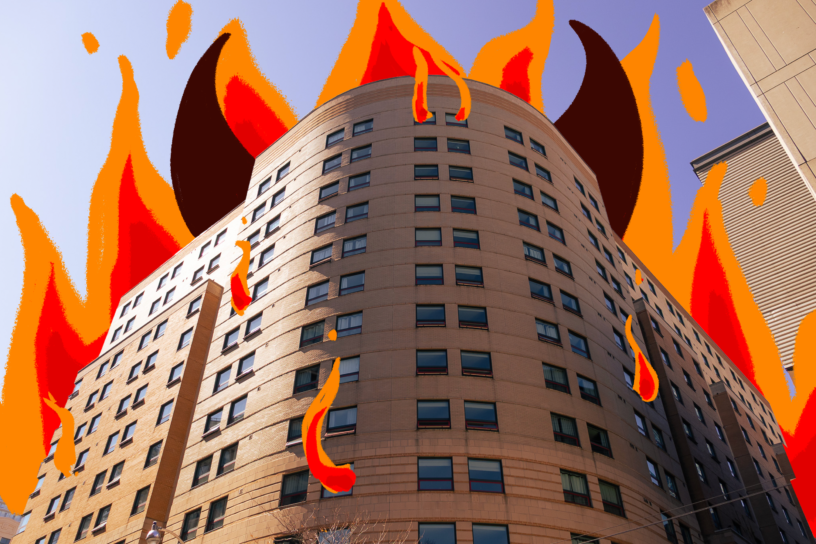
In September of 1991, Pitman Hall opened its doors, welcoming throngs of students into its shining 14 floors and 565 rooms. It was Toronto Metropolitan University’s (TMU) largest residence and maintains that title today. After the closure of O’Keefe House in 2018, which had only 30 beds, Pitman Hall became TMU’s oldest operating residence.
Nearly as long as it has been open, it has been the subject of criticism for its frequent sanitary and maintenance issues.
On the inaugural move-in day—which occurred a week late—exposed wiring and light bulbs dangling from their sockets greeted the students as they shuffled inside. Some students queued for over five hours just to get in the elevator.
The first complaints reported by The Eyeopener came in 1997, when incoming students claimed their rooms came with broken appliances, busted phone jacks and scratched desks.
2004 brought with it water leaks and cracked walls. Bed bug infestations were recorded in five different years. In 2007 a student moved in to find vomit stains on her bed, likewise in 2008 another student discovered the toenails of residents’ past still littering their mattress. Problems with appliances were rife—a faulty stove resulted in a severe kitchen fire in 2012. In 2014, cable television was abruptly cut off for all residents and a string of outages left students without water for hours at a time. In 2015, it was discovered that temperatures in the showers could surge to 56 degrees Celsius, high above the legal limit.
In 2025, complaints are still rolling in.
…
Second-year English student Cameron Ross spent much of her first year asleep. After moving into Pitman Hall she began struggling with exhaustion, which worsened as her time in residence dragged on. When finals season hit, she could barely keep her eyes open, often waking up to start her days late into the afternoon. Ross is immunocompromised and found herself exhausted and sick due to mould in her apartment style room.
She tested the apartment for mould in November 2024 with a store-bought kit, that’s when she started to feel “really, really sick,” she says.
“I was like, okay I think there’s actually something physically wrong with me because there isn’t a reason why I should be sleeping until six o’clock [p.m.] every day,” says Ross. I was so tired I couldn’t get out of bed.”
In photographs shared with The Eye, Ross shows a laboratory’s worth of petri dishes arranged along her countertop. Inside them are a zoo of orange and grey mould blooms, each labelled with “shower,” “furnace” or “bedroom.” The test identified some as black mould and others as penicillium.
According to Health Canada, black mould commonly grows in damp conditions or spaces without proper ventilation. People with chronic illness or compromised immune systems can experience what’s called mould toxicity, a condition characterized by symptoms like sinus, eye and skin irritation, difficulty breathing and fatigue.
Penicillium is another common type of household mould. The U.S. Centers for Disease Control (CDC) advises that all mould be treated the same in terms of removal.
Ross contacted maintenance about the mould and they came to her unit with a bucket and a scrubbing tool, cleaning the tile walls of her shower. They also replaced the air filter in her bedroom. However, according to Ross, maintenance never addressed the root cause of the mould.
When maintenance wiped their hands clean of Ross’ room, there was still “fur” growing from the wooden bench affixed to the side of her shower stall.
In an emailed statement to The Eye, the university said they hire an external specialized company to clean fan coil units two times a year—once prior to students moving in and once during the mid-year break.
One of Ross’ lifelines during her time in residence were the friends she made on her floor, one of whom is now her roommate at her new off-campus home. One evening, one of these floormates was suffering from a medical emergency. The girl had recently sustained a concussion and was displaying neurological symptoms that Ross feared indicated another head injury.
Doing what had been ingrained in her from a young age, Ross dialled 9-1-1. When the paramedics arrived, Ross went down to the front desk to escort them to her friend.
Four firefighters and two paramedics responded to Ross’ call. When Ross burst through the elevator doors to let the first responders up to her floor, the front desk attendants refused to let them up. Ross tried everything she could, promising to come back to the desk immediately after showing the paramedics to her friend, but staff would not budge. The first responders would not be granted entry, they told her.
“The firefighters had to scream at [the desk attendant] and we just went against her wishes. They were trying to make me stay back and let the firefighters just figure out where my friend was. They would not let me escort the first responders to the issue.”
Ross eventually forced her and the paramedics’ way through the front desk area and into the elevator. Her friend was sent to hospital for what was determined to be an anemic episode and Ross was asked to attend a meeting with Housing & Residence Life to discuss the incident.
“After the incident, I was told by security that I should have called them instead of medical professionals because they are trained in the exact same way as paramedics, which I did find out after the fact was untrue,” says Ross.
In an emailed statement to The Eye, the university said that “some of TMU’s full-time front-line crew members also have advanced medical knowledge, including: Emergency Medical Responder (EMR) training.”
EMRs are equipped to provide some out-of-hospital care in medical emergencies, however EMRs cannot replace the role of Emergency Medical Technicians (EMTs) or Paramedics. The university did not share how many TMU Security staff members are trained as EMRs.
“When I explained to them what happened [Housing & Residence Life] said that I should have called them instead,” says Ross of the later meeting with management. “They said that they would have called the ambulance, but I was like, why? Am I incapable of calling 9-1-1? I’m an adult.”
According to the university’s statement, “residence staff are trained to call 9-1-1 if any situation in residence is emergent or requires emergency medical response.”
As previously reported by The Eye, similar advice was given to another student almost 20 years ago when he was assaulted by an RA in Pitman Hall. Management seems to hand down the same edict: don’t involve outsiders, call security.

…
Architect Jim Strasman wanted Pitman Hall to avoid the common pitfalls of other university residences. His firm, Strasman Architects Inc. (SAI), designed Pitman Hall for the university in 1989. The building was built by now-defunct ACME Building and Construction Limited. Mechanical and electrical, as well as structural engineering were contracted out to other companies, both of which have now been bought out by larger firms.
Strasman—who is perhaps the least responsible for Pitman’s current state—is the last man standing.
Sitting in his office, he and his colleague, Arash Eshghpour, sift through photographs and project proposals from Pitman Hall’s design process. Strasman began his career idolizing the work of Ron Thom and working under Arthur Erickson, two titans of Canadian architecture, both of whom worked on major projects in education. Strasman tears through these references with a gleaming wit as Eshghpour click-clicks through an extensive digital archive of all of Strasman’s work.
This collection includes everything from private residences to transit projects—which are now SAI’s forte. When asked why he made the leap to university residences with Pitman Hall, Strasman simply stated that in the early days of SAI, they wanted to design “everything and anything.” When it came to Pitman, Strasman’s own time as a student in the architecture program at the University of British Columbia (UBC) influenced his decision to take on a university as a client.
Though Strasman lived at home, he visited friends in the student residences at UBC. He abhorred the buildings’ long corridors lined with dozens of small, cell-like rooms.
At Pitman, sociability would take centre stage: concentric spaces that encouraged students to gather and introduce themselves. He placed common areas in the middle of hallways—naturally guiding students into social spaces.
“If it’s behind a door, you don’t know whether you should knock or open the door and go in,” says Strasman about the building’s common areas.
From his perspective, Pitman Hall’s construction went swimmingly—the only compromise he made was removing the balconies from his original plan due to fears from the university that students would throw things off of them.
Once Strasman’s design was approved, his involvement ended. ACME and the contractors took it from there. The university told him construction went smoothly. Until his interview with The Eye, Strasman had never met someone who lived in Pitman Hall.
…
Before Robbins had left for Los Angeles he did his laundry, leaving a bag of clean clothes on his floor. During the flood the bag became saturated with dirty brown water. Staff made the executive decision to dispose of the bag. To add insult to injury, Robbins isn’t even sure what the contents of the bag were exactly—it was thrown out before he got back.
“I don’t get too sentimental with my clothes, but some of my favourite sweaters were in there and I’ll just never see them again because they got pooped on at Pitman Hall,” says Robbins.
Robbins was never provided with an itinerary of what was tossed in the garbage. The items that remained were heaped into a pile on his bed when he returned, including his guitar, the neck of which protruded from under a discordant tangle of bedsheets and grocery bags.
The only other person on floor six affected by the flooding that Robbins knew was his next door neighbour who he had never spoken to, but had a habit of staying up until 5 a.m. screaming at his video games. If his console was left behind that fateful reading week, Robbins suspects this won’t be an issue anymore.
Though it was Pitman Hall’s plumbing that was to blame for the damage, Robbins did not receive compensation because he had not taken out tenant insurance for his unit. Housing & Residence Life requires all residents to obtain tenant insurance to cover the loss or damage of personal property and encourages coverage with an “all-risks” basis.
Though Robbins is aware this decision meant he’d incur the costs, he still sees what happened as unacceptable.
“They should be paying me insurance, hello?” retorts Robbins in his interview.
Housing & Residence Life offered Robbins a new room in the International Living/Learning Centre (ILC)—he wasn’t interested. He felt the university did not care about him and spent the rest of the year sleeping at his girlfriend’s parents’ house in North York.
Robbins had spent the previous year at Carleton University (CU) for political science before transferring to TMU for journalism. He lived in residence at CU with a roommate, a window that wasn’t facing another building and management that—according to him—cared about his problems.
So much of the residence experience falls on the shoulders of RAs. They’re the ones who update group chats about monthly meetings, who stay up late at night to patrol the hallways, host events and help first-years amble through rounds of icebreakers during Frosh. However, there’s a catch—RAs are only given a yearly allowance of $100 to facilitate it all.
“Tell me, what can I do for $100 for 40 people? Not much,” says John* a fourth-year student and RA thrice over. “Not much for the nine events that I’m supposed to run a [year]. People don’t come to events if there’s no food, people don’t come to events if there’s nothing.”
Prior to becoming an RA, John lived in Pitman Hall where he had a mostly positive experience—save for an instance of flooding in January of 2022 and mould on the window of his room. As an international student, John needed a place to live to keep his student visa. He made the decision to return as an RA rather than try to secure housing in Toronto’s highly competitive market.
He knew that being assigned to Pitman Hall meant being prepared for exploding toilets and knowing which numbers to call to report mould.
The Housing & Residence Life website states that Pitman Hall is accessible. The building was designed prior to the Accessibility for Ontarians with Disabilities Act which was legislated in 2005. In a statement to The Eye, the university said students with disabilities are placed in residence halls that can accomodate their specific needs. The university did not specify which residences accomodate which needs, only that Daphne Cockwell Complex (DCC) is fully wheelchair-accessible.
After his time working closer with the management, John sees Pitman’s bottom line as the main cause of its woes.
“It all comes down to funding. I think we just don’t have enough funding in housing to address issues properly,” he says.
Strasman, five decades into a career with buildings, agrees.
“Like any institution, they’re always hurting for money,” he says. “If there was a constant, endless supply of money, maintenance would not be an issue. But there never is and there’s never enough to cover maintenance.”

…
First-year media production student Lily Mendes chose Pitman Hall because she heard that it was the social residence. She toured the building before selecting it as her first choice on the ranked ballot system that Housing & Residence Life uses to assign students their dorms. Mendes thought she knew what she was getting herself into. Though it may have been rough around the edges, in Pitman, she would surely make friends.
“I don’t think it’s going to be like The Ritz for college dorms,” she says. “Definitely not the cutest but we can make it work.”
Mendes has only lived in Pitman Hall for three weeks. Within the first week alone she and her roommates called maintenance eight times for a menagerie of issues—faulty door locks, a broken stove, flickering lights and a clogged toilet.
At Pitman Hall, some things never change.
*This source has requested to have his name omitted. The Eyeopener has verified this source.
**Correction: a previous version of this article included a sentence that has since been removed due to a factual error. This error remains in the print edition of this article. The Eye regrets this mistake.






Leave a Reply