

By Caitlin Chung

While it may be difficult to locate Indigenous-owned brick and mortar businesses in the city, these online Indigenous businesses have found different avenues to interact with customers face-to-face.
On downtown campuses like Toronto Metropolitan University (TMU), student-run initiatives like the Mutual Market on Gould Street and the annual Pwaaganigaawin/Pow Wow at Kerr Hall Quad have hosted various Indigenous vendors since the re-opening of in-person events in 2023 after the COVID-19 lockdowns.
From beadwork to designer wear, here are how some Indigenous businesses, both TMU alumni and not, are drawing people together through their culturally-reflective creations.
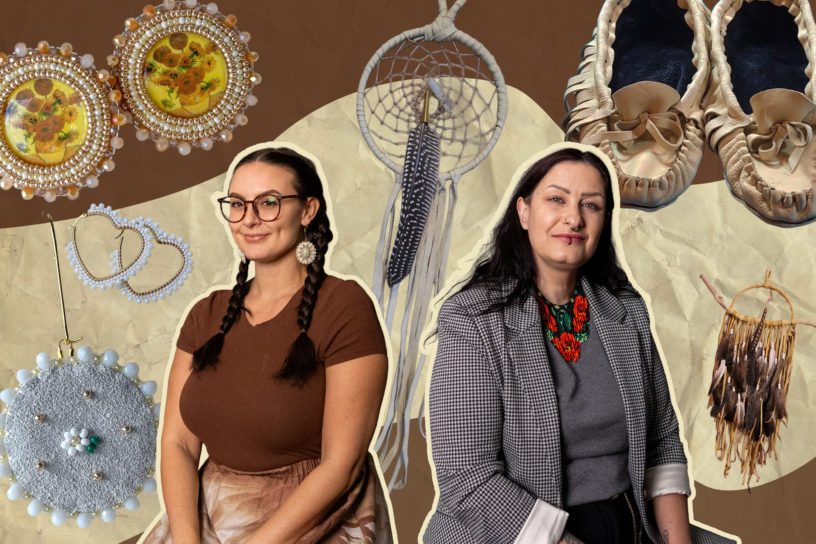
Zhalii Handmade Creations – Zoe Stefura
Zoe Stefura, a graphic designer and TMU creative industries graduate, first launched Zhalii—“pretty” in Michif—Handmade Creations at the height of the pandemic.
After moving to Toronto from Winnipeg, Red River, Treaty 1 Territory, Stefura found solace in learning how to bead with her cousins back at home over Zoom. While she credits the crafting knowledge to her Métis roots, the designer said her Ukrainian background similarly upholds the culture of beadwork.
Nudges of familial encouragement, hours of online tutorials and many book rentals later, Stefura made her instantly-successful business debut on Instagram in 2020.
In an attempt to fill the market gap in “everyday beadwork” and as per her mother’s requests for lighter earware, she began selling flat stitch style earrings. Now, she creates studs, simple dangles and gold threaders alongside a collection of keychains and pop sockets—sourcing all her materials from neighbouring small businesses, as much as possible coming from Indigenous businesses.
Through beading and vending, Stefura said she was able to strengthen the bonds between her family and the Indigenous community at large.
“It really doesn’t feel like work a lot of the time,” she said. “It’s more like a cultural exchange for me, like a lot of Indigenous people will tell you, beadwork is medicine.”
Her most popular item, turquoise and gold studs on 18 karat gold backings with vegan leather, immediately went out of stock at TMU’s most recent powwow.
Stefura said she hopes to maintain her in-person presence at markets this winter season and continue to connect with customers face-to-face.
Sticks & Bones Studios – Mary Commanda
Mary Commanda, of Algonquins of Pikwàkanagàn First Nations, founded Sticks & Bones Studios over a decade ago under a simple concept: dreamcatchers adorned with beautiful branches and skull motifs.
Despite spending half her life on the reserve—and the rest just minutes away—Commanda said she had to ask her mother to re-teach her how to weave.
“My vision wasn’t in the weave, necessarily,” said Commanda. “It was in the materials that I use, the asymmetricalness that I bring to the table and kind of getting that out of me onto the dreamcatcher.”
The artist said her drive for a creative outlet intensified while being boxed in the corporate realm for over ten years. Prior to employment, Commanda had originally attended Georgian College for hotel and resort administration and later, TMU for hospitality and tourism management.
Now, the TMU alumna said she uses her business knowledge to sell custom dreamcatchers, leatherwork, artwork, moccasins and bone bead jewelry—all while hosting workshops and facilitating community work.
In Commanda’s sourcing hierarchy, purchasing materials from her own reserve is a priority.
Other Indigenous communities follow closely and local small businesses are often her last resort. Though, for dreamcatchers specifically, the artist frequently picks up “cool-looking” branches on her reserve property or during strolls through urban wooded areas like Rosedale Valley Road.
Apart from connecting with the land, the business owner said she hopes her work will ultimately help Indigenous people initiate their journeys of reconnecting with their communities.
Neechi By Nature – Shane Kejick (Kelsey)
When Shane Kejick, born as Shane Kelsey to Irish origins, first set his mind on setting up Neechi By Nature in 2020, not even those closest to him lent him support in pursuing this endeavour.
He adopted Kejick, the last name of his Anishinaabe Ojibwe great-grandmother from Shoal Lake, as a homage to his Indigenous heritage.
Kejick initially rose to fame as hip hop rap artist Tombz The Nish in Montreal, overcoming barriers upon barriers to successfully launch his Indigenous luxury street wear brand in 2022. Growing up in poverty, he said his challenging upbringing inevitably taught him how to be resourceful.
When Kejick first launched his line, he began with three items: a button up shirt, a pair of matching shorts and a toque in the middle of summer. He then rapidly expanded to a vast selection of ready to wear runway pieces and custom designs worn by celebrities he admired—like Ashley Callingbull, Miss Universe Canada 2024.
“There were a lot of barriers,” said Kejick. “But being able to sell my stuff, being able to make my art and having space to do that now, I’m very appreciative and happy for that.”
Though the multidisciplinary artist could not attend TMU’s powwow as a third-time vendor this year, his reasons lie in his current commitments to support emerging artists, bridge gaps between Indigenous and non-Indigenous communities and expand his brand globally.
“Right now, [Indigenous businesses] still feel like a niche and it still feels like I am segregated from the country,” said Kejick. “But to truly uplift us is to have us seen in daily life.”







Leave a Reply