

When course materials moved online during the pandemic, ditching class and still succeeding became easier—now it might be getting out of hand
By Moyo Lawuyi
For Kheara Ramsahoi, a second-year psychology student at Toronto Metropolitan University (TMU), skipping class is like playing a sport.
“You just gotta know when to skip, how to skip, which course you’re gonna skip and how you’re gonna do it,” she says.
One of the first classes Ramsahoi skipped was a first-year philosophy class. She says she recognizes it was a bad choice but the professor talked a lot, often digressing from the day’s lecture to other topics. The class was also at 10 a.m., and while she lived in residence, when she learned that the friend she usually walked to class with wouldn’t be coming, she decided not to go either.
Though the class had long, heavy lectures with few slides—meaning students were expected to take their own notes—she wasn’t bothered. Since her friend knew people in the course, Ramsahoi figured she could get the notes anyway.
She only came for the final exam and, in her words, “aced that shit”
“When it comes to skipping, you gotta be smart about how you do it,” she says. “You can’t be skipping a class where there’s literally no PowerPoint, no nothing and the teacher is just yapping at you.”
This wasn’t the first or last time Ramsahoi would skip a class. That same semester she was absent from her intro-level psychology class every single week after the midterm—she says she already had a background in psychology and knew the material.
She only came for the final exam and, in her words, “aced that shit.”
…
During the pandemic, every part of university moved online—and even six years later, much of it has remained there. It wasn’t very long ago that virtual course shells didn’t exist, syllabuses were pieces of paper and handing in an assignment was a physical task—one that could rarely be done at 11:59 p.m.
While the shift online may have boosted convenience, it also meant skipping class and still succeeding was much, much easier. When lecture slides are available at all hours and quizzes can be done from home, the need to get out of bed, commute and attend your course can feel like an unnecessary chore.
Since the pandemic, absence rates in Ontario high schools and elementary schools have jumped significantly. According to a 2025 report by CBC, some school boards have seen the number of students chronically absent—those who miss more than 10 per cent of the school year—double. In 2024, the Toronto Catholic District School Board reported a staggering 35 per cent of students were chronically absent. The problem goes beyond Ontario too. In 2023, UNESCO said prioritizing learning post-pandemic is necessary to avoid a “generational catastrophe.”
Unlike in high school, skipping class in university doesn’t always come with consequences, making the impulse to ditch even stronger. While there’s no publicly available data on how often TMU students—or any Ontario post-secondary students, for that matter—skip class or what courses have the highest rates of absenteeism, the Office of the Ombudsperson states on its website that students should at least be courteous enough to let their instructor know in advance if they are missing a class. But they don’t always do.
“I began to notice the gaps in the room—gaps that increased after the mid-class break”
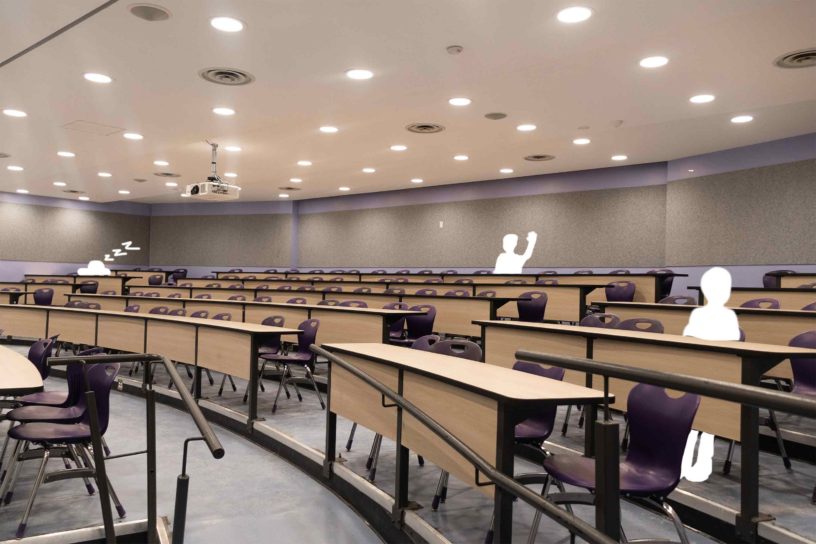
Ramsahoi’s story was familiar to me. In my first year, I took an introductory politics course and on the first day, I was genuinely excited. I wanted to sit near the front, raise my hand, ask questions and contribute. But when I walked into the classroom, a large lecture hall in the Architecture Building that curved downward like a colosseum, I settled for an aisle seat in a far back row.
After a few more classes, I began to notice the gaps in the room—gaps that increased after the mid-class break. Eventually, I stopped going altogether. I showed up only for the 12 p.m. tutorial, where the class was smaller, attendance was taken and participation counted.
The time of the class wasn’t too early. I lived on campus and the Architecture Building was only a five-minute walk. Skipping had simply become a habit and it was just more convenient to stay in bed. Still, like Ramsahoi, I did well in the course in the end.
Whether or not skipping class affects academic performance is debatable. Stories like Ramsahoi’s and my own experiences suggest it doesn’t. Many students also skip class to use the time to teach themselves or work on assignments.
On the other hand, a study in the journal Assessment and Evaluation in Higher Education suggests that skipping class negatively impacts performance, even if it’s only a small one. According to the study, this is primarily due to students who don’t attend class missing out on the opportunity for engagement, which the study says is the actual engine driving better grades.
In other words, when students skip, they miss out on the opportunity to actively participate, which, in turn, leads to lower scores. But, if you attend class and don’t pay attention or engage with the material, the benefit of being there disappears. So, perhaps it’s possible for an absent student to be just as engaged—if not more—as one who attends every lecture.
Skipping doesn’t happen for no reason. While students who skip for pleasure or leisure surely exist, students’ time is increasingly being taken up by all sorts of matters—jobs (and second jobs), long commutes and a coterie of competing responsibilities. This, combined with the fact many are still able to do well, begs the question: should attending lectures even be tied to being a good student?
…
It’s the fall of 2024 and Ely Christopher has just started university. She’s excited and, like most first years, has high expectations. She’s studying environmental and urban sustainability and apart from her mandatory courses, she has to take an open elective. She enrolls in something she has a genuine curiosity for. But after the thrill of a new semester subsides, every Monday when the time for her class nears, she sighs at the thought of attending.
For Christopher, her own motivation to attend is only half the equation. “[Coming to university] I expected the teachers to be more engaging in the way that they help us interact with the work, especially since it’s a larger group of students you’re trying to connect with,” she says. Instead, Christopher says many of her professors would just read off the slides.
While speaking to other students like Christopher, I found the professor’s engagement also strongly determines whether they’ll show up for a class.
Christopher says her open elective class felt disorganized and didn’t follow a syllabus. Finally, the day came when she was too fed up to go. That was the first time she remembers skipping a class at TMU—and while she felt guilty, she was confident she wasn’t missing much.
“…I’ll probably skip to take up a shift”
Another week, she decided to give the class another chance but discovered her classmates had also tapped out. In a class of around 50 people, Christopher says she saw 10.
Now, in her second year, she tries not to skip class too often, especially since she’s an international student paying almost $37,000 annually. But disengaged professors and boring lectures make achieving her goal difficult.
“If I’m enjoying what I’m learning, I’m there. I won’t skip,” says Christopher. “If it’s like a class where the prof is bad, the work might be interesting, but it’s not interesting enough to encourage me to get up and listen…I might not go, or I might go and leave early.”
Money is a factor in more ways than one. Many students skip because they’d rather pick up a shift to cope with Toronto’s high cost of living.
The province’s minimum wage is $17.60, yet a 2024 report from urban health research hub, the Wellesley Institute, says a single working adult needs $61,654 after taxes annually to be able to thrive in the GTA. Throw tuition on top of that and the need to work can overrule the need to attend class.
Statistics Canada data shows that in the 2023-24 year, 35 per cent of university students aged 18 were working. For students aged 22, that jumps to 52 per cent.
“[If it’s] at the end of the semester, and we’re just going through practice questions that I already have done before, I’ll probably skip to take up a shift,” says Christopher.
Commuting long distances to class is another factor.
According to a 2019 study, 77 per cent of students use local and regional transit as their primary mode of transportation to TMU’s campus. Valentina Capurri, a contract lecturer in the Department of Geography and Environmental Studies, believes the hassle of commuting is a significant reason students are not coming to class.
“The cost of public transit is fairly high…but also it’s the distance [and] the time you have to spend travelling just to come to campus,” she said.
Capurri has been teaching in the department since 2017 and says even though her upper-liberal studies courses are more “focused and intellectually demanding,” she still experiences low attendance in them.
“It’s like you pay for booking a restaurant, and then you don’t show up”
Capurri made clear this was something she had observed over time, not just in a single class. Her wisdom is as follows: attendance often drops after midterms, students are more likely to show up for a straight three-hour lecture than a course split into a two-hour and one-hour session on separate days and there really is a strong connection between attendance and better grades.
When I asked her about students who skip class without a good reason, she shook her head in disappointment, noting that they were missing out—especially given how much they’re paying for their education.
“It’s like you pay for booking a restaurant and then you don’t show up. I mean, you’re making a big loss, at least you enjoy the food if you go,” she says.
What stood out to me during our conversation was how understanding she was. I was expecting her to lament declining attendance and frustrations with absent students, but she spoke with a genuine awareness of what it means to be a student in Toronto today—one who may not always be able to make it to class.
“I do think that not attending any lecture is very problematic, but I also do not want to put this label like you are not a good student if you are missing some lectures, because, yes, students have a responsibility to come to class but life happens,” said Capurri.
…
Josephine Millard couldn’t skip her classes even if she wanted to. She’s in TMU’s performance dance program and finds her classes to be extremely rigorous. Ballet one day, then human modern right after that and jazz the next. A day with rehearsals can run from 10 a.m. to 8 p.m .so one can imagine there isn’t much choice to pick an afternoon bird course as an elective.
“I just find taking electives outside of the dance program, really, it feels very unnecessary,” says Millard. “I feel like it’s in our already busy schedules, just an extra thing that’s there to stress us out.”
So if she’s drained after rehearsals or needs to practice more, she will skip her elective class. Those are the only classes she ever skips, and it doesn’t matter if they have mandatory attendance.
“I’ll just take the worst grade of my elective if it means I’ll do better in my dance classes.”
She’s tried to be courteous as the university says she should, telling professors in advance when she won’t be able to make it and why. However, she says that because some professors hold biases against certain programs like hers, they tend not to take her explanations for missing class seriously, ignoring or dismissing her.
“I’m not saying it’s like the hardest program in the world and stuff, but it definitely does require a lot of physical and mental stamina, and it’s very time-consuming, and it is hard to have that within a university,” said Millard.
In the same vein, she also wishes the university had policies to better accommodate absences with good reason. She recognizes she could take summer classes but since she’s based in B.C., the time difference makes it challenging. Instead, she wants the university to offer more asynchronous courses during the school year that would benefit students like her.
According to 2023 findings from the Canadian Journal for the Scholarship of Teaching and Learning, giving students the option to learn in person or virtually would not adversely affect engagement or academic success.
However, at TMU, recorded lectures and uploaded slides vary from course to course. The university, through academic accommodation support, provides peer note-takers, but this is only available to registered students who have it as an enhanced service accommodation, not to students who skip class. TMU’s Chang School of Continuing Education also offers several accelerated classes, which usually take place during reading week and can provide students with full course credits in as little as one week.
“I think maybe if [TMU] had classes that you could kind of just do at your own pace, it would be a bit easier, and I probably would not pull so much weight to stay on top of all my work,” Millard says.
Towards the end of my interview with Ramsahoi, we discussed whether skipping class makes you irresponsible or someone who’s going to have a lackadaisical attitude to life in their future. For many students, missing a lecture isn’t a choice but a consequence of circumstance—of living in Toronto, juggling work, commuting and managing the realities of everyday life.
She decided she’d changed her mind about comparing skipping class to a sport. At the end of our conversation, she told me skipping is more like a trade—it’s giving up one thing to get another in return.








Leave a Reply