

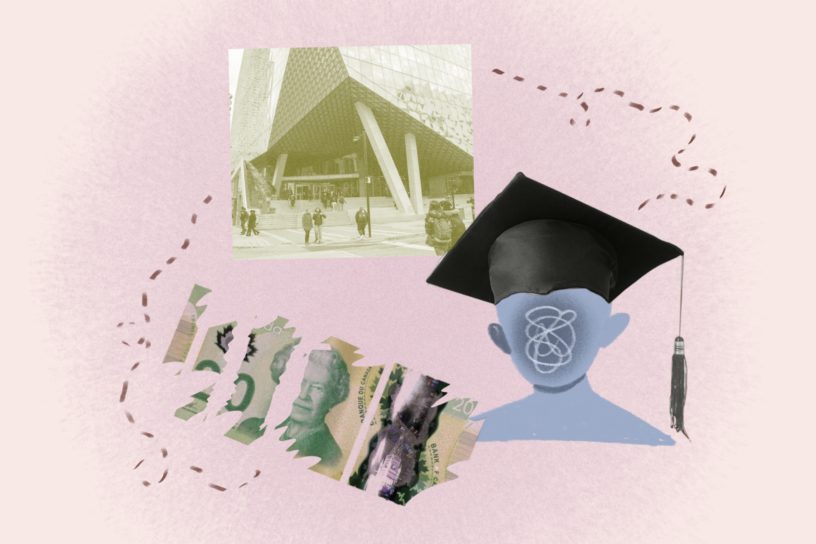
In February, the Ford government drastically lowered the amount of grants the province’s post-secondary financial assistance program provides—now, students are scrambling to restructure their futures around it
By Daniyah Yaqoob
Rahul* was on his lunch break at his Oakville high school when he found out the Ontario Student Assistance Program (OSAP) was being cut. He was sitting in Tim Hortons with a group of friends, sipping an iced capp and scrolling Instagram when a post from 6ixBuzz caught his eye.
The post says Ontario premier Doug Ford had lifted the tuition freeze—which had been in place since 2019. But most shocking was a line underneath. It said OSAP would now only provide a maximum of 25 per cent grants—a dramatic decrease from the previous limit of 85 per cent.
Rahul’s heart sank. He no longer felt like a care-free senior, enjoying lunch with his friends. In his final year of high school, Rahul had been looking forward to university for ages. He’d just accepted his offer to Toronto Metropolitan University (TMU)’s business technology management program and was eager to be one of the first in his family to obtain a post-secondary degree.
Now, he could only think of how he would fund it. Where would the money come from? He didn’t tell his friends the news, he didn’t want to dampen the mood.
Rahul is just one of many incoming and current post-secondary students across the province whose world is being shaken up by the impending cuts to OSAP. Students like him now worry whether their post-secondary dreams will survive.
The history of OSAP has been full of frustration. When it launched in 1966 it came with a cumbersome application with invasive questions about the applicant’s family and their means, according to TVO.
Students on OSAP could not receive additional provincial scholarships or bursaries. This meant some wealthier students not on OSAP could nab scholarships, while lower-income students who needed them more would be saddled with loans. Three months after it launched, students from Toronto universities marched to Queen’s Park to protest it. Their demands were largely met and the program was reformed a year later.
In 2003, the government moved to allow OSAP to waive tuition entirely for the 10 per cent of students with the lowest income. This was later expanded to offer free tuition to all students whose parents’ annual income was lower than $50,000, according to the Western Gazette. In 2019, however, newly-elected Ontario premier Doug Ford reversed this, leading to further protests from students.
Despite grievances with the program, OSAP can be considered a necessity for post-secondary education in Ontario. According to a 2024 release from TMU’s Business Career Hub, 75 per cent of TMU students received financial assistance through the program.
The most recent changes to OSAP are some of the most dramatic to date. And they come at a time when post-secondary education in Ontario—and Canada as a whole—has found itself in crisis. When the federal government capped immigration and reduced study permits for international students in late 2024, they turned off the tap from which many Ontario universities were receiving funding. In the wake of the 2019 tuition freeze, 10 per cent tuition cut and financial strain, many colleges and universities turned to international student tuition as a way to fill the gaps. When they could no longer cover them, massive budget shortfalls led to program cuts at multiple post-secondary institutions. In 2025, York University suspended admission to 18 programs when the legislation passed—largely in the liberal arts and cultural studies, according to the CBC. Seneca Polytechnic temporarily closed its Markham campus, consolidating its programs to the Newham Campus.
Now, in the face of what his government calls “unprecedented pressures,” Ford has proposed a new solution: make students pay up. Come next semester, the 2019 tuition freeze will be lifted and OSAP grants slashed—all in the name of stability in the wake of the federal government’s changes, according to the province.
While this has allowed the government to fork over a much-needed $6.4 billion funding package to Ontario post-secondary institutions, the changes will come at a high price for students. If a student owes $20,000 in tuition, they were previously eligible for up to $17,000 in grants, but this September, they’d only be eligible for $5,000.
Students’ organizations across the province are now sounding the alarm. In a press release from the Canadian Federation of Students–Ontario (CFS-O), chairperson Cyrielle Ngeleka said the changes “leave students concerned about the state of education.” CFS-O has also organized a series of protests, which began on March 4 and will continue to bring frustrated students back to Ford’s doorstep at Queen’s Park.
While the effects of these changes won’t be felt in students’ pockets until fall, incoming students like Rahul and current students are scrambling to restructure their futures around the cuts. What lies ahead is unclear but what’s certain is that next year’s students will be facing a much harder situation than those who came before them.
Anieyah Lindstrom-McFarlane knew by age six that she wanted a university degree. She’s wanted to pursue a career in the medical field. “Jobs that involve helping people have always been something I’m interested in,” she says.
In her senior year of high school, Lindstrom-McFarlane applied to the three main universities in the Greater Toronto Area—York, TMU and the University of Toronto (U of T). Ultimately, she decided to pursue English and biology at U of T’s Scarborough campus.
Her father had set aside enough money for two years of tuition, she says. “I went into university with no cares in the world.”
But having been among the generation of students whose entire high school experience was impacted by the COVID-19 pandemic—she was in Grade 9 year when the world locked down—her adjustment to university life was harder than she’d expected.
Her first year went fine, she says, but she struggled through her second, ultimately not completing enough credits to advance to third year. While she was determined to make her academic comeback, the funds set aside for her had dried up.
For the 2025 fall semester, Lindstrom-McFarlane applied for OSAP, which she described as a “surprisingly easy path.”
By the winter semester, however, she was placed on academic suspension. She’d been staying at home, putting off a meeting with the school’s financial advisor, not eager about the two-hour commute she would need to make for a much-shorter conversation. It was on one of those days where she spotted a CP24 headline on the TV in her dad’s house.
Her eyes briefly caught the words but not enough to register. It wasn’t until two days later, when she was back at her home, that she saw the headline again. This time, she paused and read carefully over the words, announcing that her OSAP lifeline was being cut. “I was devastated,” she says.
Sometime between the announcement and now, Lindstrom-McFarlane has started to consider the prospect that she will not be able to continue her schooling altogether. She had aimed to enter orthodontics nursing but without OSAP grant support, she says it’s no longer feasible.
Rahul didn’t realize at first the direct impact the OSAP cuts would have on his studies.
“To be honest, that didn’t cross my mind for a good week. I was just mad about this, like, ‘oh my god, this is so annoying, so now I’m gonna have to go through these OSAP loans.’ And then it clocked in my mind about a week later: ‘crap, I might not even be able to afford this at all. Like, I might not be able to go,’” he says. “And that’s just crushing to me.”
He doesn’t often talk to his friends or classmates about his concerns regarding OSAP, either. Rahul says compared to him, they come from well-off families and are not as worried about putting themselves through post-secondary.
When Rahul was five years old, his mother got into a car accident. When he was eight, his father had a heart attack. The medical conditions impacted his family’s income. He also largely cares for his two younger brothers, bringing them home from school, helping them with homework and making them dinner to take the load off of his mother. It means he has less time to get a job and make money to fund school.
It also means he’s concerned about his brothers’ futures and their ability to fund their dream education down the line.
Rahul said his youngest brother wants to be an astronaut someday. His other brother in Grade 8 is into art and design. He worries they’ll one day have to decide whether to get a job straight out of high school or a low-cost degree that would be more likely to lead to a high-paying job, rather than to follow their passions.
When Kelly Tran found out about the OSAP cuts, they were so upset they found themselves unable to finish an essay due that night. They ended up handing it in a day late, explaining in the D2L dropbox that their frustrations had gotten the best of them.
OSAP paid for the first two years of Tran’s sociology degree at TMU. Because of this, they said, they were able to focus entirely on their education rather than the pressure of funding it.
Tran, now in fourth year, also does whatever they can to cut costs as a student. They avoid eating at restaurants and try to commute within Presto’s two-hour free transfer frame.
Coming from a low-income family, they structured their education plans almost entirely around finances. Their first choice for university was the University of Waterloo but they couldn’t afford to move out of their parents’ house in Scarborough. Even when their parents offered to uproot the family and move to Kitchener, they instead settled on TMU. TMU, they say, was also the cheapest option among the options for their program.
But by their third year of university, they began receiving less in grants from OSAP. For the first time, they depended on OSAP loans, picking up $3,000—and a job to pay them off.
Tran is taking a fifth year but says they’re confident they can cover the costs with their savings if OSAP is no longer a viable option. However, it’s not their own education they’re worried about. Tran has two siblings, one 14 and another university-aged, currently studying at Ontario Tech University in Oshawa. They know their siblings have a much harder road ahead of them financially.
Tran is also now questioning whether or not pursuing a master’s degree is possible, something they’ve wanted for some time. They say their favourite part of their program is the academic community surrounding it. But with the cuts, they may not be able to fund it.
“I would like to pursue a master’s, but also if I had the chance to not put my siblings into lifelong debt, I am of course going to do that,” they said.
If a grad school is off the table, they say they may pursue their field in other ways. “I know that there’s other ways to contribute to research outside a master’s, like through nonprofits and social work organizations,” they said.
Following Ford’s triple-header announcement about lifting the tuition freeze, boosting post-secondary funding and slashing OSAP grants, TMU released an excited announcement about the raise in funding they’d receive—and this alone.
“This funding will ensure that our students are well prepared to take on the complex challenges of the future,” said president Mohamed Lachemi in the announcement.
What the press release did not consider, however, was how students would be impacted by the OSAP changes. The Eyeopener reached out to Student Financial Assistance (SFA)—which oversees scholarship, loans and bursaries at TMU—about whether the university is supporting students in the face of these changes.
SFA told The Eye in an email that, “The university remains committed to supporting students by connecting them with funding opportunities, employment resources, and financial guidance.”
SFA directed students to the scholarships and bursaries offered by TMU. The statement ended with, “Students are encouraged to understand available supports and repayment options after graduation to help manage costs and reduce uncertainty around financing their education.”
But students’ concerns weren’t just about the immediate funding but the long-term impacts of stripping essential support from students who needed it most.
Common among these students is one thing: they don’t want to take what they see as an attack on their education from Ford lying down.
On March 4, Rahul decided to attend the Queen’s Park rally against OSAP changes hosted by CFS-O. He went with a friend, driving an hour from Oakville to Toronto to join the protest. They carried two signs with them—one read “Doug Ford, you’re a dropout” and the other, “We’re not taking basket weaving.”
At the rally, he says he met other students going through similarly stressful situations. One person he met said neither of his parents were in his life anymore and that he was responsible for caring for his younger brother. He was heavily reliant on OSAP grants and without them, he didn’t know if he could continue post-secondary education.
Tran also attended the Queen’s Park rally, alongside Common Pot, an organization they helped found as part of a course—SOC493 Creating Social Change. The group gives out free food to the community on a regular basis and served breakfast to protesters on campus before the protesters marched to Queen’s Park. They listened in on students’ conversations—one student told her friend she didn’t mind skipping class for the protest. “Girl, there’s going to be no class if there’s no OSAP, I’m going to the rally,” she said.
Other students Rahul knew outside of the rally had started to consider whether it was worth saddling debt for a degree or whether making money straight out of school would now be the wiser option. He worried that students from low-income areas like himself—especially with the rising cost of living—would be locked out of post-secondary education if Ford didn’t reverse the decision.
Lindstrom-McFarlane, however, has no faith in a decision reversal. In fact, she says she wouldn’t be surprised if OSAP grant proportions declined further under the Ford government.
In recent months, she’s become fascinated with “endangered crafts.” She’s even considering becoming an apprentice to a craftsman if higher education doesn’t work out in her favour.
“My form of protest is going to have to be me succeeding in something,” she says. “Be it through higher education or an art that I know is really gonna piss Doug Ford off.”
*This source is remaining anonymous for privacy reasons. The Eye has verified this source.








Leave a Reply