

By Liana Yadav
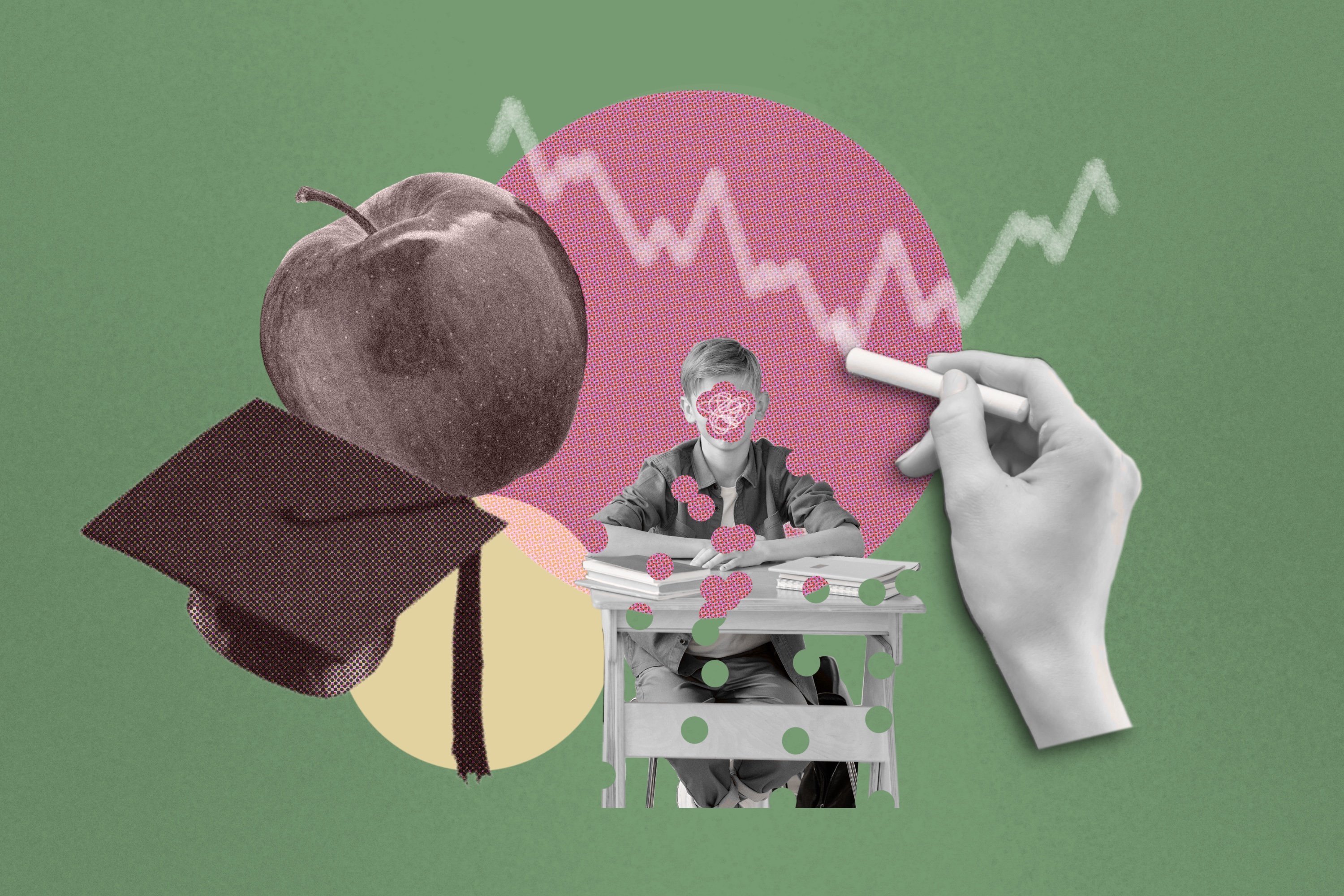
Educators from the high school level to the university level shared their concerns about lower test scores among secondary school students, despite university students performing at a high level.
The Education Quality and Accountability Office (EQAO) assessment is conducted at the end of every year, determining whether students from grade 3, 6, 9 and 10 meet provincial standards in subjects such as English and math across Canada. More than 574,000 students participated in the year 2024-25 where data showed a difference from years before.
Out of the 133,542 grade 9 students who participated in the assessment of mathematics, only 58 per cent met the provincial standard; the same percentage said they were able to communicate difficult ideas in writing and the amount of students who consider themselves strong readers has gone down from 76 per cent of students to 74 per cent since 2023. Similar results over the past few years show that little progress has been made in terms of test results.
Results came out in December 2025 after being unusually delayed by the Premier Doug Ford’s government. According to The Globe and Mail, provincial Education Minister Paul Calandra claimed the tests—which usually release in september—were held back to “better understand the data and make changes to the system.”
This comes after a tumultuous year for education with the passing of Bill 33, which hands over control of the education board to the Ontario government, as previously reported by The Eyeopener. Widely criticized by students and teachers alike, the bill lets the government decide which fees and services are “essential.” It also grants them control over funds at a time when resources are
already skimming.
In response to the declining EQAO results, the Ford government has planned to hire a two-member advisory panel sometime this year, set to be paid $1500 a day, Global News reported.
“Instead of properly funding our schools, this government’s answer is to hand control of school boards to hand-picked Conservative insiders with little to no professional experience in education,” said New Democratic Party (NDP) Shadow Minister for Education Chandra Pasma in a statement on the Ontario
NDP website.
Some EQAO results, however, have significantly improved post-pandemic. In the 2018-19 assessment, only 74 per cent of all first-time eligible students were successful in the Ontario Secondary School Literacy Test (OSSLT). In 2024–25, that number jumped to 85 per cent. Additionally, the reality of Toronto classrooms presents a silver lining.
Thomas Goutos, a high school English and history teacher at Bloor Collegiate Institute, wasn’t aware of the low EQAO results and doesn’t feel them mirrored in
his classes.
Goutos found that student involvement after the pandemic has improved. They crave in-class interaction and want to print out their readings and no longer “translate their thoughts and ideas into casual digital formats.”
Teachers say resources have been dwindling too. On the r/CanadianTeachers subreddit, a user with the name u/myDogStillLovesMe who claimed to be a grade 4 Toronto District School Board (TDSB) teacher pointed out, “We are being told we will receive one box of paper and one box of paper towels – for the whole term! ‘If you require additional copy paper or paper towels, please note you will have to order from your yearly class budget’.”
“The ministry of education says to ‘just use AI and tell your students to use AI [with] instructions that directly contradict curriculum standards,” claimed Goutos, reffering to the mandates teachers receive from the Toronto District School Board. “We had a message telling students to just generate a story…when a part of the curriculum in English is to introduce students to unique voices and teach them about the ethical use of tools in life.”
While the government encourages using digital tools, research in the Global Research Journal of Social Sciences and Management has shown that Gen Z is experiencing high anxiety and stress due to problems of addiction and social comparison caused by social media-technology.
Makana Chock, a professor in communications and a media psychology expert at Syracuse University finds it difficult to break down complex concepts into bite-sizes so students can pay attention. “Their ability to focus and learn, even if they’re highly motivated, is impacted by the amount of multitasking they engage in while they’re paying attention in class,” said Chock, who is also a media
psychology expert.
John Barnes, a contract lecturer for the Department of Languages, Literature and Cultures as well as Arts and Contemporary Studies at Toronto Metropolitan Univiersty (TMU), said he doesn’t find today’s students to be less capable, concluding that “the nature in which we consume media has shifted.”
“On one hand, students are very much engaged with really important socio-political movements,” Barnes said. “On the other hand…the news cycle seems to get more alarming each day, so it’s difficult to disassociate what we’re seeing in the news from our own sense of identity.”
Barnes does not deny the prevalence of subpar writing, similar to that written by generative AI. However, teaching at TMU since 2014, he continues to find that students exceed his expectations with “high-level” writing that could be published in academic journals.
At the same time, a consequence of the pandemic is that students have become less independent, said TMU assistant professor Francis Duah from the Department of Mathematics. Less students are showing up to his and his colleagues’ office hours, he said.
“One of the things we need to do is help students engage in what I call productive struggle [which] means that [even if you are] struggling with the problem, you wake up every day and go to the lecture. And when things are difficult, you find the professors and get them to help you out,” said Duah, adding that students today chase instant gratification.
He suspects that those who drop math in high school and end up taking it later through night classes and private tutors struggle to catch up in university. Many also “associate learning with higher grades,” which makes for a slippery slope.
Duah has used TMU’s active learning classroom where he engages students in calculas by rewarding participation. He is also compiling an AI guide for parents as a tool to help their children prepare for the Canadian Math Kangaroo Contest, a worldwide competition aiming to “spread the joy of mathematics.”
One of the biggest challenges cited by teachers is large class sizes and overwhelming workloads, according to the 2025 pan-Canadian Parachute survey that monitors changes in Canadian public education.
However, students at university are performing at higher levels than what Barnes has seen in the past. “It is a credit to the current generation, just how plugged in they are. If there is a negative impact of social media and being on their phones, what I’ve seen is that they’re aware of it.”
“I do think AI is a disruptor [in learning],” said Chock. “I don’t know if it’s a crisis.”







Leave a Reply