

By Nadine Alsaghir
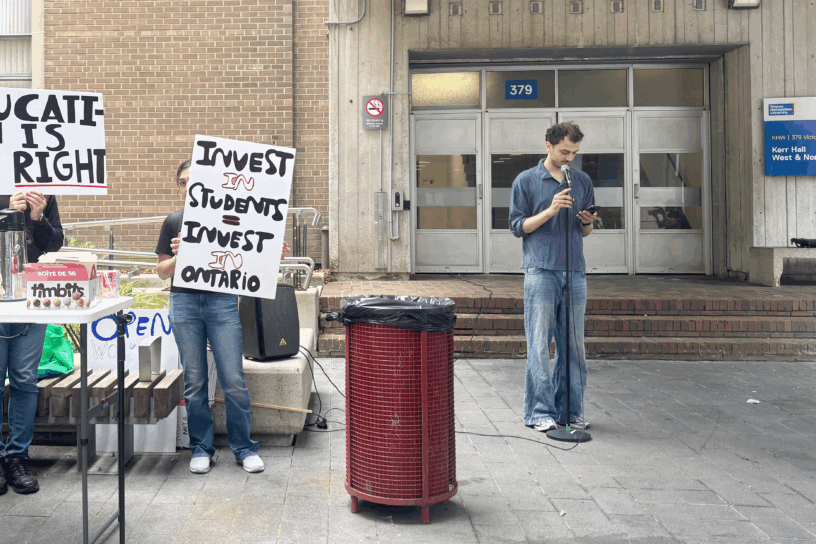
Students and community members gathered at Nelson Mandela Walk on June 17 to call on Toronto Metropolitan University (TMU) to support Iranian international students facing financial barriers.
The demonstration opposed the reversal of a 2022 policy which let Iranian international students with open work permits pay domestic fee rates, as previously reported by The Eyeopener.
This policy was put into place after the federal government made it easier for Iranian citizens to stay in Canada if they were already here. This was prompted by brutal crackdowns on protestors by the Islamic Republic (IR), after the death of Mahsa (Jina) Amini in the custody of the IR’s ‘morality police.’
However, in November 2023, the university announced the policy would be ending. They later clarified that students who had been approved for an exemption before July 10, 2024 could continue paying domestic fee rates. For those who did not, the change would apply beginning Fall 2025.
Open work permits allow the holder to work for any employer, whereas closed work permits are tied to specific employers, according to the government of Canada.
The change affects as many as 150 students, according to fourth-year biomedical sciences student Karan Kaviani. Kaviani is president of the Iranian Students’ Association at TMU (ISAMET), which organized the rally. These students now have to pay close to five times as much in tuition.
Since then, many say the unplanned additional costs have them unsure whether they’ll be able to afford tuition. In a press release, ISAMET said the university should not be applying standard administrative consequences to students who find themselves in an exceptional situation.
When the U.S. and Israel began bombing Iran in February, the IR cut off internet access to the country, according to Al Jazeera. This, combined with international sanctions, have made money transfers from the country difficult or impossible. Internet access only began being restored in late May.
Kiana Moeindarbari, a second-year economics and management science student who attended the rally said the effects of the policy reversal have been significant.
“I had to talk to a financial agent. I had to talk to everybody I could, but everyone was just passing me around, saying, ‘we can’t help you,’ ‘we don’t know what’s going to happen,’ ‘you have to wait for an answer’—I waited, but nothing happened,” she told The Eye.
According to a survey created by ISAMET’s advocacy lead, fourth-year biology student Amirreza Foroughifar, almost 67 per cent of respondents found their financial situation to be severely or significantly impacted by the situation in Iran since January. Foroughifar’s survey captured the responses of 76 Iranian students as of April 29.
Beyond TMU, Iranian student groups across Ontario have been calling on the provincial government to provide some form of tuition relief for those whose finances have been disrupted by the ongoing conflict and months-long internet blackout in the country, as previously reported by The Eye.
On June 4, students and supporters from TMU, the University of Toronto (U of T), York University, Queen’s University and the University of Windsor (UWindsor) gathered in front of the Ministry of Colleges, Universities, Research Excellence and Security to raise awareness about financial and educational challenges Iranian international students are facing.
Sara Fard, co-president of the Iranian Association of Queen’s University, also attended the June 17 gathering at TMU. She said student groups at TMU, U of T, York, Queen’s and UWindsor have since been working on a petition calling for provincial tuition support, while also meeting with MPPs across the Greater Toronto Area and beyond.
Despite their advocacy, Fard said an emailed response she received from the Ministry in May felt insufficient, and that it essentially said the decision is in the hands of universities.
“They did not even offer to guide us on where we can even go with the universities—if you’re telling us to go back to the universities, how can we approach them?” Fard asked.
The Eye reached out to the Ministry of Colleges, Universities, Research Excellence and Security for comment, but did not receive a reply in time for publication.
Kaviani said they were trying to use the word “gathering” to refer to the Wednesday’s event, rather than “protest.”
“We’re trying to show the university that we are peaceful and trying to get to a result by negotiations, by talking to you and not acting anything against you,” he said.
Kaviani added that he and other ISAMET members filed a complaint with the Ontario Ombudsman in April 2025, arguing that TMU’s policy reversal was unfair. He said the complaint has yet to receive an outcome, but the latest he’s heard is that the Ombudsman’s office is still processing the complaint.
In an email to The Eye, the Ontario Ombudsman said they cannot comment on whether or not they have received specific complaints, but said they inform all complainants on the status or outcome of their complaint.
They also wrote that while they, “cannot intervene in or overturn a university’s policy decisions,” they are, “able to look at whether their processes are fair and suggest best practices for improvement where warranted.”
Kaviani said he and his peers have exhausted many options. “We tried to contact everyone through every channel, through the deans, through the faculty members, through the students even, there were some vague responses, even some meetings with the provost’s office…but nothing really changed,” he said.
Despite this, Kaviani said they have had some luck. After “a lot of back and forth,” they were able to secure a tuition deadline extension until September, meaning no late fees would be applied during that period.
In an emailed statement to The Eye, the university said they are committed to supporting Iranian students during the “ongoing humanitarian and economic crisis.”
They say this includes financial supports, like the waiving of late fees until September, and “being flexible, where possible, in lifting financial holds that prevent enrolment in courses.”
Fardad Sadri, a fifth-year biomedical sciences student who attended the gathering, said he wanted the university to, “sense our existence.”
“Our community has been here since at least 1965, when the first international Iranian student came to Canada…this community exists and is giving to universities—so it’s a bi-directional relationship, not a one way,” he said.
Sadri said there are many opportunities he has had to give up due to his financial situation. This includes an application to an exchange program at University College London, which he said he had to withdraw from.
Moeindarbari said she had transferred from York and was initially told her work permit would be accepted, but after a few months she was informed the policy no longer applied to students admitted after 2024.
She said one of the hardest parts is not being able to communicate with family back in Iran. “It’s a lot of pressure…the fact that we couldn’t talk to our parents, no internet, no stable financial situation—it was really hard.”
According to Foroughifar’s survey, 97 per cent of respondents found their emotional well-being and mental health to be severely or significantly impacted since January.
“We all know terrible things happen in the world all the time, but [TMU doesn’t] seem to have a consistent policy for emergency support, they just react,” he said.





Leave a Reply