

By Nadine Alsaghir
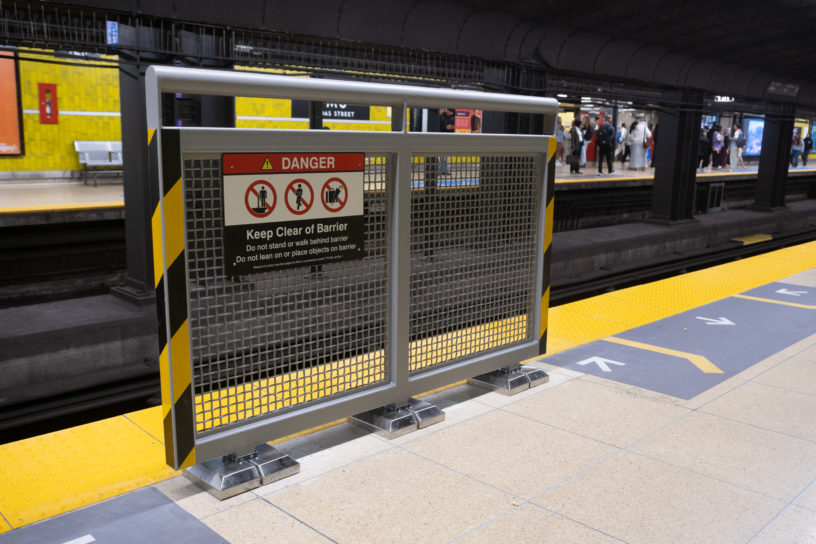
The TTC has installed the first piece of a system of platform barriers at TMU Station, but some say they’re a step in the wrong direction.
The chest-height barriers are part of a pilot project announced by Mayor Olivia Chow at a May press conference.
During the press conference, Chow said “we must prevent riders from falling or jumping onto the subway tracks.”
Chow also said the goal is to install barriers at four Line 1 stations next year.
The barriers are modelled after a program that TTC CEO Mandeep Lali says proved effective in New York City.
In an email to The Eyeopener, TTC spokesperson Stuart Green said the remaining barriers at TMU Station are expected to be installed by the end of September at a cost of $2 million. Green said the work will be handled in-house by TTC staff.
Beaches–East York councillor and mayoral hopeful Brad Bradford has criticized the barriers, saying what’s needed are full-height platform edge doors (PEDs).
PEDs are full-height barriers that only open when a train is at the platform. A June 2025 PEDs feasibility study by the city identified them as “a potential mitigation strategy to prevent unauthorized track entry and injury incidents that affect subway operations and enhance customer safety.”
In a video posted to social media on Aug. 19, Bradford called the chest-height barriers, “half fences you can walk right through.”
Students at Toronto Metropolitan University weighed in on the new infrastructure, also questioning its capabilities.
Tracy Macier, a third-year urban and regional planning student, questions the effectiveness of the barriers.
“If there’s still gonna be openings [in the barriers], how is it gonna stop someone from jumping off? You can climb on top of it—it’s not as if it’s that high,” said Macier.
Gabriel Joseph Remot, another third-year urban and regional planning student, said the barriers could improve safety but described the project as a “hard sacrifice.”
“I think spending a lot of money—$2 million on platform fences—I’m not really sure if it’s a good use of money,” said Remot.
TMU Station was recommended as the ideal station for the pilot project due to a “high incidence of track intrusions” and because it’s one of the busiest stations in the downtown core, according to the city’s PEDs feasibility study.
Andrew Pulsifer, executive director of transit advocacy group TTCriders, said his organization has long advocated for PEDs but still believes the barriers will help, though “they cannot be the final solution.”
“Our hope is that the plan is still to implement platform edge doors throughout the system,” said Pulsifer.
As part of the May press conference, Chow said the TTC is working on a long-term plan for the installation of the PEDs “when more funding becomes available.”
According to the feasibility study, the estimated cost for implementation of PEDs on Lines 1, 2 and 4 is $4.1 billion and would involve a “lengthy process estimated to exceed 20 years.”
Pulsifer said regardless of the costs, PEDs are a much-needed safety measure.
“We have to be realistic here and say that we cannot get these built without the financial assistance from the federal and provincial governments. They need to step up to help fund these kinds of things so they can help save people’s lives,” he said.
In addition to the barriers, the pilot project includes an AI-assisted track intrusion warning system pilot.
In May, Lali told reporters the system will use an algorithm to predict whether a track intrusion is likely, based on rider behaviour.
Pulsifer said the success of the barriers should not only be measured by whether they reduce track-level incidents, but also how safe riders feel.
“If they feel like they can take transit more often, you know that it’s a positive,” he said.






Leave a Reply