

By Adam Motaouakkil
Alberto Lusoli, an assistant professor in creative industries at Toronto Metropolitan University (TMU), is concerned that artists-in-training who automate their work risk losing their “eye”—the ability to critically analyze and reason about art.
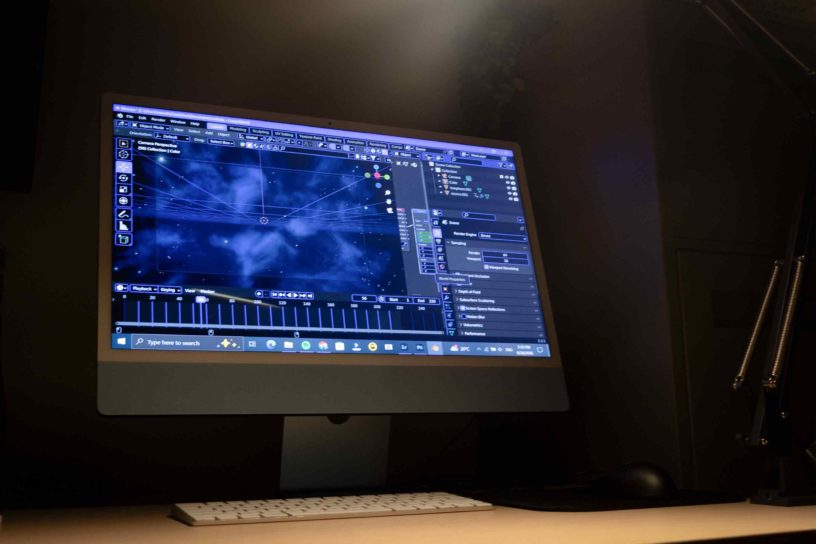
In a lecture delivered last March for the Responsible Artificial Intelligence Project at TMU, he described how techniques like chroma-keying, a process that combines multiple images together, help artists develop their craft.
Manual chroma-keying is repetitive and labour-intensive, making it a prime target for automation.
It’s one of many labour-intensive parts of production work, alongside things like 3D-modelling and creating production pipelines to allow multiple teams to work on shared material across platforms.
“These tasks, regardless of how boring or repetitive, could be a training ground for workers,” Lusoli said in an interview with The Eyeopener.
While it is not yet clear whether generative AI can provide similar training, Lusoli worries that AI chatbot design encourages users to work alone.
“I’m concerned about the way AI is designed as a super empowering jetpack that allows you to do everything by yourself in your own technological bubble,” said Lusoli. “That prevents people from having to talk to other people with different skills,” he said.
Generative AI promises to speed up the creative process, from generating storyboards to automating special effects.
Users prompt AI software like Anthropic’s Claude to produce media, going as far as embedding the chatbots into their production workflows. Adobe also embedded AI in their products—from generating assets to colour grading videos and refining workspaces.
On Sept. 18, fourth-year students promoted their projects during the annual media production practicum. Students interviewed by The Eye echoed Lusoli’s views on de-skilling and the loss of collaboration between artists.
“AI makes things look cheap,” said Teresa Van, a fourth-year media production student, referring to a saturated ecosystem of generic media as “AI slop”, such as in restaurants or in advertisements.
Annasophia Silva-Serrano presented her group project, Scales, a movie about a woman turning into a fish as she goes through the modern dating scene.
On VFX, Silva-Serrano said, “we want to [avoid] using any AI, just because we feel as though it could take away from an opportunity.” Her group was looking to work with someone to create the scales on their main character through traditional modelling software.
Lusoli recounted sentiments film crews shared with him throughout his workshops. “We are professionals, we are what we went through. That’s what builds your resumé, but also your sense of worth,” he said.
Silva-Serrano reflected on the prospect of automating a VFX role. “What people like about the industry is the community that comes from it, creating a bigger creative brain together,” she said.
Students are learning to protect their craft and understand the social consequences of fully relying on AI.
Fourth-year media production student Victoria Do said, “If they [people] hear AI was used on a creative project, they’re not going to want to support it.”
Van said that there is an emerging audience for artists avoiding the use of AI as people begin valuing original work over AI art.
Lusoli did not completely dismiss generative AI, stating that it could become another tool that artists are expected to use critically.
Silva-Serrano said, “It’s good to know about [AI]…so that you can be steps ahead of it as well.”




Leave a Reply