

By Rin Yanase
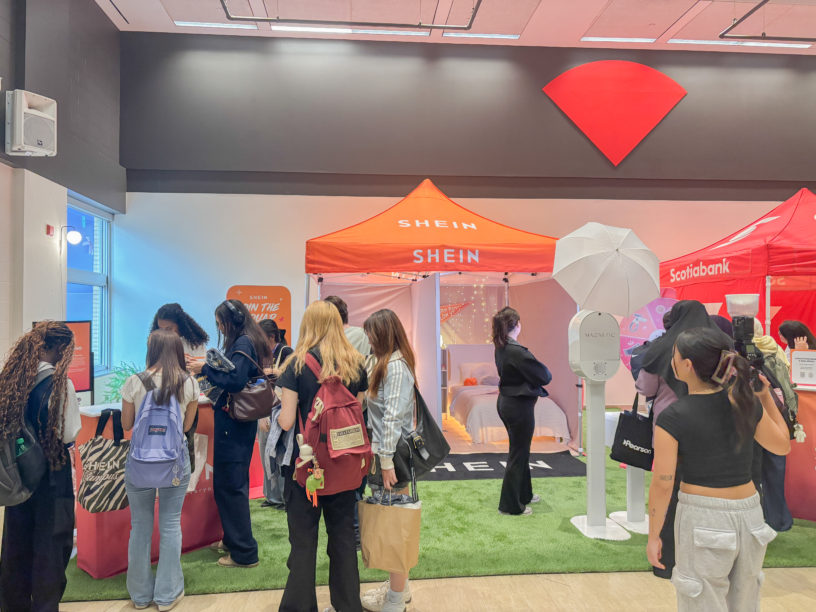
Fast fashion retailer Shein set up shop on campus during orientation week and met a mix of student reactions.
The one-day pop-up on Sept. 9 was part of Shein’s campus ambassador program, which saw campus events at universities across North America. The Toronto Metropolitan University (TMU) pop-up was the first in Canada.
The event was hosted in partnership with the Toronto Metropolitan Students’ Union (TMSU), bringing a photobooth, mini games and a sign-up booth for the ambassador program.
The program invited students to earn commission by creating content and recommending the company’s products on campus as brand representatives.
Fatima Jafri, a third-year nursing student, signed up for the ambassador program along with two of her classmates.
“We buy from these companies sometimes, so it’s kind of cool that they were here,” Jafri said.
The event was held at the Student Community Centre after relocating from Gould Street due to rain.
Not all students were excited to see the pop-up. Fifth-year biology student Mariam Mohamed was critical of the company’s pop-up event, saying it feels “weird” to have the event running on campus.
Mohamed said she tries not to buy from Shein due to ethical concerns, and believes the products are, “not even that good at the end of the day.”
The ultra-fast fashion retailer has had several high-profile controversies. In 2024, CNN Business reported that Shein found two cases of child labour at its suppliers. According to France 24, French department store BHV Marais ended its partnership with Shein, due to the alleged sale of childlike sex dolls.
According to the statistics Shein shared with The Eyeopener, over 240 TMU students signed up for the program at the pop-up event.
Jafri’s classmate Jadeinne Sadiarin acknowledged the company’s controversies, saying she is critical of the company.
“But honestly,” Jafri added, “all brands in the West have done similar things and still do. Shein is more exposed about it. So if someone just boycotted Shein, it doesn’t make sense because there’s Zara and other brands that have also admitted.”
Rishad Habib is an associate professor in marketing at Ted Rogers School of Management. She says it’s interesting that sometimes a consumer’s awareness of ethical issues steers them away from trying to make ethical decisions, calling it the ‘intention-action gap.’
“We want to be sustainable,” she said. “We want to have less of a negative effect on the climate, on the environment and on other people. But it also takes a lot of effort, a lot of time and a lot of money to be able to do that. So if you are a little strapped for resources like that, it makes sense.”
Habib said for most people, when they choose fast fashion retailers like Shein over other fast fashion retailers, price is often a stronger factor than ethical considerations—especially among university students.
In an 2020 article in The Guardian, moral philosopher Matt Beard argues that making more sustainable, ethical purchases is not always financially realistic for everyone.
Habib adds, “we can’t really blame people who choose this because it really is a practical choice.”
“It might be more effective, instead of saying ‘don’t buy from this brand,’ to kind of redirect people towards other options that are also cheaper and more sustainable,” she said.
Habib pointed students toward other options close to campus, specifically the Free Store and repair workshops hosted by TMU’s sustainability office.
Mohamed resonated with this sentiment. “We have a lot of local vendors here and students who have their own things. I think it’s better to promote that rather than something…like this.”
In an emailed statement to The Eye, the TMSU said they, “want to ensure student concerns are prioritized, and having heard dissenting voices around the activation, will take all feedback into account on any further activations moving forward.
TMSU said student feedback can be directed to their email.
In an emailed statement to The Eye, a Shein spokesperson commented on students’ concerns over their ethical standards.
“We take our responsibilities as a global company seriously and remain committed to operating responsibly, continuously improving our practices and maintaining high standards across our business. We also believe in open dialogue and welcome questions from students and others who want to learn more about Shein and how we operate.”








Leave a Reply