

By Nadine Alsaghir
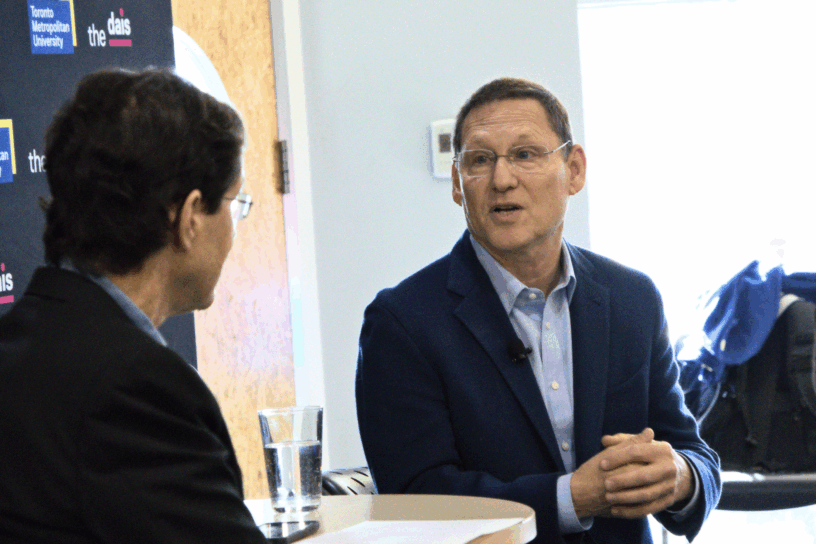
New Democratic Party (NDP) leader Avi Lewis spoke at Toronto Metropolitan University (TMU) on Thursday to discuss the future of his party and what’s next for Canada’s Left amid a rising cost of living and economic inequality.
The event was hosted by The Dais, a public policy and leadership think tank at TMU, and moderated by political columnist Martin Regg Cohn.
Regg Cohn said the forum aims to go beyond prepared talking points and typical news conferences to “dig a little deeper” and obtain in-depth answers from speakers. “This is the real Avi,” Regg Cohn said.
Lewis was chosen to lead the federal NDP in March. He succeeded Jagmeet Singh, who resigned after the party saw major losses in the 2025 federal election, including Singh’s own seat.
Lewis is a former journalist and lives in Vancouver. He is married to author and left-wing activist Naomi Klein.
Regg Cohn opened the forum with a sober look at the tough place the NDP found themselves in after the federal election, noting the party’s limited representation in Parliament with just five seats out of 343.
Lewis said the NDP can rebuild its support base and build a wider audience by proposing policies that will improve the living conditions of Canadians through addressing the cost of living crisis.
“I’ve talked to people with six figure salaries who feel one paycheque away from economic disaster … everyone’s living paycheque to paycheque, even when their paycheque is battered. When you address that, that is the widest possible audience,” Lewis said.
He stressed the importance of investing in public sector solutions to aid Canadians’ financial struggles, including proposing public grocery stores and a crown corporation to provide affordable cell phone and internet plans.
He said cutting taxes alone will not resolve the current crisis and pointed to the wealth held by billionaires, the big banks and the oil and gas industry.
“The role of government surely is to go and get some of that wealth and plough it into solutions that will actually solve the crisis of everyday life, and that’s my tax policy from a high level,” Lewis said.
Lewis also called for reversing the privatization of Canada’s health care system.
He said the federal government should enforce the Canada Health Act to ensure health services remain universally accessible. He also said Alberta and Ontario are violating the law through health care privatization and many Canadians are increasingly having to pay out of pocket for medication and other health services, making the cost of living harder to manage.
In addition, Lewis acknowledged differences between the federal and provincial NDP, saying regional oil and gas producing provinces have different approaches to energy issues. Lewis stated Canada must move away from its dependence on petroleum, arguing that fluctuations in oil prices contribute to rising costs for Canadians.
Lewis said communication with Alberta NDP leader Naheed Nenshi has remained positive despite fundamental disagreements over energy policy.
“The rest of the world is moving on. In China and India in the past year, all new demand for electricity has been provided by solar and wind, and Europe is moving off of gas and oil as fast as it can because of Russia’s invasion of Ukraine. We’re being left behind,” he said.
Lewis said the Right have been effective at appealing to people’s anger over the cost of living crisis, but argued the anger has been redirected toward immigrants, Trans people—specifically Trans youth—and people experiencing homelessness rather than those “amassing vast fortunes on our economic misery.”
He said class politics and identity politics should not be treated as opposing priorities. He said identity can be “weaponized” by the Right as part of the “blaming” and “punching down.”
“I think doing politics of the 99 per cent means a deep commitment to diversity, a deep commitment to acceptance of everybody, and fighting together as a multiracial, multigenerational group for justice. It also means fighting for working people and addressing their crisis in everyday life,” he said.
Lewis said the NDP is aiming to make political participation more accessible to young people who may not have a political background or wealth.
“We’re really focusing on a bigger funnel to bring in people who don’t consider themselves political, but who are angry about how hard life is,” Lewis said.
Ajushan Thavaseelan, a second-year computer science student at TMU, attended the forum.
He said it’s important for other students to attend these events because it allows them to hear viewpoints beyond their usual experiences.
“We all get trapped in our own kind of environment, like our bubbles, so we might not necessarily see any other perspectives,” he said.
Thavaseelan said Lewis cares about issues conservative governments often fail to address. He also commended Lewis’s focus on issues affecting young people and said this could encourage more youth to consider voting NDP.
He points to Lewis’s discussion of “friend banking,” which involves contacting people within one’s personal network to encourage them to participate in political campaigns.
“I think he’s really a grassroots leader when it comes to community building…I wish we saw a lot more of that in politics because it represents the ability to be engaged in-person with issues that really affect all of us in this day and age,” Thavaseelan said.
Shaun Ganzeveld, a third-year media production student at TMU, also attended the forum. He said Lewis’s responses gave him reasons to consider the NDP in a future election.
Ganzeveld said Lewis’s account of experiencing antisemitism as a child particularly stood out to him.
“It’s a very personal story. And so hearing him speak about his own personal experience with antisemitism, it makes you have a more personal connection with him,” he said.
During the forum, Lewis recalled a swastika carved into his school door and being bullied alongside his sister. He said his Jewish identity taught him that individuals have a responsibility to prevent atrocities from happening to anyone, not just Jewish people.
“We need to fight all forms of discrimination together, in a fight against racism, all of us together, not with exceptionalism,” Lewis said.
Lewis said his 25-year career in journalism taught him to listen to people and tell their stories. While Regg Cohn referenced Lewis’ description of politics a decade ago as “too personal and ugly,” Lewis said it’s getting uglier.
He said Canada is in “desperate straits” and in need of change and a political party that can bring people together to fight for the basics of elements of everyday life.
“I think that party politics is essential, but it’s also insufficient. I think we need strong unions, I think we need strong social movements, we need a common front against the extreme right and against rising fascism. And I think I can play a role in one part of that.”






Leave a Reply