

By Nasha Dutta and Rin Yanase
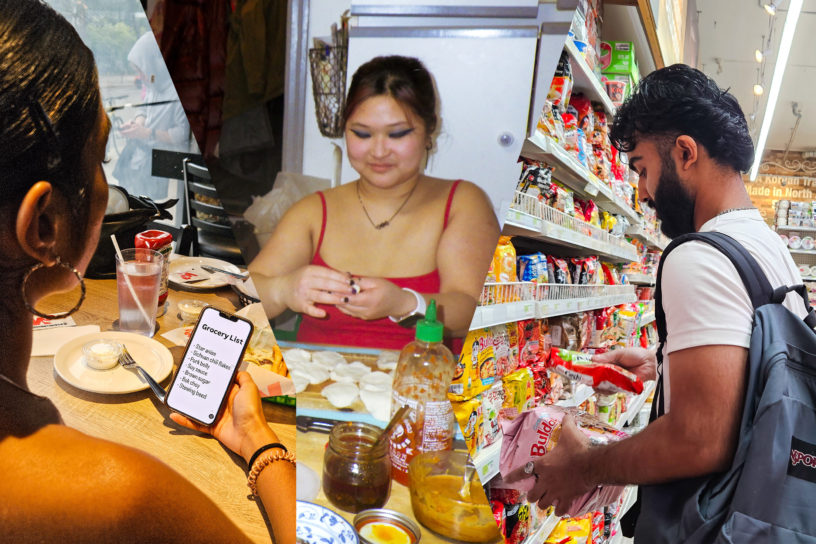
For international students at Toronto Metropolitan University (TMU), migration poses a number of challenges—and some say food is one of the biggest hurdles.
Helia Nazhad, a second-year biomedical science student at TMU moved to Toronto by herself in early 2025.
Born and raised in Mashhad, Iran, Nazhad said she considers having Persian cuisine a form of “self care.” Whenever she feels homesick or misses her parents, the dishes she cooks or orders help her feel connected with her home.
Nazhad said tasting Persian foods is like tasting her memories. Cooking ghormeh sabzi, a Persian herb beef stew reminds her of how her aunts would always bring the dish to family gatherings.
Ashika Niraula, a senior research associate at the Global Migration Institute at TMU said “access to culturally familiar food can play a very important role in supporting the emotional well-being of international students.”
Niraula said she’s spoken with a number of international students for her research on migration and settlement in Canada.
She said food is not simply a basic need for many international students. “I think it’s very closely tied with the culture, of course, but also a sense of belonging,” she said.
Rafid Ehsan, a fourth-year business management student from Bangladesh, said he rarely cooks his traditional meals at home, describing the act as an experience that leaves him “very emotional” and “asks a lot” of him.
“I personally avoid my own [Bengali] flavours because the moment the oil hits the onions or the turmeric hits the oil, it invokes very strong familial feelings when I was a little boy.”
For Ehsan, the taste of home is not always a source of comforting familiarity. He said the ingredients he grew up eating—fresh-caught tilapia or fragrant cumin—now remind him of a home that he left four years ago. “I’d say, longing for something that’s not there anymore,” he said.
Although Ehsan acknowledges the Bengali community in Toronto, particularly within the Danforth area, he finds it hard to compare the quality and price of ingredients that are accessible here to what’s available back home.
Nazhad said “All of the vegetables or ingredients that we use in Iran—they’re not all available here. Also, the meat…the way they feed those lambs and cows is completely different from here. So the meat [in Iran] has a different taste from here.”
A 2008 study published in Meat Science found grass-fed, grain-fed and concentrates-fed beef all have different flavours.
Having spoken with TMU’s international students who have smaller diasporic communities or live in the Greater Toronto Area, Niraula learned maintaining connections to cultures back home can be “both rewarding, but also challenging.”
She said they “would talk about the feeling of homesickness,” because their co-ethnic diaspora network was relatively small.
Food helps diasporic students to create the “powerful link to home, to family, to cultural identity,” Niraula added, saying it also plays a role as bridges with communities of differing cultural backgrounds here in Canada.
“They are, from my perspective, trying to balance a desire to explore new identities and experience beyond the familiar cultural circles, and food played an important role in it,” she added.
Niraula has seen how those connections become the starting point for them to build solidarity with other international students under the political insecurity they might be experiencing.
“The changes in immigration policies have direct impact on international students,” she said.
Ehsan said on the rare occasion he cooks Bengali cuisine, “the experience of making those things is one of being emotional and one of being proud. “It’s beautiful. It’s the pain that you enjoy.”







Leave a Reply