

By Maria Beltran
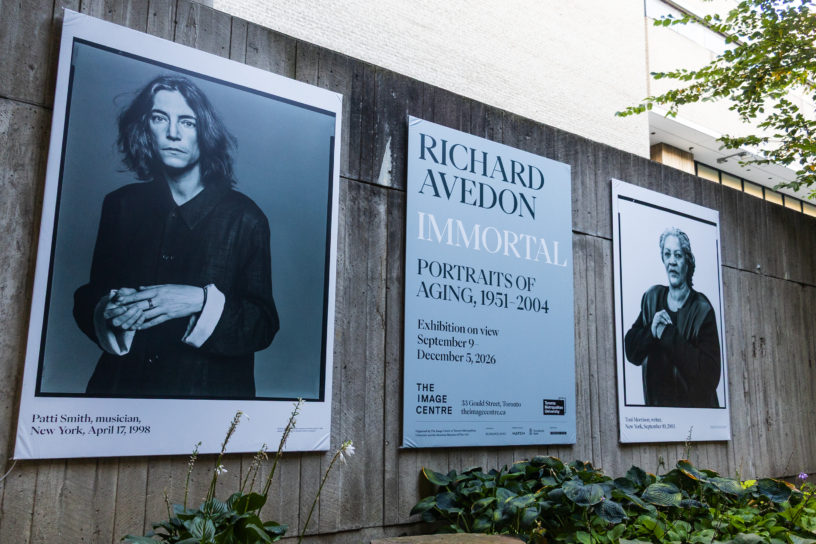
Across from the main gallery of the Richard Avedon Immortal: Portraits of Aging exhibit currently on display at The Image Centre, is a smaller room home to a series of photographs from the final years of Avedon’s father’s life.
The portraits offer an intimate encounter with aging through his father’s battle with terminal cancer. Restaged from his seminal 1974 Museum of Modern Art exhibition in New York, the year after his father died, the portraits document a body changing with time, bringing the viewer face-to-face with a process that is both deeply personal and universal.
Richard Avedon rose to prominence in the post-war fashion industry, becoming one of the most influential photographers of his time through work in magazines like Harper’s Bazaar and Vogue. Yet despite his association with glamour, Avedon challenged the convention of portraits that idealized their subjects through flattering poses, lighting and retouching.
Although Toronto Metropolitan University’s (TMU) Image Centre did not set out to make Immortal a timely exhibition, curator and director Paul Roth believes its subject resonates with Canada’s aging population and the need to address “issues of representation, of health, [and] public policy around aging in Canada.”
Drawing on his longstanding ties to the Avedon Foundation, Roth secured the artworks on loan from from major institutions like the Museum of Modern Art in New York. Through Avedon’s portraits, he hopes to bring these concerns into view by presenting aging as something all humans share.
Avedon’s own relationship with aging was complex. Roth suggests that Avedon saw it as “a condition that we are all in all the time,” rather than something that suddenly happens to us one day.
“It’s a thing that we all face, and some of us face it in pain, and some of us face it with great verve and excitement and energy…all of it is there. All of it is in those photos,” said Roth.
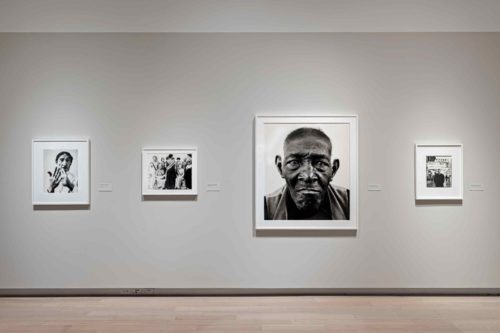
Avedon’s portraits show how differently aging can be experienced—and perhaps nowhere more strikingly than in his portraits of William Casby and singer Marian Anderson.
Casby was 106 when Avedon photographed him in 1963, more than twice Anderson’s age, and had been born into slavery more than a century prior. As Roth explains, Avedon photographed Casby as part of a project with writer and activist James Baldwin exploring the American civil rights movement. His face fills the frame against a stark white background, with wrinkles, pores and scars rendered in fine detail. Casby’s portrait carries the weight of a history that was still within living memory in the 1960s.
Anderson, by contrast, was a celebrated opera singer and civil rights figure whom Avedon photographed in her 50s. Rather than capturing her in a static pose, he photographed her mid-performance, her lips pursed as she sang. The image captures her vitality and the work that defined her life.
Placed near one another, the portraits offer two very different encounters with age: Casby’s face reflects a lifetime shaped by historical change, while Anderson is captured in the midst of a career still unfolding in the public eye.
The exhibition’s relevance, however, extends beyond aging itself. Roth mentions that The Image Centre’s mission as an institution is “to talk about photography and how we see the world through our cameras.” The Immortal portraits use the medium of photography to capture time—a force which everyone is subject to.
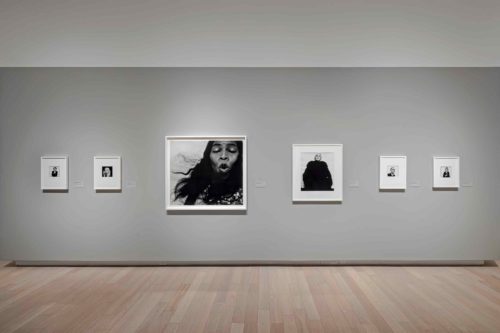
Throughout his career, Avedon made portraits for particular moments, including magazine issues where being timely and even avant-garde were especially important. But what happens to these photographs decades later, when the moment they were made for has long passed?
Some of the portraits’ subjects remain well-known and respected such as Patti Smith and Toni Morrison, but others are less well remembered. Roth points to Avedon’s portrait of Vicente Escudero, a flamenco dancer who was once an international star but is now unfamiliar to many viewers.
“Incredible picture,” Roth says. “Most people today don’t know who Escudero was.” According to Roth, Escudero helped popularize flamenco around the world, yet much of his fame has faded from public memory.
Is recognition necessary to appreciate these photos? Roth thinks that’s not always the case.
“Do people need to know who these people are? I always wonder. To me, I don’t feel like that. I feel like we can look at these pictures if we want to know more about them, but at the end of the day what we’re all starting to understand is that we’re all part of a human family,” he says.
As years pass, time acts on both the subject and the medium. Although the immediate fame of the subject fades and younger generations recognize them less, their photographs have transcended into something more timeless, stripped of their original cultural context.
The portraits are not just a depiction of once glamorous icons in a more honest, less flattering, and vulnerable light, but also a meditation on mortality—one of the most enduring concepts explored in art.
In this way, Richard Avedon’s Portraits of Aging outlast its original subjects and becomes something close to immortal.





Leave a Reply