

By Jasmine Makar and Edward Lander
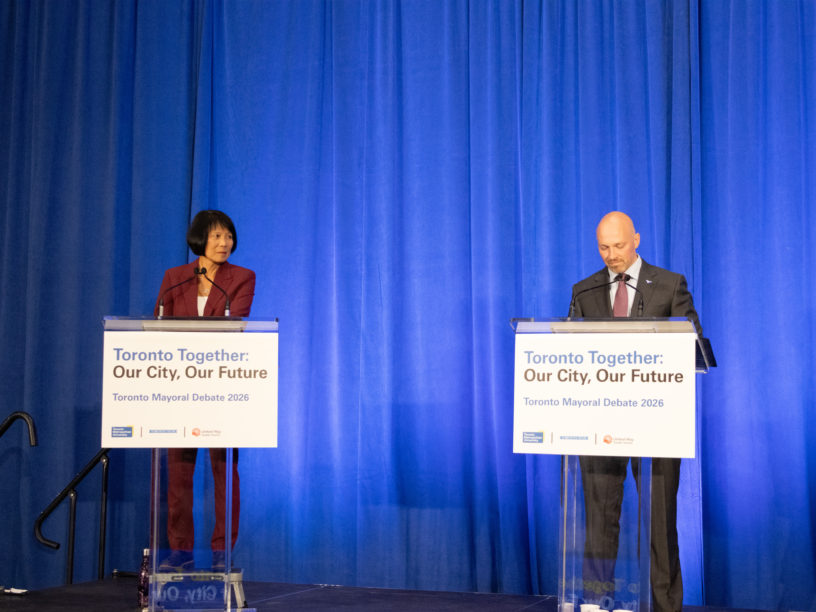
Brad Bradford and Olivia Chow took to the stage at the Student Learning Centre (SLC) last night for a mayoral debate hosted by the Toronto Star, United Way Greater Toronto and the Democratic Engagement Exchange at Toronto Metropolitan University (TMU).
The debate saw the two candidates go head-to-head over housing, transit, affordability and other issues close to Torontonians.
This was the first major debate to not feature Chris Alexander, who announced his withdrawal from the race early Tuesday morning. Alexander held a steady third-place spot behind Bradford, polling with nine per cent of the vote on Tuesday, according to a poll from Liaison Strategies.
Tuesday also marked the first day of the early voting period—which lasts until Oct. 11—with many Torontonians having already cast their ballot.
In a phone call with The Eyeopener, TMU President Mohamed Lachemi said he was proud to host the debate at TMU.
“We think it’s very important that we give students and the broader community the chance to hear from candidates on issues that affect our everyday lives,” said Lachemi. “Our hope is to create meaningful conversation so that people live with a better understanding of the issues shaping our city and candidates’ positions to make well-informed decisions.”
Lachemi said in the 2023 municipal by-election, fewer than one in three eligible voters cast a ballot, and by hosting events like this, he hopes to encourage students to vote in higher numbers.
With the debate being held on campus, many questions pertained to student issues, including one fielded by a fourth-year marketing and accounting student at TMU.
Housing
Moderator Edward Keenan of the Toronto Star opened by asking candidates questions about their housing plans. Chow discussed her push to build more affordable homes, citing 80,000 rental units currently in the works as well as plans to support renters facing wrongful evictions.
“We can build more and many more housing units that people can afford,” said Chow. “We can go after slumlords so that renters can live in dignity.”
Bradford called out Chow’s affordable housing plan for having only built two per cent of her 65,000 affordable rental unit goal. Additionally, Bradford highlighted that 77,000 people left Toronto last year and said the majority of renters feel owning a home is out of reach.
“Opening up some of our zoning, streamlining the permit process, getting to it faster, building the right type of supply in the right places-that’s what keeps Toronto affordable,” said Bradford.
Cost of Living
Chow said city services can provide “breathing room” for Torontonians facing financial hardship.
She cited the TTC fare capping program implemented under her leadership and promised to implement a universal free lunch program in schools if re-elected.
On the other hand, Bradford said he plans to freeze property taxes and reduce water bills—which he said will save Torontonians almost $300 a year. He also shared plans to conduct a “line-by-line” review of the city’s budget, which he said hasn’t been done since 2011.
Chow said Bradford’s plan would require major budget cuts in important sectors to accommodate for his property tax freeze.
Throughout the evening, Bradford mentioned his plan to cut the Land Transfer Tax, which he said is the “biggest impediment” to homebuying in Toronto.
Community Safety
Bradford said Torontonians feel Chow “doesn’t take their safety seriously” and although violent crime is down, people feeling safe is just as important.
If elected, he said he’d commit to a visible police presence on the TTC and hire 1,000 additional police officers.
“Not every day, but every week, I encounter someone smoking crack cocaine on the 505—and that person needs treatment,” he said.
“But it’s also true that you can’t engage in open-air drug use on our transit system, and that’s why ridership is 20 per cent less than what it used to be in 2019.”
Chow said she’d focus on the root of crime by boosting funding for youth supports, keeping police hiring “on track” and commit to hiring more mental health crisis workers.
She mentioned Holly Roy, the mother of JahVai Roy, an eight-year-old boy who was killed by a stray bullet in August 2025.
“Every mother in the city deserves to see her son come home,” she said.
Bradford critiqued Chow for not serving as chair of the Police Services Board, a position traditionally taken by the mayor of the city. Many past mayors, including John Tory and David Miller, served on the board.
Lightning Round
Toward the end of the debate, Keenan asked a series of questions looking for one-word answers.
When asked whether taxes were too high, Bradford gave a firm yes, while Chow attempted to answer in a sentence before ultimately saying no.
When asked whether Billy Bishop Toronto Island Airport should be expanded to accommodate jets, both candidates said no.
When asked for their favourite Toronto sports team, Chow initially said the Raptors, before changing her answer to the Tempo. Bradford said he prefers the Toronto Maple Leafs.
Closing Statements
Chow’s closing comments reiterated many of the promises she’d made earlier in the debate: lowering the TTC fare cap to 10 rides per week, building more affordable housing and cracking down on bad landlords.
“Bradford will take us backward,” she said. “Be really clear, where do you stand? Because what you said and what you’ve done is totally different,” she told him.
Bradford spoke to Toronto’s potential, saying that while he doesn’t believe Toronto is “broken,” he does think it’s “stuck.”
He said his campaign represents a new direction for city hall and that, “if you want to change the city, you have to change the mayor.”
Election day is on Oct. 26. To be eligible to cast a ballot, voters are required to bring identification.
A full list of acceptable ID is listed on the city’s website.








g
This man knows nothing about running a city. Cut property taxes will lead to a broken down city that looks old. Perhaps he will also cut monthly apartment and condo rental limits so that no one has to pay more than 1000 dollars for a two bedroom unit.