

By Karanveer Khahra
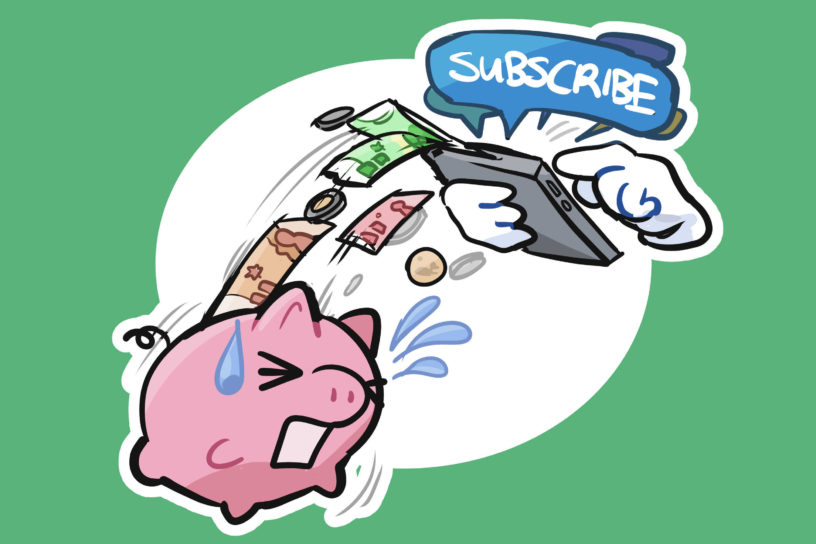
From streaming platforms to study tools, subscription services have become a daily expense for Toronto Metropolitan University (TMU) students but not everyone feels they’re worth the cost.
In recent years, the consumer economy has shifted from ownership-based models to access-based ones. A study by Purdue University published in 2019 found that college-aged students showed a stronger preference for subscriptions compared to older demographics.
Michael Boutros, assistant professor of economics at the University of Toronto, said companies favour this model for a reason. “For a business, profit or revenue is not the most important metric. It’s all about cash flow.”
According to Hardbacon, a Canadian fintech firm, found Canadians underestimate their subscriptions, where they pay for eight but believe they have only four. This gap between perception and reality shows how quickly and quietly costs can add up over time.
Third-year psychology student Vita Christoforou said she relies on Spotify Premium almost daily. “It helps me study. I like the features it has…I can choose what music I want to play, without restrictions or ads.”
Boutros explained that students should think of subscriptions as either “consumption goods,” like streaming services for entertainment, or “investment goods,” like Grammarly Pro or LinkedIn Premium, which may help with school or careers.
“The value you get from a subscription should be tied to how often you plan on using it,” he said. “You want to make sure you’re not the kind of consumer who signs up thinking you’ll use it a lot and then you don’t.”
Third-year psychology student Shapi John said Grammarly Pro has been worth it. “In our program, we have to write a lot of papers with APA citations, so I think paying for it once a year is beneficial for me.”
Not all students, however, see the same value in subscriptions marketed as career or education tools. When asked about LinkedIn Premium, some were skeptical.
Third-year psychology student Diva Kaushik said LinkedIn Premium doesn’t appeal to her. “I don’t see the point, it’s just for connecting with people. I don’t know how much further it would go for me.” John agreed, saying, “I don’t think education is really my top priority when it comes to subscriptions.”
Some students, like Christoforou, admitted to experiencing “subscription fatigue.” She recalled being surprised by how quickly the monthly charges added up. “When I first got them, I was like, ‘Oh, this is a lot of money.’ I didn’t realize how often it was going to be.”
Personal finance consultant and journalist Rubina Ahmed-Haq said reviewing subscriptions regularly—a financial “palate cleanse”—can help reset habits. “Sometimes it’s good to just stop everything and say, ‘Okay, what do I actually miss?’ and then restart those,” she said.
She also advised students to plan ahead by calculating their total budget for the semester and dividing it by the number of weeks left, so they know exactly how much they can spend each week.
Coleen Clark, former professor at Ted Rogers School of Management and former coordinator of the Chang School’s Certificate in Financial Planning, agreed that looking at annual costs is key. “What is the cost of it on an annual basis? I think the weekly or monthly cost is too small to really have an effect,” she said.
Clark said students should also weigh the time they spend on subscriptions, not just the money, since hours devoted to them and budgeting can add up over the year.
While many companies offer student discounts, not everyone takes advantage. Christoforou said she personally doesn’t find the savings significant.
Ahmed-Haq disagreed, comparing it to skipping a deal at a restaurant. “It’s like happy hour. If happy hour’s happening, why wouldn’t you take advantage of it? That’s literally leaving money on the table.”
Kaushik expressed she avoids subscriptions altogether. “I just don’t see enough value in the product itself to be paying for it.” Others, like John, share accounts with family memebers to soften the financial burden.
Boutros said that psychology explains why subscriptions remain attractive. “As a consumer, I might not be upset because it’s maybe easier for me to pay $2 a month instead of $50 [annually],” he said. “So there is a world in which the subscription model is beneficial for both firms and consumers.”
Clark said the key is to be intentional about subscriptions. “That’s an individual decision. The answer is whatever you want it to be but it’s important you’ve thought about it and made a decision.”







Leave a Reply