

By Nadine Alsaghir
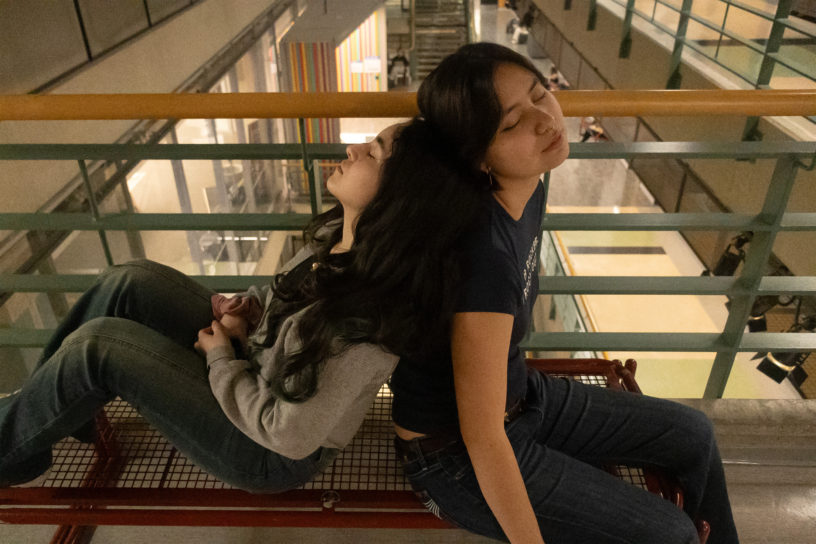
As finals season approaches at Toronto Metropolitan University (TMU), students say they’re napping in lounges, libraries and even empty hallways, struggling with sleep due to long commutes and demanding schedules.
TMU shared in a statement regarding the renaming of Dundas Station that more than 80 per cent of the school’s 50,000 students, staff and faculty are commuters.
Third-year biomedical science student Anokhi Patel said the exhaustion often begins before sunrise. She said that she finds herself napping in TMU’s library on days she has a long break between a morning and evening class.
“I had an assignment due last night and I had to be here for an 8 a.m. class, so I had to leave my house around six something,” she said. “Then I’m here for a really long time at night.”
Patel travels more than an hour to campus each day, and says the lack of resting spaces on campus only makes things harder. “Especially for students that are commuting and don’t get that opportunity to go to a dorm and rest for a little bit.” She said she believes TMU should provide “a dedicated space where they could rest, especially knowing it is a commuter school.”
According to Housing and Residence Life, TMU provides a commuter hostel located in the International Living/Learning Centre Residence at 240 Jarvis St., which “offers students short-term accommodation on-campus in support of their academic success.” It provides commuter students up to three consecutive nights and nine nights per month.
First-year electrical engineering student Pranet Chirag Talati, who commutes from Brampton, Ont., shares the same struggle. His commute takes nearly two hours each way, forcing him to wake up around 5:30 a.m. for 8 a.m. classes.
“It’s just a lot of fatigue and the stress of commuting,” he said. “Whenever I have about an hour or two difference between my classes, I find myself sleeping.”
On Nov. 7, Talati had an 8 a.m. class and then a midterm at 8:30 p.m. Together, it would be a commute of four hours, so he said there was no point in going home—that’s where the nap comes in.
Some students who live closer to campus still find themselves caught in cycles of exhaustion, especially in programs with heavy workloads. Eleanor Qu, a first-year architectural science student, says her peers often joke about the “architecture stereotype of not sleeping.”
“We thought it’d be fun to stay [in the architecture building] for 24 hours to finish our projects,” she said. “But then the next day, I realized I needed to keep working—it was 2 a.m., and I didn’t want to go home because it was unsafe that late. So I slept there again.”
Qu has even heard tales of upper-year students who spent four nights in the building during project deadlines. “Having some sort of more flexibility within schedules could really help,” she suggested. “Putting more classes together on the same days would really help those students, because commuting to TMU for like two hours just for one class is really draining.”
According to Todd Girard, associate professor in psychology and lab director at the Brain Imaging & Memory Lab at TMU, these experiences reflect a broader trend of sleep deprivation. “There is what we call excessive daytime sleepiness amongst university students—especially amongst first-years, but it goes throughout,” Gerard said.
Gerard explained that the transition to university life, whether students move away from home or start commuting long distances, often disrupts healthy routines.
“It’s that whole new context and independence—everything kind of throws a curveball,” he said. He noted that students living closer to campus or in residence “do seem to have more flexibility,” which may allow for better sleep patterns.
He suggested that students who struggle with sleep should seek support. “It might be useful to go to some of the counselling centre workshops or even one-on-one counselling,” he said.
“I would definitely want the school to acknowledge the fact that there are commuters who are doing two hours of commute,” Talati said.







Leave a Reply