
By an Eyeopener staff member
In the streets of Tehran, Ilam, Mashhad, Lorestan, Kermanshah and hundreds of other cities across Iran today, there is a familiar sound: the chants of people who have lived for decades under a system that promised liberation but delivered repression. The words “Death to the Dictator” and “Death to Khamenei” are not mere slogans—they are the echoes of a public exhausted by a regime that has consistently chosen war abroad over wellbeing at home.
What the world is witnessing now—the largest wave of protest in three years—did not begin overnight. It is the culmination of 47 years of a political project that has prioritized ideological control and regional power over human life. A rule that has inflicted harm both on the people of the Middle East and on the very society it claimed to protect.
Exporting violence abroad, importing misery at home
From its early days in 1979, the Islamic Republic (IR)—the governing body in Iran—sought to export a so-called ideological “revolution” across the region. It started building militias, funding unofficial armies, and by investing in these systems, it undermined and weakened other countries’ governments, thereby increasing regional dependance.
In Lebanon, the IR’s funding and arming of Hezbollah helped transform a fragile democracy into a battleground and a proxy front with Israel.
The IR’s intervention in Syria—deploying the Islamic Revolutionary Guard Corps (IRGC) and allied militias to back Bashar al-Assad’s regime—played a central role in turning protests that started in 2011 into a catastrophe of half a million deaths and millions displaced.
In Iraq and Yemen, the IR’s support for militias has prolonged sectarian fighting and weakened already fragile societies.
In Gaza, the regime’s support of groups like Hamas and Islamic Jihad, perpetuating cycles of international retaliation and innocent people’s suffering without a real opportunity for peace. One of the most overlooked contradictions of the IR’s rule has been its performative support of Palestine. The regime has spent decades proclaiming itself a defender of Palestinians, yet that support has often only translated into rhetoric and weapons sent through proxies—which in turn further escalate Israel’s already genocidal bombardment—not in direct diplomatic or humanitarian means.
The IR’s regional role is sometimes framed as “peacekeeping” by those who misunderstand it.
While yes, innocent unarmed civilians deserve a defence against their persecutors, deterrence and deterrence alone—enabling armed groups, normalizing proxy warfare—is not peace, but a bandaid solution. It provokes enemies and innocent civilians have to pay, keeping the Middle East in a constant state of distress. It is intentional instability. War without winners. Civilians as collateral damage.
The IR has left a trail of devastation from Aleppo to Sana’a, funded in large by resources taken from Iran while its own citizens faced a collapsing economy. While bread costs more than many can afford, the export of missiles and militia support continues.
The domestic cost
The cost of this foreign intervention has been devastating for Iranians as economic hardship like chronic inflation and plummeting currency value have become constant conditions, despite sitting on the world’s third largest oil reserve.
Then there’s also sanctions that have been imposed largely because of the regime’s behaviour and nuclear ambitions. These have overall isolated Iran’s economically, but the effects have hit ordinary citizens hardest, not the elites who evade these consequences..
Human lives have been treated as expendable in conflicts foreign and domestic. Young Iranians, often from impoverished and marginalized groups, were forced to fight and die in Syria and Iraq while their own communities at home struggled with unemployment and austerity.
Iranian society has shown extraordinary resilience in the face of these pressures. It has not disappeared. It has not broken. Iranians have weathered crisis after crisis, cultivating new ways of life, creativity, culture and even resistance despite decades of repression.
Beyond economic collapse and foreign policy
Since the 1979 Islamic Revolution in Iran, which saw the IR take power after the fall of the Pahlavi dynasty, Iranians have lived under a system that dictates how they believe, dress and even think.
Religion is enforced by law—despite over 50 per cent of the country not identifying with Islam. Women must wear the hijab. Morality police patrol the streets—though since the 2022 Women Life Freedom uprising, their presence has been sparse to reduce risk of protest.
Courts punish anyone who challenges the state’s interpretation of faith. Atheists, secularists and minority groups still left in Iran including Bahá’ís, Sunnis and Christians often face harassment, exclusion and imprisonment.
Faith and the abuse of religion has become a tool of control, stripping people of autonomy.
State propaganda shapes every part of life. Textbooks, television and online content insist obedience is virtue and dissent is treason or betrayal of god. History is rewritten, foreign enemies are invoked and criticism is framed as corruption or foreign interference. Independent journalism, universities and the arts are tightly restricted.
A collapsing infrastructure adds another layer of control. Decades of mismanagement and corruption have left Iran’s ecosystems and infrastructure failing.
Rivers like the Zayandeh Rood have dried up, Lake Urmia has shrunk to a salt plain, poorly planned dams have caused ecological damage. Land subsidence and buildings like the under-construction Metropol in Abadan have collapsed, killing dozens.
Water shortages leave families in minority regions without safe drinking water. Power cuts disrupt hospitals, schools and daily life.
The decay of infrastructure is not accidental. By making life precarious, the state enforces dependence, constrains mobility and erodes dignity—a tool of oppression and cultural erasure.
Legal discrimination reinforces control. Women face limits on dress, work, inheritance and personal status. Religious and ethnic minorities, including Kurdish people and Baluchis, are excluded from schools, jobs and political life. Security forces disproportionately target ethnic groups. This legal apartheid divides citizens and denies equal protection under the law.
The IR has done all this in the name of god—in the name of Islam. In turn, the regime has deepened global Islamophobia by perpetuating the belief that authoritarian brutality reflects the faith itself rather than a pawn in its political game.
Daily life is shaped by these pressures. They constrain how Iranians dress, study, worship and imagine their future.
And all this is just scratching the surface.
Yet many refuse to accept it. They find ways to survive, resist quietly and assert that their lives, culture and identity cannot be erased.
Executions and murder
Since 1979, the IR has used death, both openly and in secret, to eliminate opposition.
In the 1980s, thousands of political prisoners were executed after sham trials, culminating in the 1988 mass executions, when prisoners were killed following minutes-long interrogations.
Families were not informed, bodies were buried in unmarked graves and the state has never fully acknowledged the scale of the killings.
In the 1990s, repression moved outside prison walls. A series of assassinations known as the ‘Chain Murders’ targeted writers and intellectuals critical of the regime. Authorities later blamed ‘rogue agents,’ but investigations were limited and accountability minimal.
Today, the IR remains one of the world’s leading executioners, with political prisoners and protesters still facing death sentences after deeply flawed trials.
How the IR still stands
47 years after the revolution, many outside Iran still ask why the regime has not fallen. The following could be attributed as a few leading reasons:
First, control of coercive power. The IRGC, Basij and intelligence services are loyal not to the nation but to the regime. Their positions, wages and privileges depend on maintaining the system, not serving the public.
Further, the IRGC has remained untouchable as it is not just a military, but the backbone of the regime. It commands weapons and intelligence. It holds control over food imports, medicine supply chains and distribution networks, profiting from shortages, bypassing sanctions and using excess goods as leverage over Iranians.
Second, fragmented opposition. Unlike the 1979 revolution, today’s opposition lacks a single leadership structure. Yet its decentralized nature has allowed dissent to persist across generations and regions even as the state works to prevent movements from unifying.
Third, fear of chaos. Many Iranians, especially older generations who carry influence, fear what might follow sudden collapse—Syria-like civil war or foreign intervention. The regime exploits that fear relentlessly.
Fourth, international interests. Major powers prefer containment over the risks of upheaval. Even sanctions, while punitive, function as engagement with the regime.
Fifth, lethal force. The IR uses lethal force as a tool to stay in power, shooting, beating and detaining innocent protestors to punish dissent and instill fear. Every act of disobedience comes with the risk of death, imprisonment or disappearance.
The IR survives not because it is loved, but because it has engineered survival through force, fear and fragmentation.
Iranian resilience
To speak of Iranian resilience is not to romanticize suffering. It is to recognize people who build community in the face of austerity and persevere.
For most Iranians, life has unfolded under sanctions, inflation, currency collapse, political repression and constant regional uncertainty. Yet society continues to function. Children are educated. Elders are cared for. Businesses are built. Art, science and culture persist.
Despite shrinking opportunities, Iranians maintain high literacy, producing a highly educated diaspora. This is not passive endurance but active preservation.
Decades of state efforts to redefine Iranian identity have failed. Language, humour, history, pre-Islamic holidays and non-state traditions endure, while music, poetry, cinema and satire flourish beyond official control. That failure is itself a form of resistance.
Iranian resistance is often quiet and steady. It appears in women breaking dress codes, young people rejecting ideological patterns, families resisting state narratives at home and workers striking despite severe penalties.
This resilience carries a cost: trauma, depression, youth emigration and a population worn thin by decades of strain. Yet it remains grounded in a clear sense of worth. We deserve dignity. We deserve justice. We deserve a future.
Uprisings and protests
Since 1979, the IR has seen repeated waves of mass protest, beginning with women opposing compulsory hijab that year, followed by student uprisings in 1999, the Green Movement after the rigged 2009 election, nationwide economic protests in 2017-18, the Bloody November protests of 2019 and the Woman, Life, Freedom movement in 2022 after the death of Mahsa Amini while in police custody.
Each was met with excessive force, mass arrests, expedited executions and massacres, yet none erased the underlying demand for dignity, accountability and freedom.
Beyond bullets and arrests, repression is psychological. Surveillance cameras, plainclothes agents and social media monitoring track protestors, instilling fear that dissent, even in private conversations or even abroad, can carry deadly consequences.
Internet and lines of communication are shut off across the country to limit unification and gatherings, news circulation and international condemnation. If no one can see what’s going on, the IR can feed its own narrative to the world. Meanwhile they commit massacres in the darkness.
Families of activists and demonstrators are harassed, confessions are forced, homes are raided and bodies are abducted, leaving those who speak out weighing the lifelong consequences of protesting.
Today’s protests
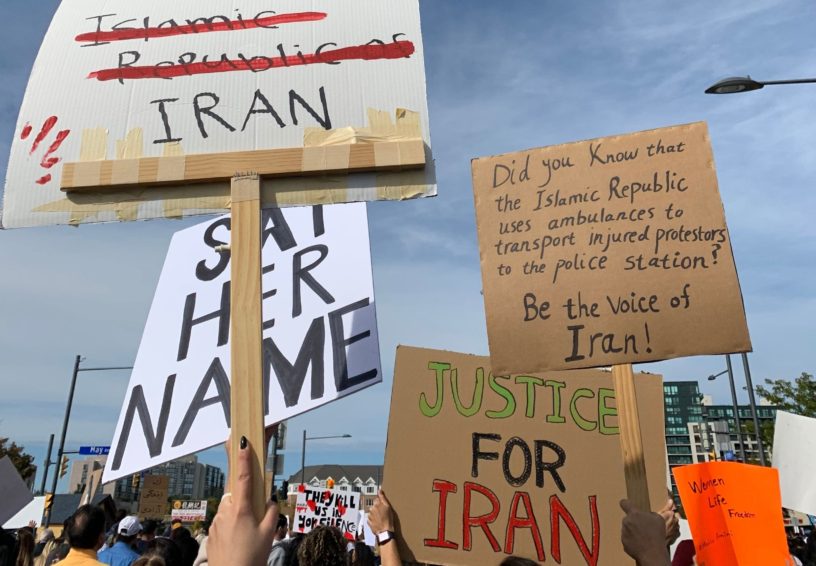
The unrest currently shaking Iran is a culmination of all the uprisings that came before it—this time sparked by a sudden currency collapse last month. Protests started in late Dec. 2025 in Tehran’s historic Grand Bazaar, where merchants shut their shops in protest against dire conditions.
Since then, demonstrations have spread nationwide, with chants moving beyond economic demands to calls for systemic change—as they always have.
The response has once again been severe. Security forces have used live ammunition, tear gas and mass arrests against unarmed civilians. Human rights groups report lethal force, detentions including of children and raids on hospitals.
Internet and communication lines have been shut down nationwide for over 100 hours as of Jan. 13. Families on the outside are unable to get in touch with their loved ones on the inside.
Yet again, the IR is murdering innocent protestors in the dark. Shooting them on sight, blinding them, using tear gas, raiding hospitals and Mosques, burning them down and blaming the “rebels.”
The reported death toll since the start of the protests has surpassed 12, 000 as of Jan. 13. The estimated toll is likely much higher.
The world sees only the surface of these protests. Beneath lies years of accumulated grievance and a generation unwilling to be silent. The outcome will depend not on outsiders cheering or condemning but on the courage and tenacity of the Iranian people themselves.
Where Canada fits in all this
Canada, too, is implicated. After the IRGC shot down Ukrainian International Airlines flight PS753 which departed from Tehran in Jan. 2020, killing all 176 people on board, including 55 Canadian citizens, Canadian officials promised they’d seek justice and accountability. Yet now, six years later, those promises ring hollow.
Despite Canada recognizing the IRGC as a terrorist entity, IR officials and their families have been allowed to settle, invest, study and move freely in Canada, while victims’ families continue to wait for answers.
This quiet permissiveness sends a painful message. Canada condemns the IR in speeches, yet leaves its doors open as a safe haven to those tied to or even criminals exiled from the regime. So much so that Canada has earned the label of “The IR’s prison” among many Iranians.
Looking a little closer to home
To the students at Toronto Metropolitan University who have time again shown their passion for standing up for what is right—your voices matter.
The struggles unfolding in Iran are not distant news. They are stories of humans seeking basic dignity, freedom of expression. Stories of people refusing to be crushed by systems that prioritize power and greed over humanity.
When you study these movements, share their stories responsibly and stand in solidarity with those fighting for freedom and justice, you are taking part in something larger than you might realize—you are a part of history bending toward conscience and change.
Keep learning. Keep questioning. And never underestimate the power of being informed.
The writer of this piece has chosen to stay anonymous for their safety.


Leave a Reply