

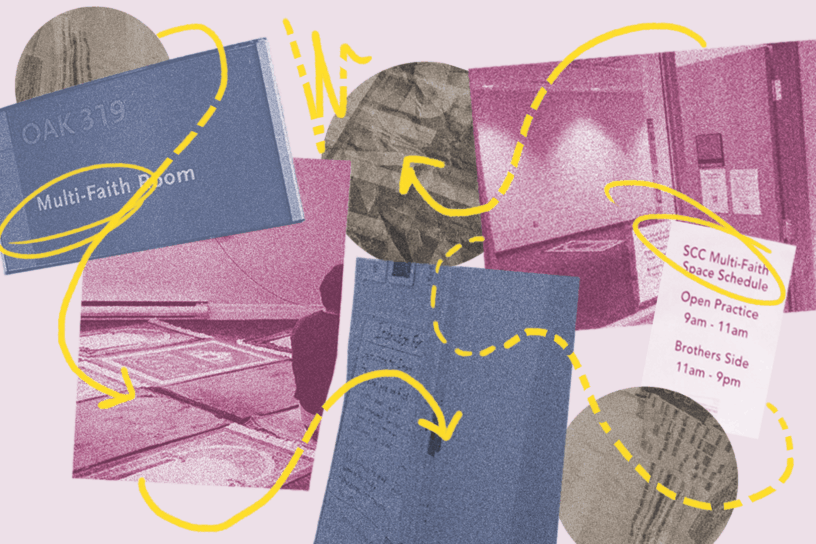
At TMU and other Canadian universities, places for prayer are in short supply. For many Muslim students, this means turning to impromptu spaces from classrooms to stairwells
By Shumaila Mubarak and Lama Alshami
BASMAH KHALID WAS sitting in the faux leather theatre seats at Cineplex Yonge-Dundas, attending a class when she had to rush outside with her friend. It was time for the evening prayers. The theatre was far from other campus buildings and going to one of Toronto Metropolitan University (TMU)’s two designated prayer spaces would take too long. Because the building didn’t have any room to pray either, she had no choice but to make use of the space she had—the cinema itself.
Khalid went to a corner near the bathrooms, took out a prayer mat from her bag and laid it down on the floor. She asked her friend to cover her from passersby and to keep guard. She was anxious—the situation was far from convenient. As a Muslim woman, she was worried for her security when visibly performing prayer in public.
The only reason Khalid was able to do it, she says, was because her friend was with her. “I don’t think I would have been able to do that if I was alone.”
Prayer is the most fundamental and mandatory institution within Islam. In the Qur’an—the Muslim Holy Book—worship is considered the ultimate purpose of a person’s life.
Hadia Mubarak, an associate professor of religion at Queens University of Charlotte says Islamic prayer can be divided into two types: formal prayer, or Ṣalāh, where Muslims pray five times a day at designated times—and informal prayer, or du’a, which is an unstructured personal supplication with God (Allah) done anywhere and any time.
In Ṣalāh, which is the second of five pillars of Islam, Muslims are required to pray in a standing posture while facing the Ka’bah, a stone building in Mecca considered to be the house of God. Mubarak calls Ṣalāh, “central to the Muslim identity.”
Although unintentional, as a result of class scheduling, university courses can get in the way of Muslim students’ obeying this
pillar of their faith.
Located in Toronto where almost 10 per cent of residents are Muslim, according to Statistics Canada, TMU also has a large Muslim student body, many of whom require a place to offer their Ṣalāh.
The university currently has two designated full-time spaces that Muslim students can use to pray on campus. There are two multi-faith rooms on the third floor of the Student Community Centre (SCC). Across campus, on the seventh floor of the Ted Rogers School of Management (TRSM) is the EDI Well-being Space. Launched by the Ted Rogers Students’ Society in 2023, the space is set up to be a place “to pray, meditate, reflect, grieve, or find quiet,” according to their website.
Between the two spaces, some Muslim students say it’s an inconvenient arrangement to balance school and their faith.
MAHA KHAN OFTEN has to pray in random spots across campus to accommodate her busy schedule. At the library, where she spends much of her time as a fourth-year computer science student at TMU, she makes use of quiet corners for Ṣalāh.
Khan believes students spend most of their time at the library or Student Learning Centre, and thinks more prayer rooms, regardless of size, should be created to accommodate Muslim students.
Sania Iqbal agrees. A fourth-year law and business student at TMU, she often has to pray in empty stairwells if her classes are not near TRSM or the SCC. If she doesn’t have a prayer mat, she makes use of her jacket, placing it down on the ground in front of her, shielding her forehead from the floor. It’s not nearly as comfortable or conducive to heartfelt prayer, when instead of prostrating on a soft prayer mat, she can feel the cold of the ground beneath her.
Hasnaa Ismail, a fourth-year social work student, said she wishes there were prayer spaces in the buildings she frequents, like Eric Palin Hall, Sally Horsfall Eaton Centre or the George Vari Engineering and Computing Centre. “Each building should have some sort of corner or some sort of [prayer] space…in the vicinity,” she says.
She says the travel time from those buildings to the SCC is too long. When Ismail’s professors give a break during class, it typically lasts 10 minutes—but the prayer itself often takes 10 minutes to offer, not including time it takes to walk to the room and back.
Khan says sometimes, in the winter when the sun sets earlier, the time between prayers is shorter. The five daily prayers each have an appointed time: dawn, early afternoon, late afternoon, right after sunset and at night.
This causes her to miss Ṣalāh when she is in class. Instead, Khan has to make it up at home, outside the designated time. She said missing prayer weighs on her during class and she sits, hoping that the professor will end class early: “It’s not the best feeling.”
In February 2026, the SCC multi-faith prayer space was relocated to a new room on the same floor of the building. The previous multi-faith room held a bigger capacity of students. Ismail remembers entering it for the first time during her TMU orientation.
She climbed three flights of stairs and navigated her way towards the back of the building. As she entered, the smell of the black carpet on the floor leading to the sisters’ prayer room “hit her” for the first time. Ismail stopped to make Wudu or ablution, the process of washing oneself before prayer, in the female washrooms. To her surprise, the bathroom had no paper towels. She had to make use of what was available.
“I’m drying my arms using the hand dryers and I used toilet paper for my face. It was ridiculous. It was sticking on my face,” Ismail says.
She then went into the prayer room, where the August heat surrounded her and the air felt stale. The room has two windows, and she says only one was cracked open.
The Eyeopener reported on the relocation, with SCC staff citing student feedback and health and safety concerns as reasons for the move. “Our student community has expressed issues with the existing multi-faith space in OAK 319 relating to accessibility, a lack of communal space and heating/cooling issues,” building staff wrote in an emailed statement at the time.
But Muslim students continued to raise concerns about the new space.
Khalid, for instance, says the old room looked better. She says entering the sisters’ prayer room before, you would see Islamic books on shelves, a prayer clock hanging on the wall and even big boxes filled with prayer clothing, such as skirts and abayas for those who preferred to wear the garments for their supplications. She also said visitors would see natural light coming into the room from the windows. The new room, Khalid says, is the opposite.
“Now it’s just a room,” Khalid says. “If you look at the space, there’s no personality.”
“We used to have those little desks… from Dollar Land that you can open up and you sit and you study. We don’t have that anymore.”
Ismail also claims they were not allowed to put pillows in the room, which they had in the old room. She says it felt like “they don’t want us to have any little things that would help students feel more comfortable in this space. It’s just like pray and leave.”
To Khalid, a good prayer room would give off a feeling “where you just go and you automatically feel at peace.”
Hadia Mubarak, an associate professor of religion
“It’s a sign of progress when we can create spaces and accommodations.”
Umar Ashraf, a third-year accounting student, compares the relocated room to an “empty classroom.”
“Mosques aren’t just places to pray. You’re supposed to sit there, engage with the community,” he says.
In Ashraf’s eyes, an ideal prayer space would look similar to his local mosque. As soon as you walk in, you see people praying, others reading the Qur’an or making du’a, incense burning and even Muslim students talking with each other outside the room.
He added that, “obviously, that’s not realistic,” but there should be students in the room who can find a spot to just “sit down for two, three minutes, close [their] eyes, take a break.”
For Ismail, the sisters’ prayer room has always been “too small” to fit everyone praying, especially in the afternoon and evening.
“There’s always times when people are just standing on the side, waiting for others to finish praying so they can pray,” she says. Students have to wait till the “first row is done, and [then] they’re waiting for the second row to be done, so they can move.”
But regardless of the issues with prayer spaces at TMU, students like Khalid are grateful for what they have. “I’m just happy there is a place to begin with,” she says.
A unique characteristic of prayer in Islam is that the sacred day of worship is on Friday, or Jummah in Arabic. Jummah prayers are offered every week, where Muslims pray in congregation for the early afternoon prayer.
Iqbal, who is the vice president of Islamic Education with the Muslim Student Association (MSA) at TMU, says Jummah is really important for Muslims.
She says there is a ḥadīth—recorded sayings from the Prophet Muhammad—that states that it is 27 times better for Muslims to pray in congregation. Iqbal also adds that there is an entire chapter of the Holy Qur’an dedicated to Jummah.
Since Jummah falls on a business day in the West, it’s often hard to accommodate for Muslim students to pray on campuses.
Mubarak points out the weekend in the Western world falls on Saturday and Sunday, allowing Jewish and Christian students to have their holy day of worship off. In Muslim countries like Saudi Arabia and some Malaysian states, the weekend begins on Friday.
“Muslim students… they’re already at a disadvantage, legally speaking, institutionally speaking, compared to their Christian or Jewish peers,” says Mubarak.
“We don’t realize that these students are not actually asking for any special treatment. They’re asking for things that…other religious traditions are already entitled,” she says.
Recently, TMU designated POD 252 as a space strictly for Jummah prayers on Fridays. In prior years, Ismail recalls the university used a room in the International Learning/Living Centre, which she says was “so crammed, it was just ridiculous.”
Currently, the MSA hosts three Jummah prayers at staggered times in order to accommodate everyone’s schedule. Still, Ismail says, “We’ve had to turn people away. We’ve had to say, ‘I’m sorry, we’ve reached capacity. You have to pray somewhere else.’”
For Muslim students, inaccessibility to the spaces is another hindrance to praying on campus.
Ashraf recalls during the summer, the SCC would close at 4 p.m., meaning he could only pray one out of five prayers on campus. According to an Instagram post, the SCC was also only open for two days a week.
“I feel like they should at least keep the prayer room open, or SCC open, from, like, 8 a.m. to 10 p.m. because that’s generally when students have classes,” said Ashraf.
With the SCC closed early, Ashraf would often have to go to TRSM, which is about a 10-minute walk, to offer his prayer in time. Sometimes, however, he claims he would find the TRSM room locked after 3 p.m., meaning he had to walk five more minutes to Masjid Toronto, a mosque on Dundas Street.
He said he never found out why the TRSM room was locked, but two weeks after the initial incident, there was a sign on the door that said, “please don’t lock this door,” and he never faced the issue again.
More recently, the SCC was closed for Truth and Reconciliation Day, as every year on Sept. 30, the building closes in observance. However, this left Muslim students with one less place to pray on campus.
On that day, Ashraf had gone to the SCC to pray but as he walked towards the door, he saw a sign saying that the building was closed. He said he noticed a couple other students trying to get in with no luck.
“I just don’t understand why one room couldn’t be kept open,” Ismail says.
When it comes to multi-faith rooms, neighbouring universities seemingly have more options for their students.
The University of Toronto (U of T) St. George campus has 16 prayer rooms—two of those are dedicated Muslim spaces. “The reason we have so many,” Azlan Naeem, the president of the Muslim Students’ Association at U of T, says, “is because our campus is very big.”
But at 37 hectares, TMU’s campus is around half the size of U of T’s 73.6 hectare St. George campus. To compete with U of T’s ratio, mathematically speaking, TMU would need six additional prayer spaces.
When asked whether TMU has enough prayer spaces, Ismail says that “the simple answer is absolutely not. They are not enough.” She says TMU needs “at least five to be called a respectable school.”
While Muslim students at TMU say the university should arrange more prayer spaces, a question still remains—do universities actually owe their students a right to faith accommodations?
On its website, TMU responds in the affirmative: “The obligation to accommodate is mandatory, not discretionary,” a statement on religious, Indigenous and spiritual observances reads.
Mubarak says, “It’s a sign of progress when we can create spaces and accommodations… to allow different types of people with different religious convictions to all thrive.”
EARLIER THIS YEAR in Quebec, a new secularism law, Bill 9, was passed, prohibiting prayer in public spaces, with universities being heavily impacted.
Several universities, such as Concordia University and McGill University, have closed their prayer spaces, according to CBC.
“It completely undermines the spirit of what secularism was supposed to do, which was to protect religious minorities and not allow the dominant religious tradition to use the government to impose its own religious values on everyone else,” says Mubarak.
The situation in Quebec is similar to when McGill evicted students from their prayer room twenty years ago. The Concordian reported the university cited its status as a “secular institution” and that it “has no obligation to provide space for religious purposes.”
Mubarak’s 2007 research paper tackled this question and addressed the debate against Muslim prayer rooms. Almost twenty years later, she finds herself repeating the same arguments.
“Quebec has repressed the progress it’s made in…celebrating diversity and pluralism. It’s definitely a step backwards.”
Mubarak continues, “The myth of secularism needs to be disrupted because when elected leaders infringe on citizens’ ability to practice their faith, that is an imposition of religion.”
For Ismail, the situation in Quebec is “very sad” but it shows that Islamophobia has always been present in Canada.
“They’re just trying to erase Muslim existence, and they’re trying to marginalize us even more, and they’re trying to make us feel like we’re the ‘other’,” she says. Ismail says she hopes Ontario isn’t next.
Iqbal mentions that in the Canadian Charter of Rights and Freedoms, “we have freedom of religion, we have freedom of speech, we have the freedom to practice what faith we want to,” so Bill 9, “takes away from multiculturalism and the individuality of people.”
So here, a border away—while they’re grateful for what their university does offer—these Muslim students are hopeful that TMU has the potential to do more for its students of faith.
“I think TMU does need to let its students know that they stand with the Muslim population and they’re doing things to better accommodate Muslim students,” says Khalid.
Iqbal believes that prayer spaces don’t just help Muslims fulfill their religious obligations, but are also a way to build brotherhood and sisterhood amongst individuals.
For Khalid, prayer helps her “disconnect from the world.” She finds downtown Toronto to be a very busy, fast-paced environment and prayer rooms help her find peace within herself.









Leave a Reply