

By Ava Whelpley
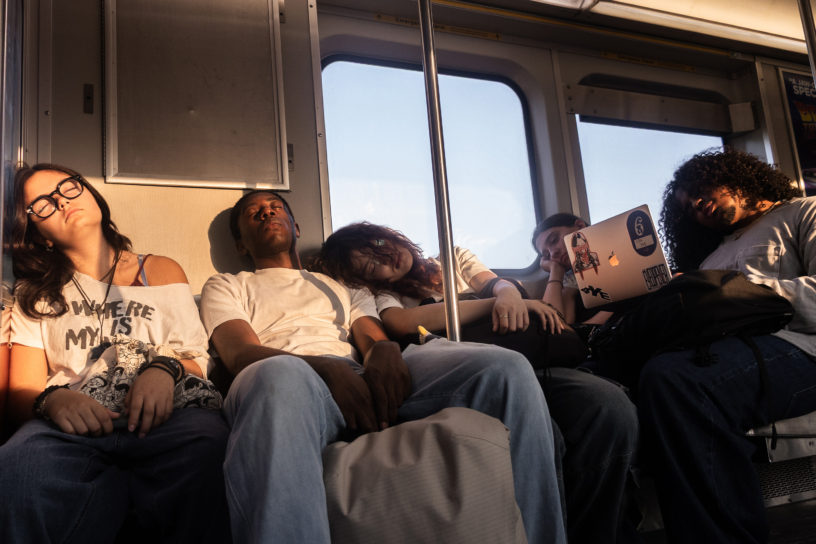
Toronto Metropolitan University (TMU) has a large population of students who live off-campus and commute to school. Commuter students say they have a harder time making friends, dealing with burnout and feeling motivated to engage in campus activities and events.
Commuter students make up 77 per cent of all students at TMU and 60 per cent of students who are disinterested in engaging in campus activities and events, according to a 2019 survey done by StudentMoveTO.
Diana Brecher, the scholar-in-residence for positive psychology at TMU, described burnout in three parts. “It’s [firstly,] the notion of fatigue that comes from caring too much for too long and that’s completely subjective. So what might make you tired won’t make me tired or vice versa,” she said.
Burnout can affect commuter students immensely, though Alexander Hall, a third-year professional music student who commutes one hour from the Durham Region, explains how he has managed to cope. “Sleep is lowkey your best friend…the best thing I’d say for now is to give yourself rest.”
Other students, like Elly Kopyto, a second-year double majoring in criminology and sociology, have found a way to optimize their commute to increase productivity. “If it’s a philosophy class or something, I’ll read my book on the subway.”
Many commuter students at TMU struggle to find a reason to stay on campus outside of class. Third-year chemical engineering student Ryan Harding said he “found it hard to make…deeper connections with people.” He says since students live all across the city, it can be challenging to get together.
The second key part of burnout “has to do with a depletion of empathy and a depletion of compassion,” Brecher continued, sharing that a disconnect can form between friends, colleagues or even family.
Kopyto who previously attended Concordia University explained how, as a first-year student there, they were given many flyers with opportunities to join and engage in campus activities and events but feels TMU has not offered as much. Instead, they simply commute back home after classes.
Brecher’s third key part of burnout “is this decreased sense of accomplishment, where you feel like everything is futile, nothing you do seems to make a difference,” she said.
To avoid falling through the stages of burnout, Brecher outlined a few ways to stay familiar with campus activities and events. For example, events can be found on department/faculty websites such as the faculty of arts page, a list of student groups can be found under the Toronto Metropolitan Students’ Union page and there are plenty of classes and drop-in programs accessible on TMU’s Recreation & Active Wellbeing page.
She also encouraged students to take 20 minutes to do *”some kind of movement or meditation or a combination thereof,” three times a week, claiming many students found a significant amount of improvement in their sleep, mood and energy levels.
Another struggle a commuter student faces is the lack of spaces available for socializing. Harding explained that most of the campus is underutilized by commuter students but these spaces are designed for studying, “I think most of the spaces in TMU could be tweaked a little more for social interaction.”
Despite this, Harding explained that the SLC is a good spot for socializing with friends. A guide to other campus hangout spots can be found on The Eyeopener’s website.
“If you’re smart, you’re gonna figure out what’s essential,” Brecher said. “Finishing that project or writing that exam is essential. Attending that extracurricular activity is probably really important and is going to help you with stamina to keep going.”
*Correction: A previous version of this story lacked clarification for this specific section and has been updated for accuracy. The Eye regrets this error.




Leave a Reply