

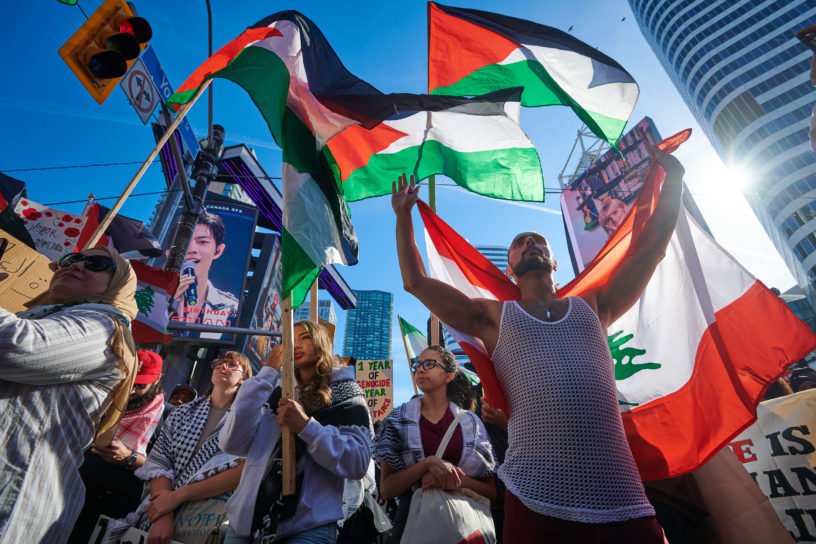
By Negin Khodayari on behalf of The Eyeopener
If this sounds familiar, it’s because we wrote a similar editorial two years ago but felt it needed to be said yet again.
Since Oct. 7, 2023, the ongoing genocide in Gaza has become not only a humanitarian catastrophe but a war on truth as journalists, medical workers and bystanders have also become targets.
Killing journalists is not only censorship—it’s a war crime.
As of September 2025, the reported number of journalists and media workers killed in Gaza alone has surpassed 240, making this the deadliest documented conflict for journalists, according to the United Nations (UN) and Committee to Protect Journalists.
The most recent example is the Aug. 25 Israeli strike on Nasser Hospital in Khan Younis, which killed at least 20 people, including five journalists. The strike is suspected to have been in two parts, known as a ‘double tap’, meaning the first bomb hit, and the second followed just as medics and reporters rushed to help.
This is not an anomaly, it’s part of a pattern.
Journalists are targeted in areas of crisis and war because they get in the way. Their job is to document what those in power want to keep hidden including civilian deaths and demolished hospitals, among other crimes. This threatens the narratives state officials prefer to broadcast, so they’re targeted. This is the most extreme form of censorship which interfere’s with the public’s access to communication and information.
When truth is targeted like this through murders, internet blackouts or the destruction of newsrooms, documents can be tampered with and often lost altogether.
Journalists are civil servants, their job is not to take sides or share their biases, but to let the facts speak for themselves. We rely on them to verify numbers and claims and help hold power to account. When reporters are forced into silence or wiped out entirely, distorted narratives and gossip thrive. In Gaza, where internet access is often cut and foreign media are barred entry, the risk of misinformation is actively happening.
“We rely on reporters to verify numbers, challenge claims and hold power to account”
Article 79 of the 1977 Additional Protocol I to the Geneva Conventions formally protects journalists as civilians. The law is clear: as long as reporters do not take part in combat, they must be granted the same protections as any other civilian. But on the ground, that protection has not held. Dozens of press vests have been found next to bodies. Camera lenses smashed in bombed-out buildings.
Beyond Gaza, Israeli strikes in Yemen have expanded the war zone and further endangered international press. Just last month on Sept. 11, an air raid in Sanaa and Al-Jawf killed 46 people, including 11 journalists, and injured 165 civilians, according to Reuters. Several Yemeni newsrooms reported that entire offices were wiped out. Apart from threatening the media, these attacks also escalate a broader regional war and prove the state’s is willing to expand the conflict beyond Gaza where the crisis continues to worsen.
On Sept. 13, at least 32 Palestinians, including 12 children, were killed in an overnight Israeli bombardment on Gaza City, according to the CBC. Outside of these intentional attacks, famine is also increasing deaths in the region. Al Jazeera reported hunger-related deaths in Gaza as of Aug. 27 had risen to 313, including 119 children. The medical system, already on the verge of collapse, clearly cannot cope.
The total documented death toll in Gaza since October 2023 has exceeded 64,000 as of Sept. 15, with many still unreported. The UN declared on Sept. 16 that Israel is in fact committing genocide in the Gaza Strip in retaliation for an attack from Hamas which killed 1,195 Israelis on Oct. 7, 2023.
With Israel banning foreign media from entering Gaza, it is local reporters and civilians who carry the burden to get locals’ voices heard. They documents scenes and help differentiate truth from fiction. They upload their content through intermittent internet, showing mothers searching for sons under rubble and surgeons operating in corridors.
“Their press vests didn’t protect them. Their cameras didn’t make them bulletproof”
One of them was Anas Al-Sharif, a reporter killed by an Israeli drone strike on Aug. 10 while sheltering in a tent clearly marked as a press area near Al-Shifa Hospital. His death was confirmed by Al Jazeera and added to the list of the network’s killed staff.
It’s not hyberbole to say truth is being targeted.
This is an emergency as there is no more “gray area”—if there ever was.
The world must demand independent investigations into the attacks on media personnel. When we see the same patterns repeating—journalists killed while sleeping, while taking shelter, while working—we need to question the intentions..
And the purpose is clear: to ensure the world doesn’t see their atrocities. To prevent documentation and to erase records because if there’s no proof, the state’s crimes can be buried.
Because to lose journalists is to lose history.
“It’s not hyperbole to say truth is being targeted”
But truth is not only threatened by bombs and bullets, it’s also endangered by those who exploit their platforms in the name of justice but fail to commit to transparency, fairness or accountability.
As the genocide enters its second year, over 200,000 Palestinian deaths or injuries have been documented, according to The Guardian. The estimated toll is much higher, exceeding 600,000 according to The Canary. In contrast, as of Sept. 10, the number of documented Israeli deaths is 1,660, according to the UN. And among the dead are hundreds of people who held cameras instead of weapons, notepads instead of shields.
Their press vests didn’t protect them and their cameras didn’t make them bulletproof.
Truth is under attack and the world can’t pretend it didn’t see it coming.
We at The Eyeopener stand in solidarity with the journalists killed by Israel while they were bearing witness to history. We call for an arms embargo and independent investigation into Israel’s war crimes.







Leave a Reply