

By Jerry Zhang
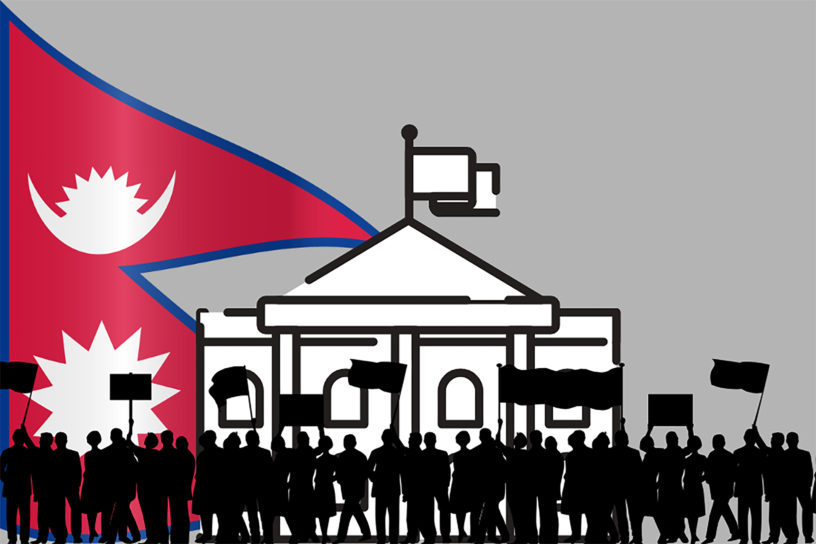
On Sept. 4, Nepal’s decision to ban 26 social media platforms sparked a violent protest that initially left 19 protesters dead—forcing the country’s prime minister to resign on Sept. 9, and the death toll has since risen to 72 as unrest continues under a fragile interim government.
The ban not only cut off communication but also shut down online shops and student-led organizing channels. This revealed just how much young people depend on digital platforms for their livelihoods and activism, according to Abinav Acharya, a political science lecturer at Tribhuvan University in Kathmandu.
While the protests were rooted in widespread political corruption and economic inequality, experts and Toronto Metropolitan University (TMU) students say the ban highlights a broader reality where social media platforms like Instagram, TikTok and Discord are not just entertainment outlets but essential social infrastructure.
In Nepal, shutting down TikTok and Instagram meant more than silencing criticism—it also halted many businesses.
Acharya explained that “most of the youths right now here in Nepal use social media, not just for entertainment purposes but they use it for business purposes as well.”
He explained that while hashtags and campaigns could expose corruption, online tools couldn’t finish the job on their own. “Yes, the digital media protest can be your first step towards a bigger protest…but it cannot completely finish off the movement.”
Rajshree Sharma, a third-year Nepali human resources student at TMU, echoed this sentiment. “It’s not just about Instagram, Snapchat…it’s like businesses too were shut down,” she said, noting that the ban also cut off the already limited economic opportunities for youth as online shopping has now become central to commerce in Nepal.
For many young people, the online space doubles as a space for work opportunities and an emotional outlet. Before the ban, Nepali youths used hashtags like #NepoBabies and mass unfollow campaigns to vent frustration at corruption.
Sharma said online spaces acted as a release valve for young people’s frustrations, giving them a voice. She belieives when that outlet was removed, the protests escalated: “It would not have gotten this bad if they hadn’t banned social media.”
Fion Li, a fourth-year politics and governance student, expressed the opposite—she argued that while the ban accelerated tensions, underlying systemic issues like corruption, inequalities and scarcity of economic opportunities meant protests were inevitable.
“Whether or not they kept Facebook, they kept Twitter, etc., it wouldn’t have changed the outcome,” she said. “You can only prolong things so long before something sparks it.”
The transition from hashtags to street marches reflects a broader trend, according to Kara Brisson-Boivin, director of research at MediaSmarts. “That is the real life, that is the real world to them,” she said. “These platforms are now the spaces through which civic engagement and democracy happen and take place.”
She added that online activism often overlaps with offline organization, citing everyday examples such as students who use WhatsApp to coordinate meetups or TikTok to practice routines together. “It really is interconnected. Young people don’t see the online world as distinct from their real world,” Brisson-Boivin said.
But with opportunity comes risk. Students and experts warned that the very platforms that help build solidarity can also amplify misinformation and create echo chambers. “People are operating as their own news stations,” Li said.
“News is running faster than people can check it,” she added, noting how the rapid circulation can intensify anger on the ground. Li stressed that while social media is a powerful amplifier, it is not the “linchpin” of protest. “People get angry for many reasons, but it’s never going to be social media that did it.”
She goes on to say that policymakers underestimate how much online and offline life have merged. “People are their online lives…online culture is real life culture.”
Acharya sees the Nepal ban as a textbook case of this. “Digital media can showcase the real faces of politicians…it can trigger the moment, but you need people in the streets,” he said.
Brisson-Boivin described social media as a double-edged sword for youth activism.
“On the one hand, it provides [an] opportunity to facilitate and mobilize advocacy, youth activism and all kinds of wonderful causes, from protecting stray cats to environmental activism,” she said. “And the other side of that is the exposure to all kinds of extreme beliefs, to conspiracy theory, to other forms of harmful content.”
She added that the speed and volume of online information can overwhelm young people, opening them up to vulnerability, misinformation and echo chambers. “It’s often like drinking out of a fire hose trying to navigate all that information…we know everything and nothing at the same time,” said Brisson-Boivin.
She added that marginalized youth often encounter more harmful content, leading some to withdraw from activism altogether.
Sharma raised a practical concern: organizing primarily through Discord or other platforms could leave in-person protesters vulnerable. “You never know…you also want to see how safe it is for yourself as well…you can’t protest if you’re not there.”
For TMU students, the Nepal protests highlight how online platforms have become key to youth expression and activism.
Acharya said digital media has given young people a space to voice frustrations and shape politics, but warned that lasting change depends on government action. “Digital media will play a very crucial role,” he said. “But the movement is still not complete…the main causes raised by youths are not yet fulfilled.”
Li noted that Nepal’s unrest is part of a broader regional pattern. “We see little clusters of protests throughout the decades. Like it’s never just one protest. It comes in waves,” she said. She pointed to similar cases across the region where economic hardship and corruption have fueled distrust and pushed activism into online spaces.







Leave a Reply