

By Liana Yadav
Writing is intuitive. It’s at its best when it comes from the heart. Great literature is not great because of the complexity of words or the length of sentences; it is great because it stirs something in the reader and imprints into their mind. In a sense, we all have been writing our whole lives. Essays, emails, long-winded text messages, love letters, dating app prompts, Instagram captions—we can claim these collections of words as our own.
Unless of course, they aren’t.
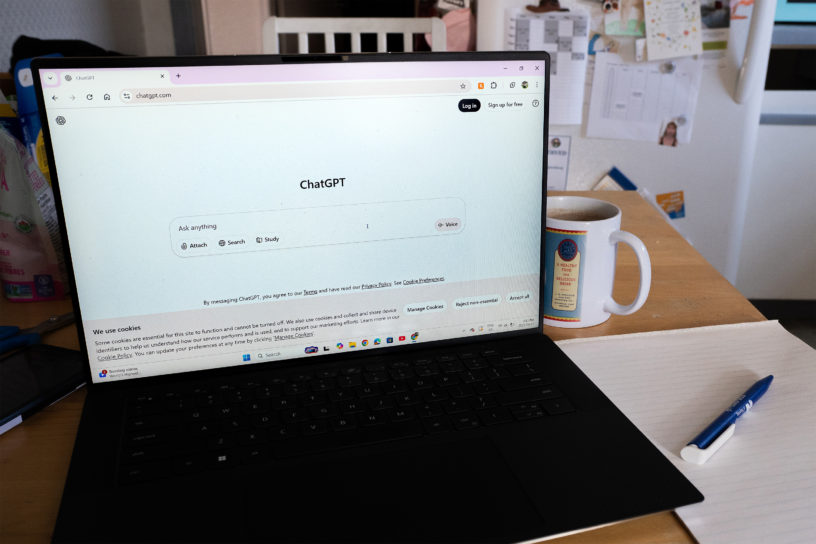
Artificial Intelligence (AI) has permeated much of the digital world. Embedded within online tools we use in everyday life—Meta AI, Google Gemini, Microsoft Copilot—it is marketed to us by their parent companies as a friendly companion that improves our efficiency at no real cost.
As a student myself, the discourse around AI has felt overwhelming over the last couple of years because of the constantly changing attitudes around it. Sometimes, a violation of academic integrity and other times, an important tool encouraged in classrooms, AI is posited to us in different ways depending on who we talk to.
After spending this summer working on my own creative writing project, publishing articles on Substack, coming back to university to discourse on a technology I have actively tried to stay away from in my writing has been a challenge.
Writing for my newsletter, slightly ajar door, on Substack these past few months was a way for me to explore my own mind. I kept the name ambiguous so I could allow myself to explore every topic, keeping the door to every room of knowledge slightly ajar.
This meant that I wrote long-form essays on topics such as the feminist movement in South Korea, the loss of nuance in the digital age, the history of gossip and the need for fiction in a world where stories drive more hope than reality.
It helped me reckon with some truths I often find disturbing, such as the commodication of my attention and its visceral effects on my still developing pre-frontal cortex —but also find hope in these areas.
When I let myself do something creative with volition and not for academic validation, I was finally able to explore places my brain takes me when not forced to rush a dopamine hit or achieve a quantitative goal. The process was often messy and taxing, which made hitting publish at the end of the week all the more rewarding.
Dale Smith, a professor and undergraduate program director in the English department explains that writing gives us possibilities to determine our outlook towards life. It’s a way of “encountering yourself in new ways and also connecting that self to a larger cultural or historical reality,” he said in an interview with The Eyeopener.
Writing has always been a way to attain self-expression, and with the ability to outsource this activity, some professors believe students are losing important skills that are needed beyond university and work. “I notice a lot of AI generated work coming in, which makes, from a teaching perspective, everybody quite exhausted and [apprehensive],” said Smith.
“We’re in a complicated period and I think one of the dangers of AI is it produces an illusion of knowledge and information,” he added.
Shortcuts may get you to your destination, but they significantly change your journey. A study by Cornell University on GPT-3 found that the chatbot produces misinformation up to 26 per cent of the time.
Smith believes that “actually doing the hard work of thinking, criticizing and challenging,” is how one learns in a classroom.
As a business major, Smith’s opinions are far different than the discussions around AI in my classes, where AI tools are posited as important skills we must attain to secure our future careers.
A 2024 study at Carnegie Mellon University found that generative AI improves writing productivity and quality amongst graduate students, reducing their writing time by 64.5 per cent.
But learning doesn’t happen when AI does the work for us, as pointed out by Mathieu Lajante, associate professor at the Ted Rogers School of Management (TRSM). “When you delegate all your power and skills and resources to ChatGPT, it is winning out of this exchange but you’re losing everything…you’re losing a good opportunity to learn, you’re losing a good opportunity to train your skills.”
An intense emphasis on productivity is not necessarily what will help improve the process of learning. Ideas spring to life when we linger in the unknown, when we don’t know the answers so we go looking ourselves.
With generative writing, all outputs are built on what already exists, drawing combinations of pre-existing work. This begs the question: as students, how do we draw the line between productivity and authenticity?
In response to students relying extensively on AI in the previous school year, Joanne McNeish, associate professor at the TRSM, has changed some assignments for this term. Students are now required to complete three handwritten assignments in class after reading hard copy documents they have never seen before. In addition, at least once during the term, they will lead a discussion of the assignment that they submitted the night before class and be asked questions by the professor and other students.
“The initial reaction of students was that they were fascinated to see can they still hand write, on a piece of paper, with a pen, from a document they’ve never seen before,” said McNeish.
When asked if she thinks AI writing is the future, McNeish said, “there is no such thing as artificial intelligence, intelligence is a human characteristic.”
Some advice she has for students struggling with the switch to generative AI is to “be self-reflective and don’t accept the hype phase that AI is in right now.”
McNeish also mentioned, “where you can use it, use it. But where you can’t, don’t and challenge yourself.”
In an attempt to meet students halfway, Lajante has his own approach. Right after his lecture on algorithmic capitalism, Lajante said, “If ChatGPT can help you rephrase and reframe some of your texts, why not?”
“English is my second language; sometimes, I feel safer when I submit some of my texts to ChatGPT to check my English,” he added.
“I learn out of this process because I provided my input first and I can compare what I was writing with the corrections suggested by ChatGPT, and I can agree or disagree with it.” He explained that through this process, he remains in “the driver’s seat,” and is still making the effort to think, work and write, without relying on generative AI.
While Lajante is not opposed to students using AI writing tools, he hopes they “don’t take the opportunity to use ChatGPT as an invite to do everything.”
The professors I spoke to all felt the same way: what we learn from being in university depends on how much we put into it. AI produces the option to do as little work as possible, but it can be helpful if used correctly.
Right now, however, there is a lot of subjectivity around it. How AI is handled and communicated in educational institutions today will have a bearing on our collective futures. And so, as McNeish said, we must use our own judgement by “balancing contradictory sides.”
The art of writing has allowed people to find solace, especially in times of political and social unrest. When powerless and hopeless, people express themselves in their written word. It is how they reckon with who they are and how they fit into the world. That is what makes it a personal, political and creative act. AI is just one of the strong forces at play that I believe can infringe on this form of self-expression.
In her book Remembered Rapture: The Writer at Work, feminist author and activist bell hooks wrote, “We do not write because we must; we always have a choice.” Today, with AI readily available to do the work for us and social media platforms stealing our attention, we have a choice to not write, reflect or communicate.
But as hooks said, “we write because language is the way we keep a hold on life…to connect, to know community.”
As a student, I want anything I create to be an authentic reflection of the times I live in, much more than I want it to be a perfect, lifeless string of words. The classes that have taught me the most have been where I have read difficult texts and spent the time required to rack my brain understanding them.
It is through such messy, sometimes convoluted pieces of creation—words, paintings, dances, songs or theatre—that our ancestors shared their stories with us. AI is not the threat, how we use it is. It matters heavily what we choose to do today. It will shape not just who we become, but what happens to the world. By letting our humanity show through creation, we can shape ours to be another story of survival and hope for future generations.







Leave a Reply