

By Lama Alshami
Ramón Who Speaks to Ghosts follows its titular character as he roams through the volcanic island of La Palma, microphone in hand, searching for the phantoms that linger among the ruins.
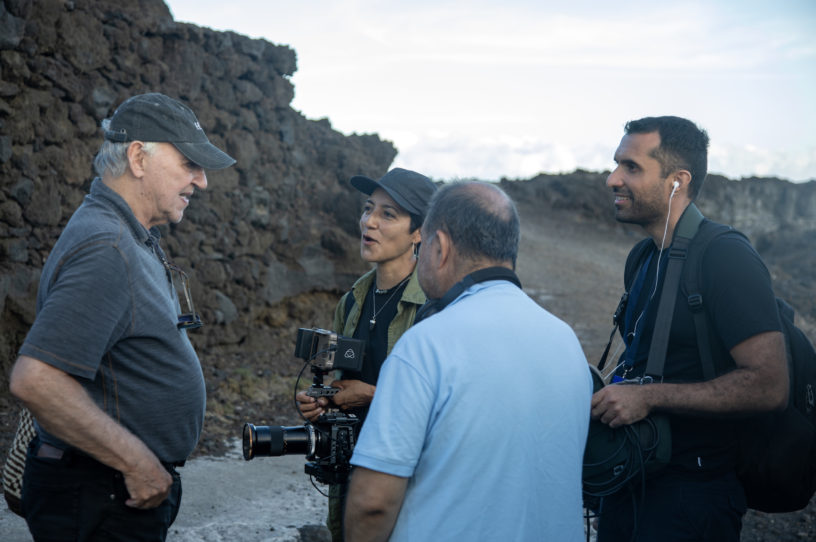
Directed by Shervin Kermani, a graduate of Toronto Metropolitan University’s image arts program, the seven-minute Spanish-language short film had its world premiere at the Toronto International Film Festival.
It was created as part of film production company La Selva’s third film accelerator, led by director Werner Herzog and cinematographer Peter Zeitlinger. The program paired 50 emerging directors and cinematographers together to create works under their guidance that would honour the people of La Palma.
The project was a response to the eruption of Cumbre Vieja in 2021 which lasted for 85 days, destroyed nearly 3,000 buildings, displaced thousands and claimed one life.
Shot in the style of a documentary alongside cinematographer Karla Reyes, Kermani effectively blurred the line between reality and fiction. The film opens with Ramón introducing the viewers to many of the ghosts he is in contact with—the first being his grandmother.
He listens to the love poem of a pirate ghost who died in a volcanic eruption in the 1700s. He watches a game of volleyball played by two ghosts on the beach. His friend, Marcelo the ghost, smokes a cigarette, against Ramón’s better judgement. “This guy doesn’t even have lungs anymore,” Ramón joked.
All the while, we cannot actually see these people who Ramón claims he can communicate with but nonetheless, it feels real. The audience is immersed into the world of Ramón. With his fancy gizmos and gadgets—ghost communicators, antennas and headphones—he shows us a world where the supernatural exists. If I didn’t know any better, I’d say that Ramón really can speak to ghosts.
In an interview with The Eyeopener, Kermani said “the ghost idea was my attempt at finding a metaphor for the disaster.”
Despite its brief runtime, the film carries the weight of a feature, thanks to Pedro Moisés Herrera Concepción’s portrayal of Ramón, who packs raw emotion into every minute on screen.
“He just became the character and he mixed his own personal life with this fictionalized ghost hunter or paranormal investigator persona,” said Kermani.
As the story progresses, we learn about the volcanic eruption that caused Ramón to lose everything.
He tells us the story of his best (ghost) friend, Paulino, who died before meeting his grandson. Breaking down in tears, Ramón insists he’s not crazy—he has feelings just like anyone else. Witnessing the lava bury homes and lives deeply affected him and now he seeks to connect with those who have passed.
Kermani told The Eye that the scene was unscripted. “He was actually having a genuine breakdown about somebody that he personally had lost. So the details of this character who doesn’t get to see his grandchild grow up, was from his own personal life, but he continued with this ghost narrative at the same time.”
As Kermani didn’t speak any Spanish before joining the accelerator, he relied heavily on Reyes for translation. “The fastest way to learn a language is to direct in another language,” he said. “I’m sweating during the takes being like, let me figure out is this the right point to cut? Should I let him keep talking? Is he onto something?”
Interwoven with scenes of Ramón searching for ghosts are interviews with residents of La Palma, each sharing their experiences and thoughts on Ramón.
One musician shows us a large field of ruins—“a black mass,” as she calls it—that used to be full of houses, including her own, all destroyed in the eruption. She explains that Ramón was able to find the sound of her buried piano beneath the lava.
Near the end, a resident’s voiceover plays as Ramón walks through the rubble with a microphone in hand, explaining that by listening for ghosts, he is simply trying to recover what was lost in the eruption.
“I thought that approaching the character through these quirky moments with these different ghosts, was like a misdirection to the audience, so we can fall in love with this character before we realize the tragedy or the tragic reason behind his strange obsession,” said Kermani.
“If you go directly to the tragedy, it doesn’t necessarily give you a chance to fall in love with the character before you realize that they’ve lost something and allow you that moment to empathize with them before you get all the details,” he added.
Kermani said he tested out 500 film titles before eventually settling on Ramón Who Speaks to Ghosts.
“The very first working title was The Phantoms of La Palma. Eventually it changed to Ramón Who Speaks to Ghosts because I realized the movie is a character portrait of Ramón.”
The idea for the film gradually dawned on Kermani as he was location scouting during his first few days on La Palma. Visiting places where lava had submerged entire residential areas, he was struck by the haunting, ghostly atmosphere.
“There was something really eerie about being in that space and seeing the devastation of this huge amount of lava…There was just this thought of this guy with a microphone on this lava, and that became the image that spawned the rest of the movie.”
Perhaps the film’s most poignant moment comes with Ramón’s final line: “Ghosts just want to be heard. They don’t want to scare you,” a feeling that many in the audience could relate to.
This line “wasn’t conscious, it just felt right in the moment,” said Kermani. “It’s related to the ideas of what healing means is often to be heard, not to necessarily have a solution.”
What began as a quirky ghost hunt gradually evolved into a search for memory and connection. Kermani takes risks with verisimilitude, crafting a beautifully resonant short that poetically engages with truth and honours the impact of the eruption.








Leave a Reply