

By Daniyah Yaqoob
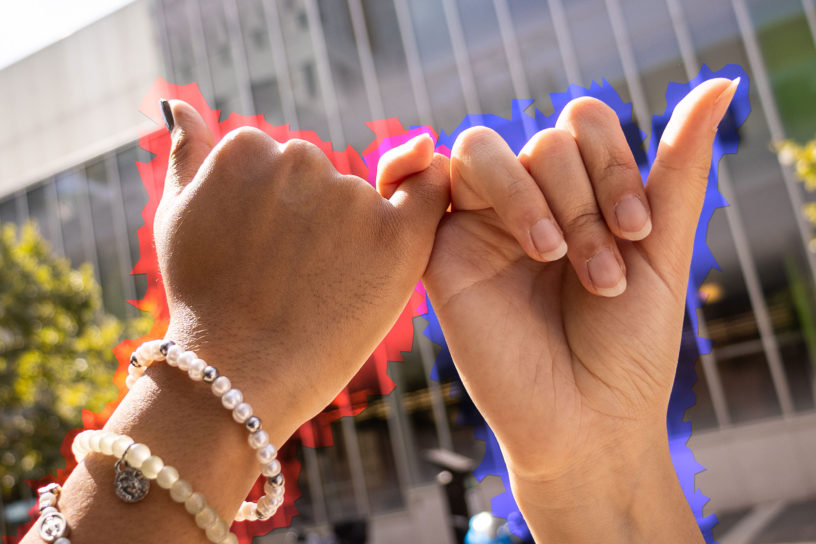
It is no secret that politics can elicit deep emotions, such as anger, sadness and joy. As political tensions rise around the world, students are figuring out how to navigate their personal relationships.
A study from Mental Health Research Canada earlier this year found that nearly half of Canadians have experienced heightened anxiety. Among the top four reasons were “unpredictability” in Canada-U.S. relations and other global events, an indicator that politics plays an impactful role on many.
Students at Toronto Metropolitan University (TMU) are not immune to those political stressors. More than that, many of them accept that politics are intertwined with their existence and therefore, will have personal impacts on them—from how they conduct themselves to who they maintain relationships with.
Ella Oladipo, a second-year language and intercultural relations student at TMU, said her politics are integral to who she is.
“I don’t separate my political leanings from my values because my values inspire my political leanings,” she said.
Oladipo considers themself a decolonial activist and supports love and care for all. But, they said, that doesn’t mean they will hesitate to cut someone out of their close circle over differing political views.
They had made good acquaintances with a peer from a politics class. As Oladipo sat in the Service Hub area on campus with a few other peers, the conversation turned political in nature and quickly heated from there. It was then that their classmate said, “racism is just a buzz word,” and later, “Donald Trump is not a racist.”
Oladipo said it was jarring to hear those words come out of her classmate’s mouth. It made her come to the conclusion they couldn’t continue a relationship any further.
“I don’t feel like I’d be safe around you because, in a moment that is evidently racist, you might defend the racist,” she said.
Now, when she and the classmate walk past each other in the halls of TMU, there is a physical shift. She says her classmate doesn’t make direct eye contact with her anymore and Oladipo prefers the distance.
It’s not just a handful of students who are practicing cutting off from friends, family or professional contacts over political disagreements. An online survey conducted by Research Co. in March found that more than one third of the youngest adults in Canada would choose to abandon a person in their lives over differing views on federal politics alone.
Garv Gupta, a fourth-year computer science student, said they draw the line when someone disagrees on a topic that’s unquestionable to them.
In one class, Gupta met someone she could see herself hanging out with outside of school. When the genocide in Gaza was brought up, she says her classmate openly defended the killing of women and children.
“I feel like that’s not political in the sense of like, it shouldn’t be something defendable,” Gupta said. After engaging in the short debate, Gupta stopped pursuing the friendship and cut communication all together.
There are situations where Gupta thinks it is possible to disagree with someone and maintain a relationship. In debates surrounding immigration, for example, she thinks there might be enough room for nuance and healthy disagreement to learn from each other’s perspectives.
For students like Khalid Abdulwasi, a first-year politics and governance student, allowing political views to impact personal friendships makes no sense.
“People nowadays love to be around people who agree with them and not challenge them for what they say,” he said. “And that’s a bad thing.”
Abdulwasi thinks you need people who disagree with you in your circle and to be able to co-exist with them. As long as they are not forcing their views on you, he said, debates about politics can always be laid to rest.
At the same time, some research suggests that even the prospect of discussing political issues leads people to feel threatened over their views. And when they feel threatened, it becomes natural for strains in relationships to rise.
Abdulwasi believes a sign of a good relationship is that it can stand the test of politics.
“You could still be a good friend even if you don’t believe in the right thing,” he said. In his understanding, your whole personality does not need to revolve around your political views.
Gupta, on the other hand, said while they make new friends without politics in mind, friendships with similar leanings can be more fruitful. Many of the friends they’ve met at punk rock concerts, for example, share a political understanding that strengthens them.
“There’s a commonality,” Gupta said. “That’s cause for deeper friendship, because we relate on something.”
Oladipo said they never believe in cutting someone off all together over politics. Instead, they remove people from their life whose foundations don’t align with theirs—whether that’s followers from their Instagram or people and professors in their in-person circle.
“I think it’s a romanticized view on life to think you can disagree on politics and still be close,” Oladipo said. She asks whether you can ignore that someone votes for a politician who dislikes immigrants, while you’re an immigrant, or someone who supports budget cuts to healthcare, while you’re in need of services and maintain a relationship with them despite that.
“You can ignore that from a privileged perspective,” Oladipo said. “But in the real world, the real effects of politics come into play.”






Leave a Reply