
By Kaitlin Pao
In a world of facial recognition, website cookies and ads that hit slightly too close to home, where do Toronto Metropolitan University (TMU) students draw the line when it comes to their own school watching them?
During the 2025 Toronto Metropolitan Students’ Union (TMSU) election, it became known that OneCard taps can be monitored by campus officials. Then-chief returning officer Tatiana Carrion alleged a running candidate distributed unapproved and defamatory posters of another slate throughout Kerr Hall, claiming OneCard data showed the member entering the building at the time of the posting, as previously reported by The Eyeopener.
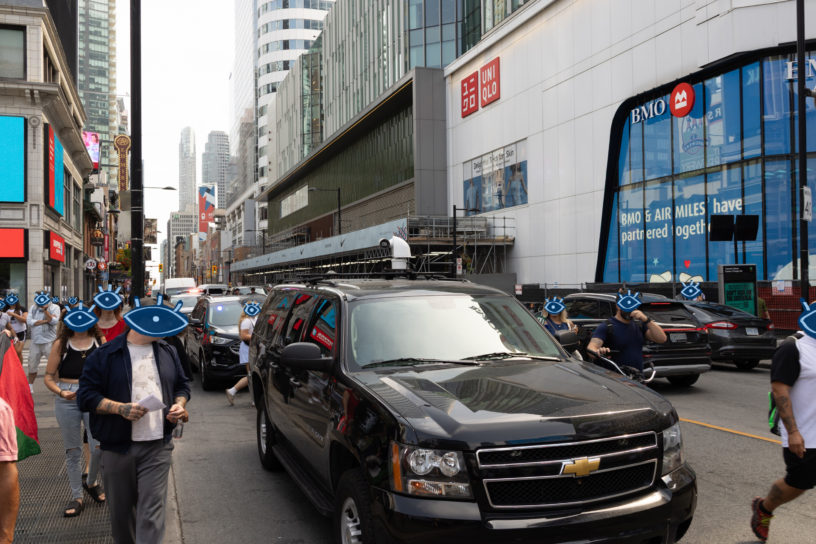
Walking through campus, it’s hard not to notice just how many cameras are watching from above. For some students, the presence of cameras feels less protective and more disturbing.
Sebastian Johnston, a third-year film student, said being watched on campus is “unnerving.”
“Just even at this moment, while I’m chilling at the quad, how obvious the emergency camera is right there, that’s probably looking at me. I think I don’t notice it that often, but when I do,” he said.
Johnston thinks while some surveillance is useful for security, excessive tracking—such as monitoring OneCard usage—is unnecessary and intrusive. He feels security footage should be deleted promptly and that student privacy should be respected unless there’s an incident.
For first-year business management student, Julia Pralat, surveillance on campus feels like a necessity.
“Especially because we’re on a downtown campus, it’s kind of open to a lot of people. I think that it definitely does make me feel safer,” she said. “I would rather have that security than know that anybody could enter [school buildings] and things aren’t checked out.”
First-year fashion student Teela Rodney-Greenidge said that if cameras were intentionally facing bathrooms or athletic facilities, then that would be a larger concern than watching students’ daily activities on campus.
“I feel like [surveillance] doesn’t really change the way I act because it’s school. I feel like everyone that goes to school is just like, normal,” she said.
The Eye reached out to TMU for comment on their use of facial recognition and OneCard tracking technologies, but did not receive a response in time for publication.
However, as shared through TMU’s Computing and Communications Services (CCS) and the Centre for Excellence in Learning and Teaching, the university has been open about the consensual use of facial recognition in specific contexts like student login authentication and virtual exam proctoring—the monitoring procedure for taking examinations online.
Evan Light, an associate professor in the Faculty of Information at the University of Toronto elaborated on what the implementation of facial recognition technology could mean for universities.
“Picture recognition, it’s rolled out in many, many spaces. It’s also not terribly accurate…I’d be terrified if universities started to use it as a way of identifying people, especially as a way to enter your building as an ID card,” he said.
He mentioned how biometric data, such as facial recognition, could reveal sensitive details about a person, including potential health indicators.
Light raised concerns about the prevalence of security cameras themselves, which he argues often operate in a legal grey zone, and are “essentially illegal.”
“Every surveillance camera that’s used should have signage on it explaining that you are being watched and how long it’s being kept for and who you can contact about it,” he said. “This is rarely done anyway. At York University, at the main campus, there’s essentially a sign when you enter saying, ‘just assume you are being surveilled’—and it’s not right.”
His concerns also extend to how constant monitoring shapes behavior, particularly for young people.
“I worry that there’s a decrease in spontaneity, especially for young people…the places where people go and experiment with self-expression, experiment with themselves and people who they want to be with.”
Light warned that constant surveillance could lead to two extremes: people growing numb to constant surveillance, or feeling personally impacted every time they see a camera.
He emphasized that universities—as spaces meant for free expression and challenging societal norms—must remain transparent and minimally surveilled. If these environments become highly controlled, he argues, the same culture of surveillance and lack of transparency could spread throughout society, limiting personal freedom on a different scale.
“If you already have the security footage that you can see when kids are going into the building, I don’t think having our OneCard be tracked should be happening,” Johnston said.






Leave a Reply