

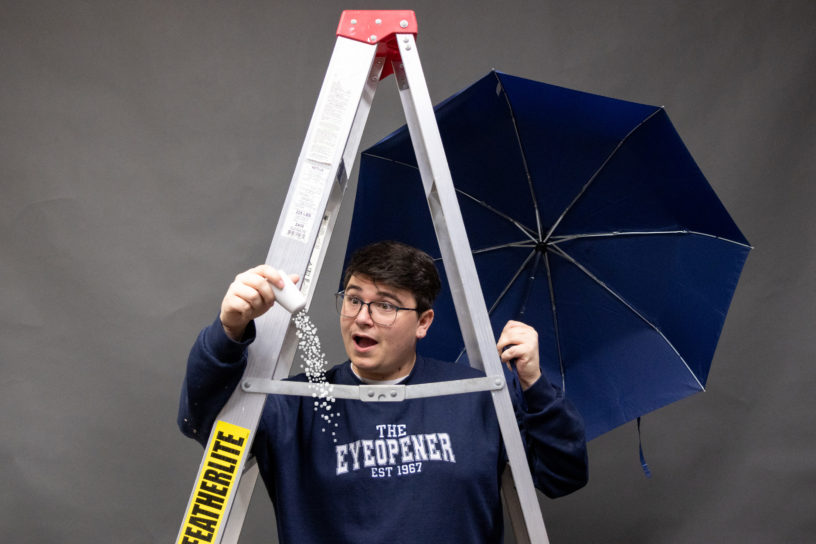
By Ella Oladipo
As midterm exam season ends at Toronto Metropolitan University (TMU), students across campus are crossing their fingers, hoping their lucky superstitions paid off.
Many superstitions stem from tradition and myth, then are passed around as common practice. According to Oxford University Press sources, knocking on wood has roots in animist beliefs that benevolent spirits reside in trees and to stir them is to call upon their protection.
Third-year graphic communications management student, Juliana Nguyen, shared that she has quite a few superstitions. From never letting a pole split the group while walking, to the need for a quick sign of the cross when she passes by cemeteries, Nguyen provided an extensive list of comfort rituals.
“Breaking mirrors, it’s bad luck. Like seven years, so I don’t do that,” she said.
Yousef Ahmed, a first-year engineering student, would have said he didn’t hold any superstitions before beginning undergrad but after his first round of exams he discovered one he plans to stick to.
“I’ve started going to Tim’s on exam day and trying out a new muffin. I feel like it benefitted me the first time around, so now I guess I have my own ritual,” he said.
Ahmed said that no one in his personal life is outwardly superstitious, which he connected to before the stress of university life.
Winta Yohannes, a third-year new media student on exchange, recalled peers in middle school stocked with lucky pens and charms from stuffed animals.
Yohannes herself said she tries to refrain from superstitiousness before tests, leaning more towards diligent study, healthy habits and prayer.
Associate professor at The University of Chicago Booth School of Business, Jane L. Risen, found in the Psychological Review that top-performers of all sectors engage in stern superstitions—from surgeons to athletes to well-prepped students during exam time.
Former tennis player Serena Williams—ranked number one in the world during her time—has her own need-to-do pregame quirks. According to Quirkopedia, it’s commonly known that she ties her shoes the same way and wears the same “lucky socks” that won her the previous game.
The psychological research available on superstitions may surprise some. Risen wrote in the review, that while being superstitious has a tendency to be conflated with irrationality and cognitive shortcomings, there is evidence to show more people than you think hold superstitions.
“Even smart, educated, emotionally stable adults have superstitions that are not rational,” the study reads.
From studies conducted and compiled by Lysann Damisch and co-writers, the idea of performance-boosting superstitions offers a softer take on the quirks of others.
By holding onto superstitious beliefs—that were good-luck associated—people were found to perform better, with heightened self-confidence, the authors wrote.
“[Studies] found that for competitive basketball players, superstitious beliefs and performance are positively related: Superior teams, as well as superior players within a team, exhibit more superstitious behaviors,” they wrote.







Leave a Reply