

By Hannah Sabaratnam
Starting Feb. 1, the Good Food Centre (GFC) will require students to register before accessing the food bank, according to the Semi Annual General Meeting Report released by the Toronto Metropolitan Students’ Union (TMSU) in December.
During the 2023-24 school year, students were required to register by receiving a Daily Bread Food Bank number. The Daily Bread Food Bank is a partner of the GFC and where the majority of the food supply comes from.
However, this changed roughly a year later, when registration was no longer required. The change to go back to registration ensures the GFC receives the amount of food they need from Daily Bread, according to the GFC co-ordinator Rob Howard and the TMSU report.
“We weren’t able to keep statistics on who was using the [GFC] which helps with reports…and showing who’s using it, how many people use it and how often they use it,” said Howard.
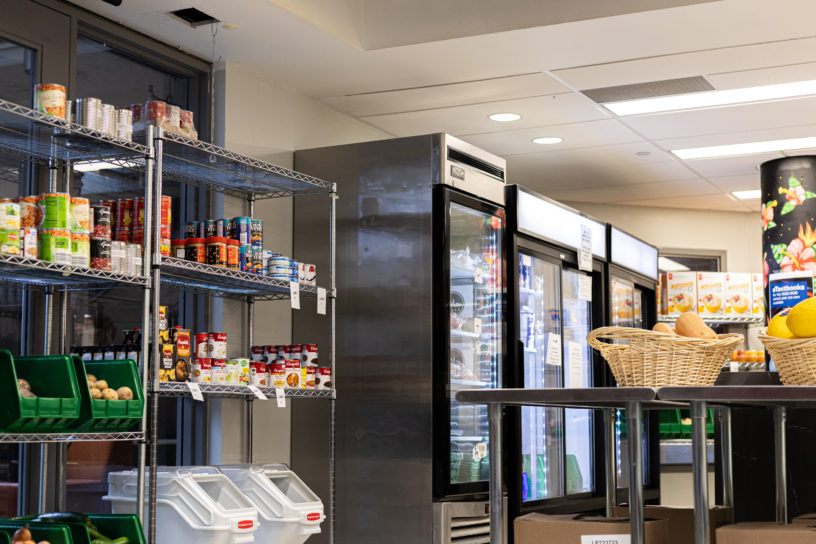
Currently, the GFC is open to all students at Toronto Metropolitan University (TMU). Students can register by setting up an intake appointment online, followed by going to their meeting in-person in the basement of the Student Campus Centre.
The process takes about five minutes, and after it’s completed, students will receive their Daily Bread Food Bank number. This number will give students access to other food banks in Toronto once a week, so they have the option to either receive food from the GFC or a food bank of their choice that may be more accessible to them. Registration also ensures access to the GFC is limited to students who attend the school.
“Since it is student fees that largely keep the GFC going…we want to make sure that it is being accessed by the TMU community,” said Howard.
Second-year fashion student Katherine Stier recently found out about the GFC when a professor mentioned it during class. For them, as long as registration keeps the food bank accessible, they do not see any complications.
“I wish it was more known that we had [a food bank],” said Stier.
Ayden Fortier, a second-year fashion student, also did not know about the food bank.
“Toronto prices, groceries, taxes and everything can be crazy, so having a resource for people who need it is good,” he said.
The partnership with Daily Bread has been beneficial for staff and students at GFC, as they receive a wide selection of foods, such as bread, eggs, vegetables, a variety of meats, including halal options and snacks like granola bars or potato chips.
Daily Bread also provides support for the GFC. Set up like a store, the GFC created their layout based on recommendations from Daily Bread, this way students can choose what they want instead of receiving food they may not need.
Only being in his position since Nov. 3, Howard hasn’t noticed any significant patterns in food bank use.
Interim co-executive director Scott Miller Berry also said in an email to The Eyeopener that TMSU won’t have any accurate data until the end of the winter 2026 semester.
The number of students that have registered for the GFC has increased, which also may be an indication that students are more aware of its operation, according to Berry. Howard and Berry said they have heard from students about the increasing cost of living, which makes the GFC an essential part of the TMU community for those in need.
“[The] cost of living is out of reach for many students…And that cost of living, including food costs, continue to increase and cause more stress,” said Berry.
Stier and Fortier are both from Alberta, where the cost of living is much different than in Toronto. Both agree that access to a food bank is beneficial for students.
According to a report by Daily Bread, Toronto food banks had over 4.1 million visitations between April 2024 and March 2025, and 23 per cent of visitors were students.
“TMSU hopes that we can continue to grow the number of options, number of hours of access and programs to alleviate food security for TMU students,” said Berry.







Leave a Reply