

By Edward Lander on behalf of The Eyeopener Masthead
On Feb. 12, the Ontario government gave us good news and bad news. The good: colleges and universities will be receiving a 30 per cent funding increase. The bad: we’ll be the ones paying for it.
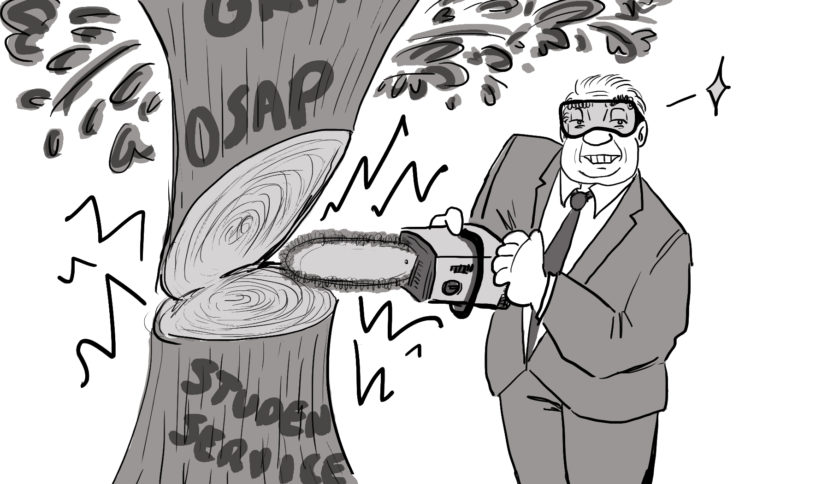
Ontario’s minister of colleges and universities Nolan Quinn announced the province will be lifting a domestic tuition freeze that’s been in place for seven years and overhauling the Ontario Student Assistance Program (OSAP) to give less grants and more loans—dramatically increasing the amount of debt OSAP recipients will leave university with. Quinn said the change will bring sustainability” to post-secondary institutions.
This is all in addition to recently-passed Bill 33, the “Supporting Children and Students Act,” which will make ancillary fees—the fees which fund student groups and services—optional, as previously reported by The Eyeopener.
These two sweeping changes to education in the province must be understood for what they are: an attack on our education.
In the face of this, it’s crucial we don’t remain apathetic—and there’s reason not to be. Students in Canada have a history of fighting education cuts like these—and sometimes winning.
In 2012, students in Quebec brought down a massive tuition hike imposed by their provincial government.
In the face of economic troubles following the 2008 financial crisis, the Quebec Liberal government of Jean Charest wanted to cut taxes and red tape to encourage investment in the province. To do so, they slashed the amount of provincial spending on universities and offloaded the remaining costs onto students in the form of a 75 per cent tuition increase.
Following months of organization among students’ unions and societies, they elected to strike indefinitely until the hike was reversed. Over the course of a semester, they ditched classes and organized demonstrations against their government until Charest came to realize students would not accept the hike.
When anti-protest measures failed, Charest called a snap election and made his campaign promise one of “law and order” against the chaos of the student protests. Charest lost, a new Parti Québécois government was elected, which canned Bill 78 and froze tuition at the pre-Charest figures.
Tuition for domestic students in Quebec remains among the lowest in Canada, according to Statistics Canada.
While the students in Quebec were facing a 75 per cent tuition hike, high above what the Ford government is presenting us with (two per cent per year, according to the province), we are facing something they weren’t: a gutting of student services in the form of Bill 33.
Universtiy is more than academics, it’s also the groups and societies which surround them. To defund these—even partially—is an effort to turn universities into degree mills, not the spaces for meaningful discussion we need for the health of our democracy.
However, we cannot entirely blame students if they choose to opt out of these services given the opportunity. The cost of living is higher than ever and youth unemployment is skyrocketing nationwide. The youth unemployment rate hit 16.5 per cent in August, the highest in decades, according to the provincial government’s figures.
Broke students aren’t the ones to blame here. The person to blame is Doug Ford, who has been underfunding Ontario’s post-secondary institutions for years. According to the provincial government, Ontario has had the lowest per-student post-secondary funding of any Canadian province—providing around half as much funding to students as the average province.
We wouldn’t be forced to pick and choose whether to fund academics or student services if there was enough money for both.
We’ve seen time and time again that this government does not listen to appeals to their empathy. When a reporter brought up the hundreds of concerned calls Ford has received over the OSAP cuts, he responded by encouraging students not to enroll in “basket-weaving courses,” and suggesting students are spending their OSAP funds on “fancy watches and cologne.”
This isn’t the first time Ford has come for post-secondary funding.
In 2019, the Ford government made a 30 per cent cut to OSAP, according to the Canadian Federation of Students. They also introduced the Student Choice Initiative, a bill similar to Bill 33 which also made ancillary fees optional, as previously reported by The Eye. The bill was only scrapped when an Ontario court found it had not followed correct procedure. Bill 33, on the other hand, is watertight.
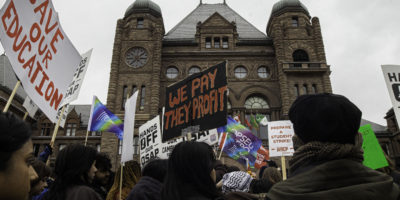
We can’t rely on the courts this time—only on student action, the kind that worked in Quebec.
The protests in Quebec didn’t come from nowhere. These students were inspired by movements like the Arab Spring and Occupy Wall Street in 2011. Months of organization took place, students created committees, held assemblies and democratically elected to strike. At its core was student democracy—without the interest and direct participation of average students, it likely would not
have materialized.
We too have examples to follow. Many students in Canada have been engaged in a yearslong fight against our universities’ investments in companies contributing to the genocide in Gaza. The Palestine solidarity encampments were some of the largest student mobilizations the country has seen in decades. We know that when it matters, students aren’t apathetic. And right now, it matters.
OSAP kickstarts students’ futures and helps make Ontario the “place to grow” Ford spends his time saying it is. Less grants and more loans will saddle students with insurmountable debt and place education entirely out of reach for others. The tuition increase, may seem marginal now, but it will pile on year-after-year, hitting students’ wallets hard.
The situation we are in today closely parallels 2012, where both the provinces and the federal government under Stephen Harper were enacting massive programs of austerity—cutting public services in the name of balancing the budget. Now, in the face of economic uncertainty caused by tariffs, our governments are doing the same and offloading the costs onto the most vulnerable members of society.
Prime minister Mark Carney has already promised five per cent cuts to public services this year, 10 per cent the next and 15 per cent the year after that—amounting to billions of dollars. Canadian Union of Public Employees (CUPE) national president Mark Hancock said in a press release last year that “not even Stephen Harper could dream of cuts this deep.”
We are entering a period where we’re going to be told we need to pay more and expect less.
We can sit idly while our provincial and federal governments dismantle the institutions and services we’ve relied on for decades—or we can stand up to them. The more we accept austerity, the more they’ll throw at us. It’s on us to draw the line.






Leave a Reply