

By Kyla Pugen
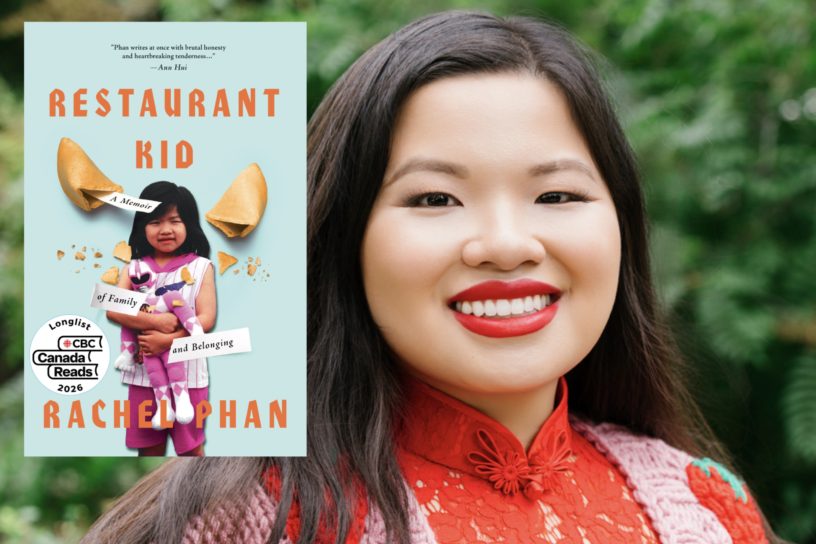
Before Toronto Metropolitan University (TMU) alum Rachel Phan was a celebrated author on the Canada Reads 2026 longlist, she was a self-described “restaurant kid” from small town Southern Ontario. Phan’s childhood was centred around the May May Inn–a Chinese restaurant in Kingsville, Ont. that her parents opened in 1991.
For Phan, the trajectory from the corners of the May May Inn to the newsrooms of TMU’s Master of Journalism program (Class of 2013) has come full circle.
Phan’s parents immigrated to Canada from Vietnam in 1978, fleeing the persecution of ethnically Chinese (Hoa) people in the aftermath of the Vietnam War.
While the restaurant was a symbol of achievement for her parents, Phan describes it as “both a blessing and a curse.” Growing up in Kingsville, she was one of only two racialized children in her class.
The conflict between being the “good daughter” at the restaurant and the young woman longing to find her own voice is explored in her debut memoir, Restaurant Kid: A Memoir of Family and Belonging.
Today, Phan’s personal history has become a national bestseller being debated as one of the most important books in Canada right now.
Phan credits her time at TMU, specifically her time working at On The Record (then called The Ryersonian), with giving her the tools to transform her personal stories into professional narratives. “I feel like I’m the writer I am today, I’m the person I am today, because I went to school at TMU,” Phan said.
Phan described the nature of writing as “inherently a very isolating activity.” It was through her time at TMU that she learned about feelings “of camaraderie and the collaborative spirit…It taught me that you don’t have to do this on an island.”
These lessons proved to be crucial to navigate a publishing industry she described as “opaque” and stressful. By learning to view fellow writers as collaborators rather than competitors, she was able to find the support system necessary to be able to write such a vulnerable memoir.
Phan noted that the racism she experienced was often tied to an exhausting pressure to cater towards the white gaze. She recalls receiving messages from peers who projected their stereotypes onto her, “I was getting messages from my peers about ‘oh I saw a Chinese girl in this XYZ, whatever movie or show, are you like this too?’”
“I just thought this is what I have to be if so many people are telling me this is what an Asian girl is,” she reflects. “I might as well be palatable to them in this way, because this is how they’ve told me that they can digest [me].”
She describes the sense of a “pushpull” relationship, between feeding into what those at school wanted and what her parents at home wanted. She felt as though she was receiving the same underlying message of how “you can never live as yourself or be yourself, because others are expecting you to be a certain thing.”
The diverse environment of TMU and Toronto provided Phan with a sense of safety she had not always felt in her youth.“Moving to Toronto and going to TMU, it’s the first time where people didn’t make racist jokes about me,” she reflects. She was around 24 years old at the time.
Through these experiences Phan finally felt as though she was “not in defensive mode…expecting a barbed comment, I was actually free to be myself and to figure out who I was.”
Finding this freedom allowed Phan to tackle the rawness required for her debut memoir. She describes the writing process as a “deep dive into [her] dirty laundry,” sometimes questioning why she was sharing so much of herself.
The vulnerability wasn’t just about her family. She also explored topics surrounding reclaiming her identity—particularly her sexuality and desires—that had been suppressed by the small-town “good girl” narrative.
Phan said that during her writing process she would often perform what she calls a “gut check” and see whether she was “really comfortable with this out there.”
Phan’s work on this memoir was met with a level of national recognition rare for a first-time author. She describes the news of being longlisted for CBC’s 2026 Canada Reads as a shock and a moment of profound validation.
“It was such an honour for me,” Phan said, noting that an author is never really sure what kind of attention a project will receive. She also reflected on how the personal risk of creating something so vulnerable was worthwhile. “Maybe it’s reaching people who need to read it,” she said.
The 2026 longlist “was just such a huge honour, especially for this year was a bit of an interesting year because of the fifteen books, eight were written by Asians.” Seeing her name alongside close friends and peers in the Canadian literature scene “was just like a huge bonus too.”
It also reinforced her belief that the restaurant kid experience is not just niche family history, but a deeply profound Canadian narrative that represents the backbone of communities across the country.
Ultimately, Phan hopes Restaurant Kid will showcase the “mom and pop shops across the country,” because “they’re the lifeblood of so many of our communities.”
Through her journey, Phan has proven that embracing vulnerability can be a driver for important conversations. Phan hopes to continue on this path as she is set to release her second book in the fall of 2026.






Leave a Reply