

By Jasmine Makar
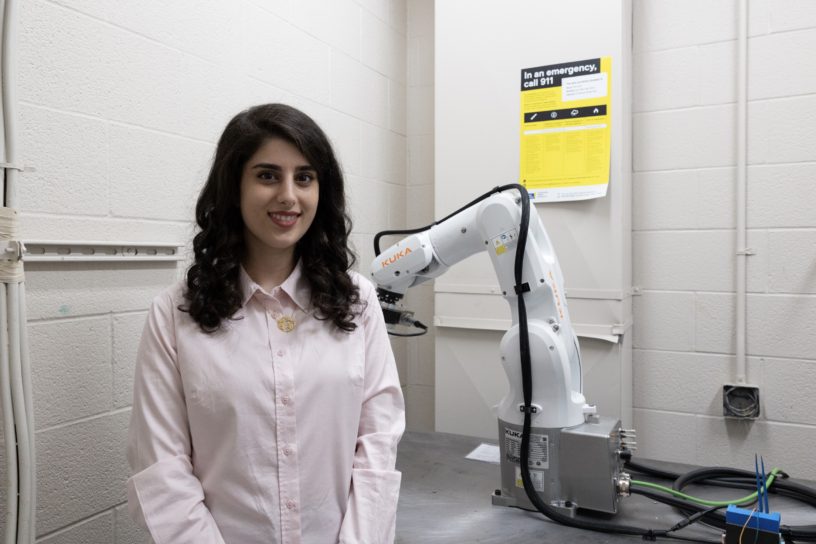
Toronto Metropolitan University PhD candidate Haniyeh Altafi is developing a robotic arm designed to perform remote surgeries to help healthcare shortages in rural areas around the world.
The fourth-year mechanical engineering and robotics PhD student is mainly focused on developing a way for doctors in larger cities to be able to perform surgeries without having to travel, while shortening patients’ wait time for adequate care. She describes her largest hurdle in this project to be the internet and other issues that arise in such a high-stakes environment.
“Even milliseconds of delay can have a detrimental effect on the patient. So we have to make sure our system is reliable in a remote location working perfectly,” said Altafi in reference to internet delays.
Altafi admitted that this problem is more or less inevitable, but she is looking at what “other things we can do to make sure the procedure is done safely.”
She was initially inspired by her own experience with rural healthcare. Altafi’s grandmother suffered from breast cancer while living in a rural area in Iran. The healthcare options in the area were sparse, and by the time she had gotten a hold of a doctor, it was too late.
While robotic arms that conduct surgeries do exist in the field already, Altafi’s version will have the ability to perform it remotely, opening up new possibilities.
“So da Vinci robots, in 2025, added this feature of force feedback, but they’re not working in a long-distance or teleoperation system. There they are in the same room,” she explained.
Da Vinci were cleared by the U.S. Food and Drug Administration (FDA) in 2000 for operations, but the surgeon controls them within the same operating room. The main goal of this three-four armed robot is to increase the dexterity of the surgeon and the general range of motion for hard-to-reach areas, according to the Cleveland Clinic.
Altafi is currently working on a “force feedback” feature in her robot that the da Vinci robots also possess.
“What that means is that whoever is running the operation will be able to feel what it’s like. When you’re working with your hand…you can feel if it’s soft, if it’s solid, rigid, or any kind of texture. But when you’re working with a robot, you cannot understand how much you’re pushing and how much force you’re putting into the system” said Altafi.
Altafis robot is still in the testing phases and is waiting for ethical approval. She is currently working on inviting participants to experiment with the robot and gather the data to be able to modify the prototype.
Kourosh Zareinia, associate professor in the department of mechanical, industrial, and mechatronics engineering, has been Altafi’s research supervisor for the past four years having first-hand experience with robotic surgical arms.
Zareinia started getting involved with the project neuroArm in Calgary following his PhD. According to their website, neuroArm is “a global first MRI-compatible image-guided robot for brain surgery.” Following that experience, he continued research in similar fields. Both Altafi and Zareinia emphasize that despite the robot being prototyped now, there is still a lot of work needed before they bring this arm to the market, it will likely take several more years.
“Usually, these types of research that are done, are the base for future developments and improvement [for] those robots. So if you do something today, let’s say you design a new needle, for example, today it gets to the market after 10-15 years,” said Zareinia.
He stressed the need for extensive testing given the ambitious nature of Altafi’s project.
Existing robotic systems do not take into account internet and communication problems because of the close proximity of the surgeon and robot, but in this case, “doing teleoperations from a distance where the quality of the communication tunnel and delay become important,” said Zareinia.
He also spoke to the complexity of skills needed to a design such a concept, especially with its niche technicalities. “In robotics projects, you need to know a lot. You need to know about mechanical engineering, about materials. You need to know about programming computers, programming electrical circuits, and many other stuff and obviously, no one has all these skills.”
In 2025, the median wait time from a referral to treatment was 28.6 weeks, and across 10 provinces in Canada, patients waited for 1.4 million surgeries, according to the Fraser Institute. The Canadian Journal of Surgery also states that despite at least 18-30 per cent of the population living in rural areas across the country, only 8 per cent of general surgeons work in rural hospitals, leaving a disproportionate gap.
“Because of the volume of the patients and the population that grows and the need for more doctors, we get to a point [where] not all these procedures can be performed by humans…so we have to move towards that.”
Ontario urologist and member of the Society of Rural Physicians of Canada, Dr. Emmanuel Abara is optimistic about this technology.
His medical practice mainly focuses on “using technology like telemedicine and has established satellite rural urology clinics in Northern Ontario for teaching and mentoring.”
In regard to the future of remote surgeries, Abara believes that it is appropriate to introduce this type of innovation if the technology is available and there are resources to fund the service.
“Certainly, it is beneficial, because they don’t have to necessarily leave their home to go to downtown Toronto… or any of the big cities like Ottawa to receive care. They could receive care at their very community using telemedicine or tele-robotic technology,” he said.
Abara adds that the technology must be well-conceptualized, weighing the benefits and risks, and believes that consistent maintenance is crucial to sustainability. Despite being a “downtown person” now, Abara grew up in rural areas and is aware of the challenges rural areas face in terms of adequate healthcare.
“This is one aspect of technology that should be utilized, because in terms of building equity… making [care] easily available, this technology can actually help us,” Abara said.
Abara reflects on his excitement about this technological development and the importance of giving rural communities proper care. “If we really want to be honest with ourselves, then it is important for us to get involved, share the concerns of rural communities, and meet their needs.”







Leave a Reply