

By Rogene Teodoro
Toronto Metropolitan University’s (TMU)’s fashion program and urban farm opened an exhibition on January 21, showcasing their work ‘The Flax Project’.
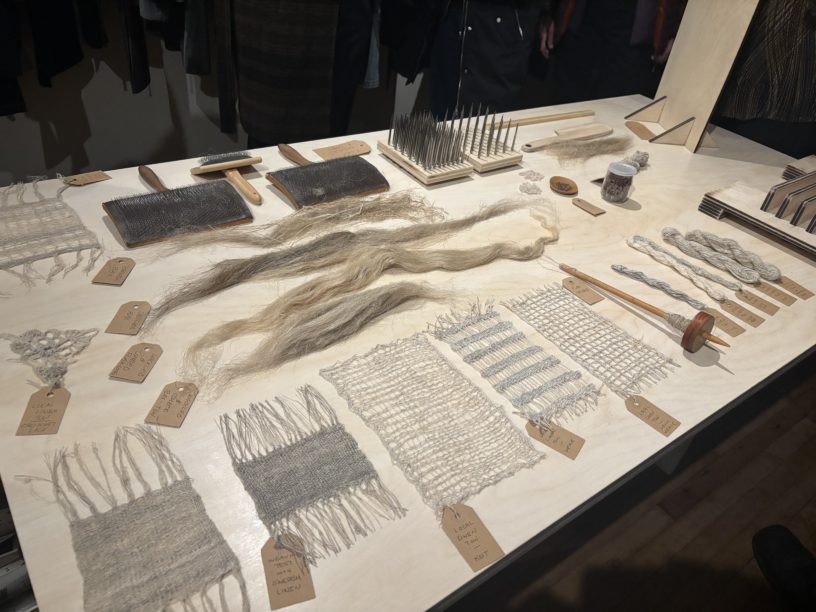
The exhibition explores the roots and revival of manufacturing linen from flax.
‘The Flax Project’ began as an extension of professor Rachel MacHenry’s Natural Dye Garden at The Urban Farm Living Lab. The plants were used for a natural dye workshop course, appealing to students interested in sustainable fashion practices.
Mika Soetaert, a fifth-year fashion student, got involved in the project through MacHenry’s natural dye class. With family from West Flanders, Belgium, she grew up around flax farms.
“I was talking to my relatives about this project, and learned that I do actually have direct ancestors that worked in linen production,” she said. She felt The Flax Project was her chance to further explore her own cultural history and allowed her to grow closer to her homeland.
The production of linen is a time-consuming, but collaborative effort. Soetaert said understanding the amount of labor that goes into making linen was eye opening. “We’d been working on this project for essentially a year and a half before [the team] actually got any textile samples,” she said.
The tools the team used are the same tools “that have been used for a millennium,” a flax brake, a skutching board, skutching knife and a set of hackles. Soetaert shares she enjoys knowing that “we still make things the same way…using knowledge from thousands of years ago.”
TMU Urban Farm’s operations coordinator Jess Russell said she is passionate about proving farms can do more than just provide food.
“We’re growing medicines. We’re growing traditional Indigenous plants. We’re growing pollinator plants, flower crops, and then we have this little demonstration garden that shows that plants can also be turned into dyes and fabrics,” she said.
Soetaert added that linen production in Ontario was once abundant. She says The Flax Project proved that especially with a large team and enough funding, “there’s really no reason why we can’t have our own local linen textile production in Ontario.”
MacHenry explained in a statement that the flax seed variant used to manufacture linen has few growers in Canada.
MacHenry said the project has been a way for people to put sustainability ideas into practice. She feels hopeful that it is “possible to raise and forage” plants in Ontario that can be incorporated “within local and circular production systems.”







Leave a Reply