

By Jerry Zhang
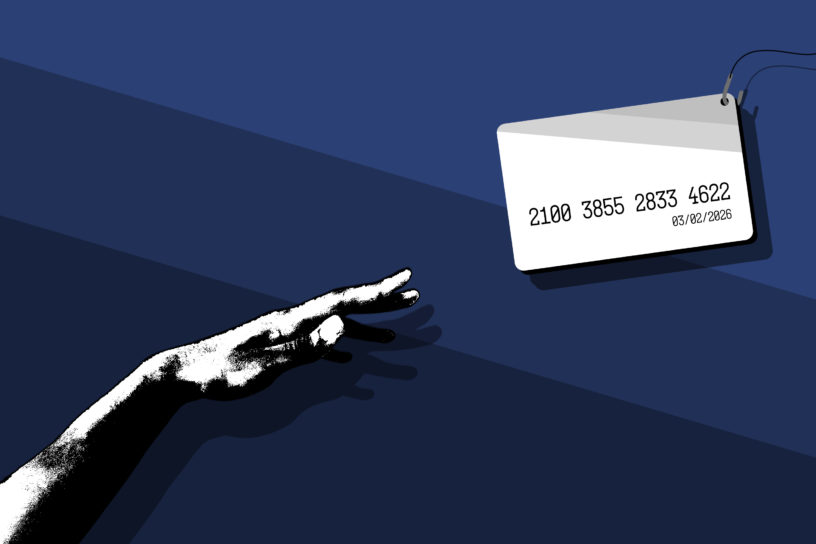
As the economic landscape grows more uncertain, some Toronto Metropolitan University (TMU) students say managing credit has become harder, describing the system as emotionally taxing and increasingly unforgiving.
Data from TransUnion, a credit reporting agency in Canada, suggests these concerns are not unique to TMU students. The 2025 report stated that Gen Z has lower than average credit scores, but experts say this reflects broader economic and institutional issues rather than just reckless spending.
Wyatt Ewart, a third-year mechatronics engineering student, got his first credit card a year ago. He expected clear guidance from his bank but instead was left with more questions than answers.
“Even to this day, I don’t really know how much I should use my credit card,” Ewart said. “I’ve always gotten very different opinions.”
Some told him to use no more than 10 per cent of his credit limit—others advised him to use the card for every purchase and pay it off in full. He said both sounded confident in their advice.
This uncertainty shapes how Ewart interacts with his credit card, making sure to pay his balances immediately and avoiding relying on it heavily.
Even as rising costs have forced him to cut back on food spending and sometimes skip meals, Ewart said he remains unwilling to rely on his credit card.
According to Cristián Bravo Roman, a professor and the Canada Research Chair in banking and insurance analytics at Western University, the increasing pressure on credit scores is further amplified by the “K-shaped” economy, where higher-income earners gain faster, while early-career workers face higher pressure due to rising costs.
Some students said they understand the unforgiving nature of the credit system.
Kyle Kim, a second-year business management student, said his credit score is in the high 700s.
“As soon as I turned 18, I got a credit card,” Kim said. “And then I started spending it, but not too much, because I know that’s the fastest way to raise it.”
Kim said research and financial discipline have helped him avoid debt-related stress, which he sees among his peers.
“I think they just didn’t learn it ‘cause schools don’t really teach that,” he said. “People are paying it off paycheque by paycheque, and it’s just so sad to see that at an early age.”
Kim said he went through a trial-and-error phase to secure his confidence in his credit.
“Originally, when I first got it, I thought, the more you spend, the higher [the score] will go,” He said. “But I later found out that the less you spend, the better.”
Some students say the knowledge gap needs to be addressed earlier.
Arin Hincer, a fourth-year film studies student, said she wants financial literacy education to be taught before post-secondary.
“This is the important thing that we should be learning in school,” said Hincer.
“You’re slowly going into your teen years and then adulthood. [All of a sudden, it’s] here’s what a credit card is, here’s what not to do, here’s how you pay it off.”
Hincer said she actively avoids using credit because the delayed repayment makes her anxious.
“I see how it could be a very slippery slope,” she said.
Hincer added that the delay between purchases and seeing her balance update makes overspending inevitable and prefers paying with cash or debit to stay grounded.
“I have X amount of money right now…I could ration this [amount of money] off, and then I’ll pay [for it] right now,” she said.
Given the current economic conditions, her goal of financing a house feels unattainable, leaving Hincer reluctant and pessimistic about building credit.
“The goal post has just been moved so far away…we can’t even see it,” she said.
To Hincer, pessimism can drive spending. While some may label it irresponsible, she sees it as a coping response to a bleak future.
“I’m probably not gonna…have a house,” she said. “So I’m just gonna buy this purse now because that’s gonna make me happy now.”
Experts say these students’ experiences reflect structural issues in how credit is assessed. Gail Henderson, Allgood Professor in Business Law at Queen’s University, said credit score models tend to penalize borrowers with a thin credit file, unstable income and shorter financial histories, which are common characteristics among young adults and early-career borrowers.
“Mistakes can have bigger consequences where you don’t have a cushion,” said Henderson, explaining why score volatility has a disproportionate impact and is pronounced early on.
Despite the turbulent economic landscape, Bravo Roman said credit outcomes are still driven primarily by individual behaviour.
“It’s not really dependent on your income as much as your financial behaviour,” he said, pointing to steady payment and moderate utilization to strengthen the credit score.
While financial literacy is often framed as the solution, Henderson said education alone cannot compensate for structural gaps. Credit stops being helpful when borrowers are forced to rely on it without any realistic path to income growth.
“If you are constantly borrowing…and your income isn’t increasing, then that debt is going to put you in a hole that you’re maybe not going to be able to climb out of,” she said.








Leave a Reply