

By Lama Alshami
Toronto International Film Festival’s (TIFF) decision to reinstate director Barry Avrich’s documentary, The Road Between Us: The Ultimate Rescue, after initially being withdrawn, ignited calls for increased transparency in how films are chosen for the festival.
Avrich’s film centres around a retired Israeli general, Noam Tibon, rescuing his family during the Oct. 7 attacks in 2023.
After the film’s reinstatement, multiple pro-Palestine organizations posted calls on social media to boycott the documentary due to the main subject of the film being involved with the Israeli Defense Forces (IDF). Among those groups is GTA Boycott for Palestine, a cross-riding collective organizing within the Boycott, Divestment and Sanctions (BDS) movement.
They called for a boycott of Israeli films by TIFF and audiences. The Road Between Us was the main focus of the campaign “due to the fact that it showcases a war criminal and was added as part of a highly problematic, non-transparent pressure campaign.”
However, they still left the decision to attend TIFF to the audience, as there were Palestinian films that they believed the community would want to support.
According to a Human Rights Watch report from April 2001, during Tibon’s command of Israeli forces in Hebron in the West Bank, the IDF carried out unlawful killings, extrajudicial executions, wide-scale collective punishment and indiscriminate gunfire into civilian areas.
The report further stated that Tibon had a clear bias in favour of protecting Israeli settlers, as he stated in an interview from May 2000, “Let there be no mistake about it. I am not from the U.N. I am from the Israeli Defense Force. I did not come here to seek people to drink tea with, but first of all to ensure the security of the Jewish settlers.”
On Aug. 23, GTA Boycott for Palestine called for people to take action through an email campaign to TIFF.
They had four demands: immediately pull The Road Between Us from the lineup, as well as any film tied to the Israeli state or individuals endorsing genocide, adopt the Palestinian Academic and Cultural Boycott of Israel guidelines developed by the BDS movement, engage in meaningful dialogue with the Palestine solidarity community to address the damage that was caused and establish transparent policies and accountability measures to protect against anti-Palestinian racism, guaranteeing no bias or donor influence.
Throughout the duration of the festival earlier this month, none of these demands were met. As of Sept. 30, no demand has been met.
An organizer with GTA Boycott for Palestine* said in an interview with The Eyeopener, “We want [TIFF] to understand our point of view and make sure that in the future, there is a more just and representative, transparent and accountable process in place.”
But some students at Toronto Metropolitan University (TMU) were still disappointed with TIFF 50’s programming decisions.
Jacob Sillick, a third-year psychology student at TMU, doesn’t agree with the choice to reinstate Avrich’s documentary.
While Sillick went to several screenings at TIFF, he made sure to avoid The Road Between Us, opting to watch the three Palestinian films instead.
After attending a screening of The Voice of Hind Rajab (2025), he recalls sitting in the theatre and feeling so defeated. “It was just devastating to me…and that one really just struck me to my core,” he said.
Sillick believes that institutions like TIFF have a lot of power and influence on people as they decide what gets shown, so they have a responsibility to take a stance when curating their programming.
“Yes, I think perspectives are important, but it’s also important to recognize genocide and understand that, yes, that is another perspective on the issue, but is it really something that we need to see or promote?” he said.
Maria Hogan, a fourth-year media production student, said “I think to uplift a state that’s harming so many people can be seen as insensitive, especially at this time. So I totally understand the reaction.”
She added she is interested in researching how films at TIFF are chosen and being a little more critical in the content she consumes. “I assume they don’t want to be biased in any way. But at the end of the day, we’re living in a world where whatever you do has an impact. It really does. And people consuming that content has such a big impact.”
Avrich is a former board member of TIFF and a long-time donor to the festival.
The organizer said to The Eye, “We wanted to raise awareness about this wider issue of the need for transparency on programming and to make sure that it’s not affected by donor influence with certain political agendas, and of course, propaganda.”
They mentioned this wasn’t the first instance where bias was shown to Israel.
In 2024, TIFF screened the Israeli film, Bliss (Hemda), funded by both the Israeli Ministry of Sport and Culture and the Israel Film Council, according to the film’s trailer. In August, the chairman of the Israel Film Council stated in Hebrew on Israeli news channel i24, referring to Gaza, “With this enemy, it’s just like using a lice comb. Just kill them, exterminate them.”
The organizer said, “There’s clearly some donor influence or external influence on TIFF’s programming, which means it’s not entirely independent.”
They added that this is problematic not just for the Palestinian cause, but for all future TIFF programming. “For a festival that’s partly funded by taxpayer money, it is highly problematic for it to not be independent and for the programming to be politicized through donor money.”
The organizer explained that she herself emailed TIFF multiple times since October 2023, “because I personally have always believed in the message that TIFF holds and the power of art in raising important social and political issues…and I was extremely disappointed when, after Oct. 7, it was clear that all of their actions and statements have been somewhat swayed by donor pressure.”
TIFF did not respond to The Eye’s request for comment.
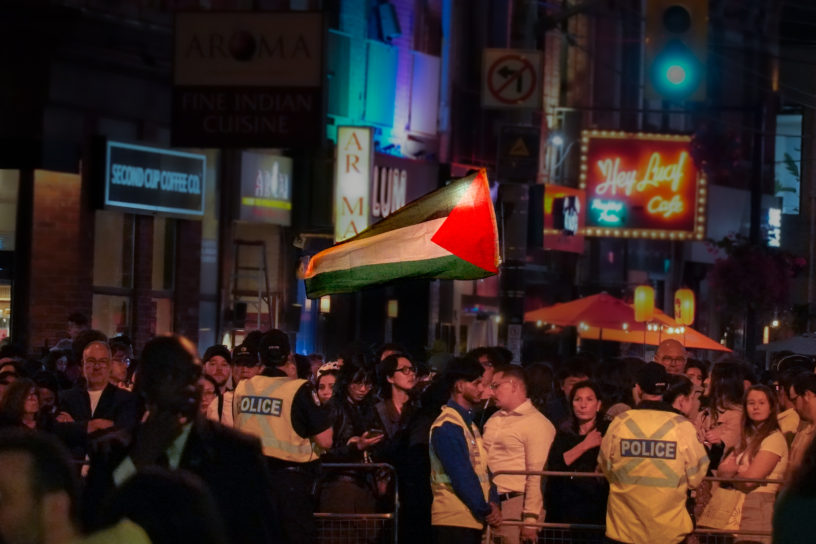
During the festival, GTA Boycott for Palestine was part of a multi-group effort in handing out flyers, projecting messages at TIFF Lightbox and doing a silent march.
The organizer said that TIFF staff asked them to move away from the main area of the festival and head towards Peter Street as they were passing out flyers, while police tried to intimidate them.
During the silent march, police asked them to leave.
“We were non-violent…exercising our basic rights of freedom of expression,” the organizer said.
“We were just trying to make sure that there will be no business as usual at TIFF as long as they try to whitewash Israel’s crimes at such a time when the genocide is raging on.”
A third-year civil engineering student at TMU** said, “Morally speaking, [TIFF] shouldn’t be including that film at all, they should be boycotting that film as much as possible, even the directors, the people that work behind that film, they should be boycotting every single aspect of that film.”
But, they added, “I’m still hopeful that at least people when they are exposed to the Palestinian films, they will be able to create their own opinions and make sure that they do the right thing.”
When fourth-year media production student Nuha Farhan found out about TIFF including The Road Between Us she was, “shocked that TIFF isn’t taking a stronger stand on this.”
Farhan continued, “Film is a medium that’s rooted in programming. Whoever’s watching it is getting some kind of message from it and by screening a movie like this, if people are naive and susceptible to being influenced easily, this is something that’s highly dangerous for whoever watches it.”
She added that she doesn’t think it’s fair to exclude Israeli films from the festival but rather to ensure that the films being played at TIFF don’t have harmful content instead.
Right now, Farhan said she hopes TIFF continues to showcase more Palestinian stories “because they’re the ones being oppressed and silenced in so many different ways. So the least they can do is raise their voices.”
The Road Between Us won the People’s Choice Award, a fan-voted award, for Best Documentary at TIFF’s award ceremony this Sunday.
The organizer with GTA Boycott for Palestine said, “As long as the genocide is ongoing and complicity is not addressed, there’s always a need to do more work and to keep the fight going, until Palestine is free and the genocide ends.”
*This source has requested to remain anonymous due to the sensitivity of the matter. The Eye has verified this source.
**This source has requested to remain anonymous due to the sensitivity of the matter. The Eye has verified this source.


Leave a Reply