

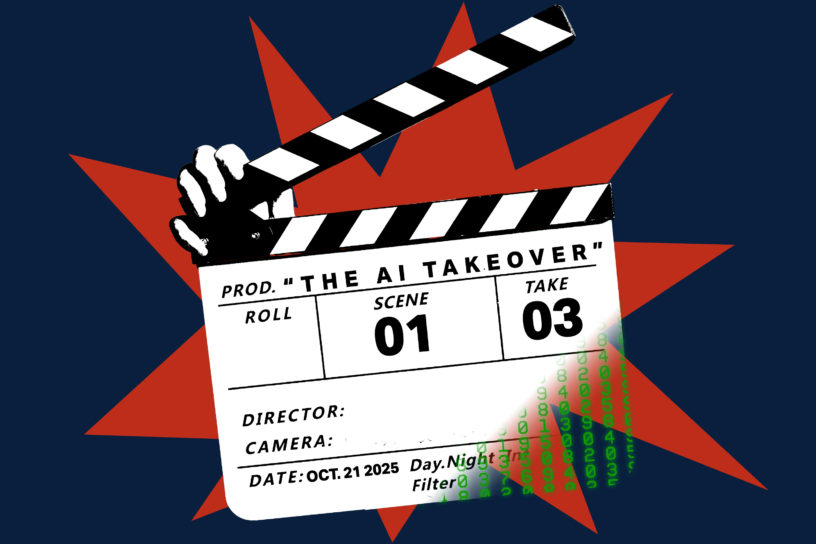
Artificial intelligence poses a threat to jobs in the film and television industry—for the TMU students poised to enter it, anxieties run high
By Sarah Grishpul
Luke Donovan is wrapping up his time in Toronto Metropolitan University’s (TMU) film program when he has a brush with generative artificial intelligence (AI) in the classroom.
He sits amongst his cohort in the dimly lit theatre of the Image Arts building. While the end of the school year means exams and final projects for some, for the fourth-year students in Donovan’s program it means screening the short films they’ve been working on for nine months.
This is when their peers and a committee of professors will critique their work—or “rip it to shreds,” in Donovan’s words.
For him, this six-hour class alone makes the tuition he’s spent almost worth it.
At the end of the screening, one of the professors pulls up a video. To the students’ surprise, it’s an AI-generated clip of Lord of the Rings in the animation style of Studio Ghibli. He explains to the audience of soon-to-be film graduates that this, generative AI, is part of the future of the industry. They’ll need to understand this technology—not bury their heads in the sand, but confront it, he says.
The students start to laugh. The professor does not.
“You laughed at me,” he says to the crowd of doubtful students. “I’ll remember that you laughed at me.”
In May 2023, Hollywood North watched from above as the Writers Guild of America (WGA) went on strike after six weeks of negotiations with major studios. Nearly a month later, the Screen Actors Guild-American Federation of Television and Radio Artists (SAG-AFTRA) joined them on the picket lines.
The unions were embattled over poor compensation, residual payment disputes caused by streaming and a fight for regulations on generative AI—which was just beginning to feel like a real threat to the workers in the industry.
After 148 days, the WGA and the studios came to an agreement, ending the second-longest strike in the guild’s history since 1988. The writers walked away from the table with their demands met, including—for the first time in a WGA collective agreement—protections from generative AI. According to a summary of the 2023 Minimum Basic Agreements, AI-generated material can not be used to write or rewrite material in place of a member, writers’ work must not be used to train AI, studios can’t force a writer to use AI software and must be transparent if any materials provided have been generated by AI.
Since then, unions north of the border, like the Writers Guild of Canada (WGC), the Alliance of Canadian Cinema, Television and Radio Artists (ACTRA) and the Directors Guild of Canada (DGC), have been open in their opposition to the use of AI in place of human labour.
Assistant executive director of WGC Neal McDougall says the union has already achieved some protections against AI. As part of a new collective agreement, producers must disclose whether they are handing off assignments to writers that are AI-generated. Material written by screenwriters can not be created by AI nor be used to train AI and content generated by AI will not receive credit or compensation.
“We are focusing on what we call the three C’s for training of AI. So that means consent, compensation and credit,” he explains. “AI companies should not be able to just take copyrighted works and use them to train AI.”
While he admits nobody knows exactly what the industry is going to look like in the future, McDougall feels the potential impacts for AI could be very significant for screenwriters—particularly for those vying for entry-level positions in the field, like students.
“Certainly one of the potential challenges is disrupting the talent conveyor belt that starts when you begin your career doing more junior level tasks, learning your craft, learning about the industry,” he says.
“That would halt the process of students and junior level people becoming mid-level and senior people, which would be a problem down the line.”
It was when he watched an AI-generated video of Will Smith eating spaghetti that he began to grow concerned
At a time in which Canada’s youth unemployment rate is skyrocketing, AI has been steadily decreasing the need for human roles to fill entry-level positions, according to The Logic.
In a study conducted by American consulting firm CVL Economics, the entertainment industry jobs most likely to be displaced by AI are visual effect artists, sound designers, tool programmers, script writers, animators and concept artists.
“The potential for disrupting entire careers, entire segments of the economy, all of those are very significant potential outcomes that we’d like to try to avoid,” says McDougall.
For those on the cusp of entering the industry, like students at TMU, this spells danger.
About a year and a half ago, second-year psychology student Matthew Walker is on the phone with his member of parliament (MP) at the time, Julie Dabrusin, to discuss what government regulation of generative AI in the arts might look like. Walker started off acting and voice acting from a young age, and is growing wary of the evolving presence of AI in the creative industries.
When ChatGPT made its way onto the scene in late 2022, Walker didn’t see it as a threat. “I just thought of it as a toy,” he says.
It was when he watched an AI-generated video of Will Smith eating spaghetti that he began to grow concerned. More so when only a few months later some programs were able to self-improve and create a more realistic interpretation of the prompts they were fed.
“I had the thought of like, ‘Oh, okay, it’s not just my job that might be screwed. It’s also just kind of like the fabric of reality in [the] virtual space’,” Walker says.
A week after his call with the MP, Walker sits in his apartment on the phone with a representative from ACTRA, trying to build support for an open letter to the federal government calling for AI regulation. Although the union was willing to help, the representative told him their primary focus was their membership and their specific needs.
After hanging up, Walker remains seated at his dinner table feeling a sense of helplessness. He comes to the conclusion that there isn’t a whole lot he could achieve on his own, nor did he believe the groups advocating for AI regulation in the arts had the capacity to focus solely on AI amidst their other battles.
He decides, if no one else was going to take action, then he would have to do it himself. On Sept. 10, he launches Artists4Humanity—an organization dedicated to lobbying the Canadian government for stronger protections against AI—on Instagram.
Although the group is only weeks old and still in its early stages, Walker’s dream for Artists4Humanity is anything but small.
“We’ve got to get going on this in a way that is fast and bold, and really takes in the perspectives of people who are feeling like they have no voice right now when it comes to that issue,” he says.
Through advocacy, his end goal is to build public pressure towards regulating the technology by spreading awareness and working with elected officials. According to Walker, what will set Artists4Humanity apart from other groups seeking AI regulation is the inclusion of a broad scope of artists. From actors to photographers to visual effects artists—Walker says anyone who identifies under the arts and culture umbrella will be welcome.
“It’s very easy for artists to feel helpless right now and a more broad goal is for them to understand that they’re not alone in their worries,” he says. “Not just that they’re not alone but that they can be a part of something to ease those worries and to make them feel like their voices are being heard.”
When OpenAI released ChatGPT into the public eye in November 2022, many companies embraced the new technology with open arms. In a survey conducted by CVL Economics, they found that over 90 per cent of business leaders foresee generative AI playing a larger role in the American entertainment industry. However, the report indicated that only 26 per cent of respondents felt their organization’s workforce was fully prepared for the integration of AI.
Allan Novak, a contract lecturer for the RTA School of Media and an independent producer, is integrating generative AI into his classes with open arms.
“I want to surf the wave rather than be washed over by it”
In RTA920, students must complete several ‘Digital Drills’ in which they are encouraged to use AI creatively. For one of these exercises, students are asked to blend AI and live action together to create an opening theme song for their weekly quiz. In RTA978, each week a student must research and present their findings on a new AI tool that intersects with media production.
Novak is aware some of his students may find this unorthodox.
“My openness to it…I know it’s striking some students as this is the first time this is happening,” he says.
According to Novak, he was able to integrate AI into the class with the program director’s approval by using it as a teaching technique. As a contract lecturer with little to no input on material changes, he seeks small areas where he can find flexibility. Novak is able to make adaptations to in-class teaching techniques and not core curriculum modules.
Having been in media production since the 1980s, Novak has watched new technologies come and go. With every new groundbreaking innovation, he finds that it’s the people who jump on and embrace it that end up doing very well for themselves.
“They’re the ones who are going to own the future, and so if we’re turning out students here, let them come out of TMU fearless,” he says. “And as I say: I want to surf the wave rather than be washed over by it.”
With these assignments, Novak hopes his students will at the very least gain a basic understanding of AI tools that they can take with them into their careers.
He acknowledges that AI could cause distruptions for workers in the industry, he is optimistic that new opportunities will arise. Novak compares this movement to when the position of a secretary was threatened by the invention of personal computers. The secretaries didn’t lose their jobs, their jobs evolved and they became administrative assistants, he says. Much like the secretaries, Novak believes entry-level jobs in the film and television industry will likely have to shift and redefine their roles.
“RTA grads have always had to think independently and entrepreneurially,” says Novak. “It was never like we’re setting you up for a union job that will be safe and secure for 30 years, because that’s never really existed.”
“I think knowing how to edit, plain and simple, is a lot better than knowing a bunch of cheat codes”
Ayla Goodrow is not thrilled when they discover Novak’s AI-focused exercises in RTA978. The fourth-year media production student took the course to improve on their basic learning of editing and finds the promotion of AI editing tools to be counterintuitive.
“I think knowing how to edit, plain and simple, is a lot better than knowing a bunch of cheat codes,” says Goodrow. “Because what if one day you don’t have these cheat codes or they are making sure you’re not using them?”
After the first class, they approach Novak and explain they were against using generative AI and would prefer to do something else for the presentation. He allows it.
Goodrow recognizes that while some professors understand the fears and anxieties students have toward AI, there isn’t much conversation in the program surrounding how to navigate it in the industry.
“We get a lot of, ‘Yeah, AI is taking over your jobs. So, good luck.’ And I’m like, okay, but how can we work with governments or film boards or the CBC in implementing rules and sanctions and ways to protect our jobs?”
Now in their final year of the program, Goodrow is pursuing a career as a camera operator with the long-term goal of live technical producing. The latter—for now—seems far from the synthetic hand of AI. However, learning to navigate a field where generative tools like the ones being presented in Novak’s class are actively being used weighs heavy on their mind.
Donovan, now an alumni, spends his days creating art. He carries an audio recorder with him wherever he goes, capturing sounds and adding his own commentary, creating a kind of auditory diary of his life. A “sound scrapbook,” he calls it.
When Donovan thinks back on what he refers to as the “Ghibli moment,” he recalls his peers being quite bothered by the notion that AI-generated filmmaking was the world in which they were stepping into. When there would be issues with a film in another of his classes, to the dismay of the students, the same professor would suggest fixing it with AI. Donovan likens him to a heretic, almost, yet finds himself agreeing with him—they can’t just ignore this.
“I’m not a Puritan in the sense that I believe everyone should unplug, because it’s not going to happen,” Donavan admits. “Someone’s going to use the AI thing. If I could push a button to delete AI, I’d be like, ‘Sure.’ It’s kind of annoying that it exists.”
He thinks back to when photography was invented and portrait painters suddenly found themselves out of work. While it was a huge labour issue, the answer wasn’t to say photography was a bad and morally wrong tool to use.
“Are all the filmmakers going to be disgruntled portrait painters? No, that’s not how you move on to whatever’s next,” he says. “The painters who did, they became the impressionists.”
For Donovan, the question now becomes: What is actually unique about the filmmaking medium that can’t be replicated by AI?
According to him, people will always be interested in things that are made by people—that personal expression is always going to be valuable.
“AI is this weird, hallucinatory facsimile of what we see in videos, but it’s not going out there, showing us what’s out there,” he says.
As to whether his time at TMU prepared him to enter an industry disrupted by AI, Donovan is coming to understand there are just some things he’ll have to learn to navigate on his own.
“What I’m realizing from film school is the professors who are there and the institution, they can be so helpful. You can take out equipment, they can give you their perspective, they can give you their wisdom, they can give you their opinion,” he says. “But that nugget of what is going to be the future is not something they can tell you. Because it’s not their time.”






Leave a Reply