

By Maryam Parkar
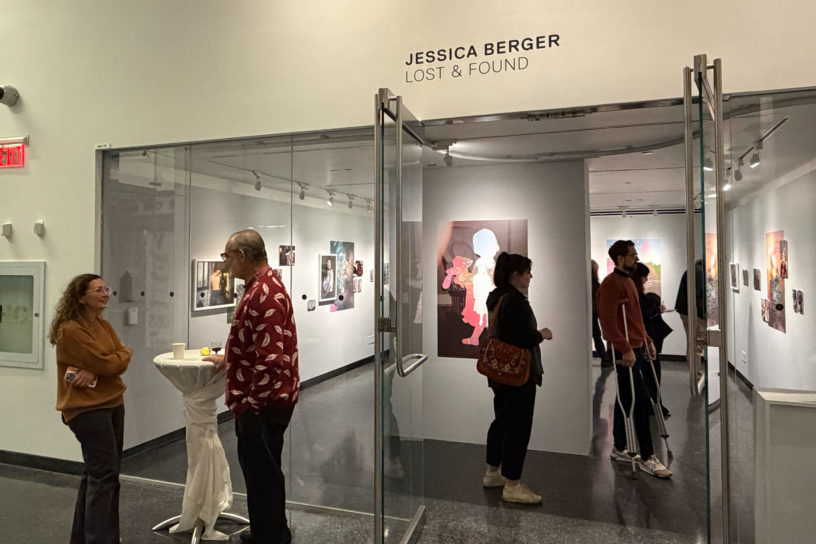
Toronto Metropolitan University (TMU) graduate Jessica Berger brought her memories of girlhood to life at the Image Centre in late October. Her exhibit, titled Lost and Found, interprets the experience of feminine coming-of-age through a combination of photographic and collage-based works. Joined by her community of friends, family and fellow photography enthusiasts, the exhibit filled the student gallery at its opening party on Oct. 29.
Lost and Found is a collection of vinyls, mounted prints and framed prints. The artworks in the exhibit range from portrait photography to layered collages that incorporate symbolic imagery and pictures from the artist’s personal archives.
In an interview with The Eyeopener, Berger said, “Layering as a concept was pretty important to me—layered meanings and distortion.”
Berger was gifted her first point-and-shoot camera from her grandma when she was about 10 years old. She nurtured her creative passion from a young age, experimenting with photography techniques to see what kind of unexpected shots she could create.
“That camera was stuck to my side,” said Berger.
She added, “I actually use a lot of those images as parts of the collages in this series because it’s a project about girlhood and girlhood, for me, also involved photography.”
Exhibition curator at the Image Centre Gaëlle Morel describes Lost and Found as an “intimate exploration” of the emotional transitions that come with aging.
“I think she wanted to discuss that moment in time where you’re not a child,” said Morel. “But you’re not completely into adulthood yet.”
Berger infuses young adulthood with bubbling nostalgia. Despite telling these stories through an abstract and intuitive lens, Berger’s work can resonate with those who understand the unspoken language of girlhood.
Berger’s circle of friends often became part of her visual storytelling, appearing in many of her photographs. Gabriella Rigakos, also an image arts graduate, highlighted the playful environment Berger established when composing her photographs. Rigakos said modelling for Lost and Found was reminiscent of having a sleepover with her friends.
“Shooting this was really fun,” said another friend, Mia Jones. “When we were getting ready, I went into Victoria’s Secret model mode, where I was like, ‘okay, I’m gonna do this’.”
The group portraits were intended to “recreate sleepovers and getting ready—these acts of girlhood,” said Berger.
Lost and Found speaks to the shared memories and rituals that define early expressions of femininity.
The artist said she sought to reconstruct scenes of childhood, exploring the space where innocence and adulthood intertwine.
Among the exhibit’s most striking works is a medium portrait of a young woman with tattoos scattered over her arms and chest. She layered a colourful collection of children’s stickers over the ink in an effort to contrast something whimsical and childlike with tattoos, which can often symbolise adulthood.
“Tattoos are kind of like permanent stickers for your body,” said Berger.
It’s one of many ways in which Lost and Found blurs the line between Berger’s past and present selves.
“It felt sort of full-circle to have these sorts of visual conversations with my past self,” she said.
Berger said she initially developed Lost and Found as her final thesis project while completing her bachelor of fine arts in photography. Over time, the project evolved into a delicate juxtaposition between her artistic maturity and the amateur years when her love of photography first began.
Morel said, “We treat the student gallery exhibitions exactly the way we treat the other exhibitions.” TMU students and recent graduates must go through a selective application process to have their work featured.
After four years of hard work, “it’s kind of the cherry on top to have this great exhibition,” Morel added.
Lost and Found will be on display at the Image Centre in the student gallery until Dec. 13.




Leave a Reply