

By Adrian Ord
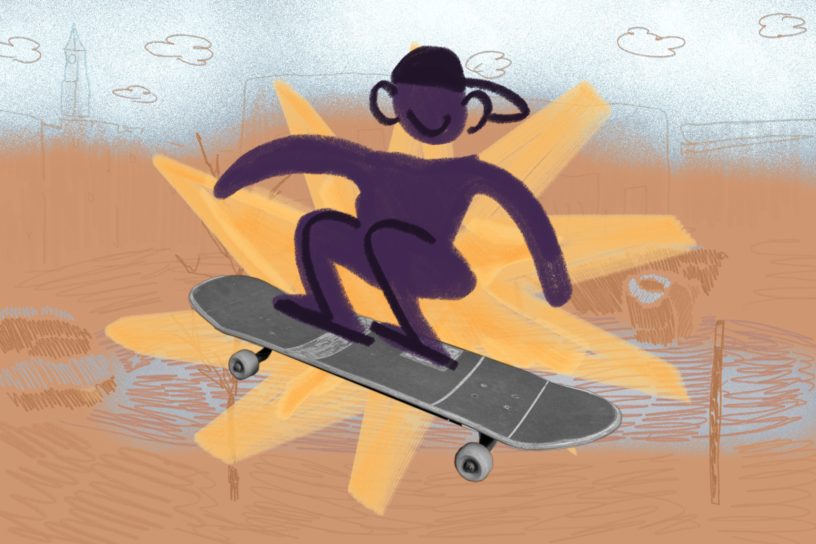
In the valley at Christie Pits Park, all kinds of recreation goes down. Baseball players occupy the three diamonds, smokers on blankets lounge on the hill and basketballers dribble on the courts. But throughout it all is the sound of cracking wood on pavement—perhaps the park’s most distinctive regulars: skateboarders.
In the corner of the park, a plot of pavement which may have at one point been used for sport has turned into a jungle of graffiti-covered do-it-yourself (DIY) ledges and quarter pipes. The DIY park hosts a frenzy of movement; someone is practicing a new grind on a waxed concrete slab, while a pair of shy beginners stay on the edge practicing their ollies next to a father covered head to toe in protective gear skating the ramps with his son.
On the sidelines of the park, skaters and non-skaters alike lounge on a set of picnic tables and bleachers which function as the watering hole where stories are told, joints are passed and acquaintances are made. A new skater arrives and greets everyone—regardless if they know them or not—as per the unwritten social contract of the skatepark.
Over the past 76 years, skateboarding has evolved significantly, according to the skatedeluxe website. What started in California and Hawaii as surfers attaching wheels to flat wooden planks to cruise on widewalks, has grown into an Olympic sport practiced all across the globe.
Pioneers like Rodney Mullen and Kareem Campbell showed a new form of expression through skateboarding by inventing tricks like the kickflip and Ghetto Bird in the 80s and 90s, or Ishod wair who became the first Black Skater in Thrasher Magazine’s Skater of The Year in 2013 and Brazilian skateboarder Felipe Nunes, who became a professional sponsored skater all without the use of his legs.
“I just enjoy the idea of popping a skateboard, that sense of weightlessness on individual levels, there’s a real sense of freedom,” says John Barnes, a language and intercultural relations professor at Toronto Metropolitan University (TMU).
No one is more passionate about skateboard culture than Barnes, who says he has dedicated an entire course to the importance of skateboard culture. LIR 208 – Skateboarding as a Cultural Bridge, describes itself as a Language and Intercultural Relations course—first ran in Winter 2025—that “aims to develop a critical understanding of how skateboarding and skateboarding culture contributes to intercultural communications globally,” according to it’s website.
“I pitched the ideas that skateboarding is sort of the socio-cultural bridge that allows oftentimes marginalized communities, a medium of expression and to sort of advocate on behalf of themselves and maybe other aspects of their identity via skateboarding,” says Barnes. “If I can go into a class and talk about Kareem Campbell and Rodney Mullen and the proliferation of skateboarding now internationally as an Olympic event, that’s a really cool thing, right?”
Barnes says he got into skateboarding in the summers of sixth and seventh grade.
“The kind of aesthetic, the sort of demarcations of skateboarding and skateboarding culture was really intriguing to me. And I really liked the sense of not having to go through adult channels in order to do things,” he says.
The sense of freedom and connection that comes with skateboarding has become enjoyed by many. A study conducted in 2020 by Pullias Center for Higher Education, funded by Tony Hawks’ non-profit organization ‘The Skatepark Project’ found that skateboarders saw value in the connection with other skaters and the gaining of a deep understanding of others’ race, gender and age.
Around the world, groups have been using skateboarding as an avenue for their expression. Like the Bolivian women’s skate group called Imilla, whose members skate in traditional Indigenous garb as a form of political protest.
Jaden Mah, a first-year fashion student, says skateboarding influenced his decision on what to study in university. He says he feels attached to the culture’s “rugged, baggy” style.
“If you skate a lot, you can get on deep levels with your connections. Because one thing that grows deeper connection is polarity between high and low. So going high and low with your relationships and going through the struggle of landing a trick together with someone…will build a strong relationship because you experience that load together,” says Mah.
With spring just around the corner, the ground will be dry, temperatures will be higher and the skateboarding season will be back in full swing.
The return of the skateboarding season will be marked on campus by skater activity in TMU’s Lake Devo, which has become revered by some skateboarders With its smooth ground, wide space and perfect ledges, Lake Devo is an open sandbox for skateboarders, where campus security tends to leave you alone, as previously reported by The Eyeopener.
First-year philosophy student Noah Niles says Lake Devo’s smooth ground and ledges are one of many reasons he skates there.
“I probably at least meet five to six random people. Because you always have someone walking by, there’s always people there,” Niles says.
Barnes stated that the safeguarding of skateboarding is a common discussion within his class. “Students I’ve taught within the context of LIR 208…felt like there is an element of gatekeeping per se,” says Barnes.
Barnes says his course covers this. He teaches that the culture has become a deterring factor for many who are starting—or are interested in starting— skateboarding. Used as a way to protect skateboarding from mainstream co-opting, gatekeeping has left a lingering impact that deters many beginners from going to skateparks due to a fear of immediate ostracization.
However, Barnes mentioned a student in his class had interviewed her immigrant aunt who started skateboarding after moving to Canada. “just seeing that perseverance and that dedication, she eventually was very much welcomed into the community,” he says.
A 2010 study by The Journal of Occupational Science concluded that taking risks while skateboarding with others provides a core sense of freedom. So this spring, dust off that old skateboard and head to a parking lot or Lake Devo with some friends, fall on your ass and meet some new people.
“You’re not competing against other teams. There’s no formalized rules. There’s no Ivy League, this, that and the other thing, it’s more just skating for the love of skating,” says Barnes.


Brian Pingle
Great Article I was part owner of a skate shop at queen and sherbourne and the funny thing is I am in all your TMU kitchens plus lived in california during the street skating boomhttps://www.instagram.com/p/BjVNDzPHxD0/?utm_source=ig_web_copy_link&igsh=MzRlODBiNWFlZA==