

By Sophie Wallace and Daniel Opasinis
A small crowd gathered in the low-lit basement of 304 Parliament St. in downtown Toronto. Guests were welcomed at the door with enthusiastic handshakes, cups of tea and pastries. A projector flickered on, displaying in bold lettering: “Egerton Ryerson: Humanist.”
The gathering aimed to discuss a matter which was once top of mind at Toronto Metropolitan University (TMU)—the legacy of the school’s former namesake, Egerton Ryerson. The lecture, which took place on March 25, was hosted by Friends of Egerton Ryerson (FoER), a self-proclaimed advocacy group which aims to, “restore and defend his reputation,” according to their website.
Lynn McDonald, co-founder of FoER, commenced the evening by sharing an unconventional land acknowledgement. “Please accept our meeting on the traditional territory of any Indigenous peoples, most notably, the Mississaugas of the Credit, with whom Ryerson himself lived, learned their language, made lasting friendships and whom he supported their very struggles,” she said.
After McDonald’s remarks, Patrice Dutil, a professor of politics at TMU since 2006, moved to the front and addressed the seated audience.
“My talk tonight is a slightly different perspective on Egerton Ryerson,” he said.
Nods and murmurs of agreement echo around the room. He said the guest lecture is the first in a proposed annual series to take place on or around Ryerson’s birthday, March 24.
Reporters from The Eyeopener were amongst the only people of colour in the audience, not to mention some of the only young adults.
Earlier in March, FoER attempted to advertise the March 25 lecture in The Eye. The advertisement was pulled before production, after masthead members lodged a complaint, prompting a vote from the newspaper’s Board of Directors.
FoER criticized The Eye through a note on their website’s homepage. “Clearly, our mandate to amplify the truth about Egerton Ryerson’s legacy is perceived by some as ‘harmful messaging toward marginalized groups on campus,”’ the website reads.
Public opinion on Egerton Ryerson has changed significantly since the university was named after the Methodist Minister and writer in 1948—a change largely propelled by Canada’s ongoing reconciliation with the residential school system and Ryerson’s connection to it.
In November 2020, then-Ryerson University created the Standing Strong Task Force (Mash Koh Wee Kah Pooh Win), a group of faculty, community members and Indigenous advisors tasked with seeking, “an understanding of both Egerton Ryerson’s life and legacy and the role of commemoration in our community,” according to TMU’s website. The group produced a list of 22 recommendations to the university, one of which was to change the name.
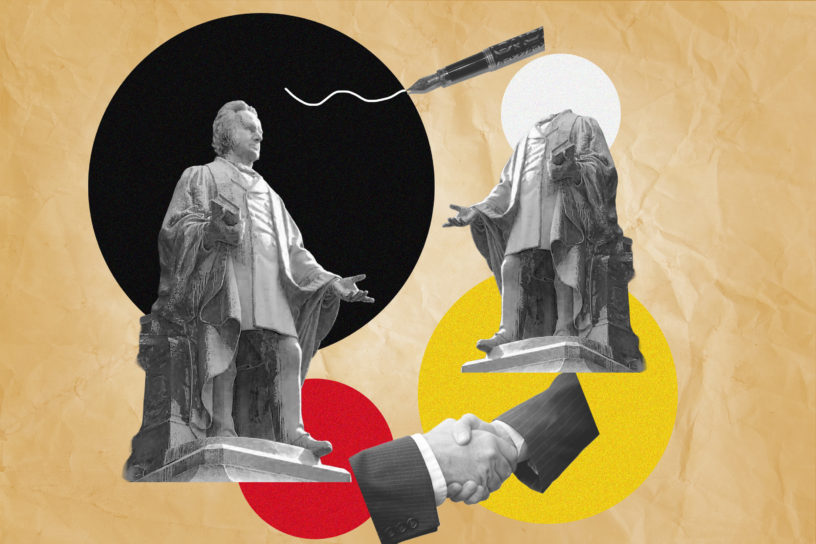
In August 2021, president Mohamed Lachemi announced the university would be changing its name per the task force’s recommendation, as previously reported by The Eye. This came just two months after the statue of Egerton Ryerson which once stood outside Kerr Hall South was toppled and beheaded by protestors.
According to their website, FoER aims to restore the name of Egerton Ryerson against “erroneous” claims, such as those from the university. They publish a newsletter, pen letters to officials and create content supporting Ryerson—including a video series in which a member of FoER portrays him in a sort of role play, defending himself in his ‘own words.’
According to meeting minutes published to their website, topics of discussion include the plaque describing Ryerson’s legacy on campus, location of the statue’s misplaced head, and campaigns in support of other historical figures whose legacies have been tarnished—like British politician Henry Dundas.
Mary Jane McCallum is a professor and Canada research chair in Indigenous people, history and archives at the University of Winnipeg and a band member at Munsee-Delaware Nation in Southwestern Ontario.
She believes efforts to protect the reputation of Ryerson and other controversial historical figures are born from a fear of altering traditional narratives of Canadian history and “heroes of the past,” even when they contradict lived Indigenous histories.
“These are people who feel, I think, offense by a view of the past that includes more than just simply a one-line story of progress,” she said.
Rose Dyson has been a part of FoER since its inception in 2021. She’s a University of Toronto graduate with a doctorate in education as well as a self-employed writer and media education consultant.
“I think that there is too much distortion of historical facts and inclinations of people to assess or judge the legacy of some of our predecessors or forefathers on the basis of today’s value systems,” she said in an interview with The Eye, a sentiment shared by many on the night of Dutil’s talk.
Members of FoER that The Eye spoke with acknowledged residential schools’ harm to Indigenous communities, however perspectives on what took place in those schools varied.
For instance, the discovery of unmarked graves at residential schools—including at Kamloops Indian Residential School, where what are believed to be approximately 200 unmarked graves were discovered in 2021 by way of ground-penetrating radar. In May of that year, Tk’emlúps Te Secwépemc First Nation—where the school is located—released a statement claiming the survey combined with previous knowledge and oral history indicated 215 children had been buried at the site.
A book that has brought her attention to the misinterpretation of historical facts is Grave Error: How The Media Misled Us (and the Truth about Residential Schools), published by True North—a now-defunct right-wing Canadian publisher. She stated that this book, along with another, are what have informed her on historical and social justice misinterpretations.
“[Grave Error] was inspired primarily when there was that, the rumor—I guess you call it—of missing and murdered, or children, the 210 graves—or something—in Kamloops residential school, well that’s never been established,” Dyson said in an interview with The Eye.
Although she admits abusing kids is “terrible,” she believes it was—at the time—the “conventional wisdom on how you raise children,” she said. “Sexual abuse in particular, was inexcusable.”
“I personally—and this may not be some view that everybody shares—feel that everything that went on in the residential schools was not necessarily bad,” Dyson said.
McCallum called this “residential school denialism” and said there is conclusive evidence of the violence and abuse inherent within the system.
“The denialist approach is to reject all of that work and to create a sense of doubt in the Canadian public about those studies and those histories,” McCallum said. “To basically kind of undermine the Truth and Reconciliation Commission and to really kind of undermine the whole project.”
Talulla* is an Indigenous fourth-year Faculty of Arts student at TMU. She said knowing TMU professors are involved in groups such as FoER makes her question the credibility and quality of the education for Indigenous students at TMU.
She said she has already felt “severely uncomfortable” many times throughout her degree as an Indigenous student, especially when it comes to feeling seen in academic spaces.
In one tutorial, Talulla recalls an instructor speaking about their research on an Indigenous community. “They talked about it in a way that I thought was respectful towards Indigenous people, until they said, ‘and none of us in this class will ever experience any of that,’” she said.
“You’re telling the story of my life and then acting like there’s not even a single possibility that I could be sitting in this classroom right now,” she said.
Talulla added that she has seen the effects of the residential school system on her family and community all her life.
“There’s such a clear bias in this academic space that really denies the lived history and experience of our people and once again, makes it an unsafe space for Indigenous students to learn,” she said.
In 2021, Dutil signed an open letter, along with 55 historians, condemning the Canadian Historical Association (CHA)’s Canada Day Statement.
“We write to express our grave disappointment with the Canadian Historical Association’s “Canada Day Statement”. The Council of the CHA claims that “the existing historical scholarship” makes it “abundantly clear” that Canada’s treatment of Indigenous peoples was genocidal and that there was “broad scholarly consensus” as to the evidence of “genocidal intent,” the letter reads.
Ronald Stagg, a member of FoER taught in TMU’s History Department for more than 30 years. He also spoke at the March 25 lecture.
In an interview with The Eye, Stagg explained FoER’s perspective on Ryerson’s connection to the residential school system.
He said the organization does not deny Ryerson’s ideas contributed to the “Industrial Schools” which he explains taught children farming skills. He also claims that the purpose of an industrial school was very different from residential schools. However, they do reject the idea that these schools led to the broader residential school system.
“Ryerson was suggesting—again, he wasn’t involved—but the schools he was suggesting were very in tune with the times,” he said.
While FoER does disagree with the renaming of the university, Stagg does not believe it is reasonable to expect them to change it back.
“Once the task force was set up at Ryerson and they changed the name, we recognized that we’re not going to get a change back. The university was spending money to rebrand,” he said.
The group has however taken aim at a plaque on Gould Street, writing letters to president Lachemi petitioning for its removal.
“Conversations with V.P. Michael Forbes led us to believe that the university wanted the plaque down,” FoER wrote in the letter. “For us, it is shameful that a public university, to which we contribute our tax dollars, should be the source of a disinformation campaign.”
The plaque in question reads, “As Chief Superintendent of Education, Ryerson’s recommendations were instrumental in the design and implementation of the Canadian Residential School System.”
In an email statement to The Eye, the university admitted to meeting with Friends of Egerton Ryerson on multiple occasions, as they said they would with any stakeholder group.
“The university is discussing how to best preserve the plaque and is working closely with the Indigenous community at TMU on potential next steps,” they wrote.
Talulla spoke to those next steps, saying that for her, reconciliation isn’t just a one-off act, but a continuous process of working with Indigenous people.
“I think my hope for the school is just a safe space for Indigenous students all the time,” she said.
*This source requested to remain anonymous, The Eye has veried this source.
*If a member of the public wishes to access transcripts from this story, reach out to editor@theeyeopener.com (excluding anonymous sources).


Leave a Reply