

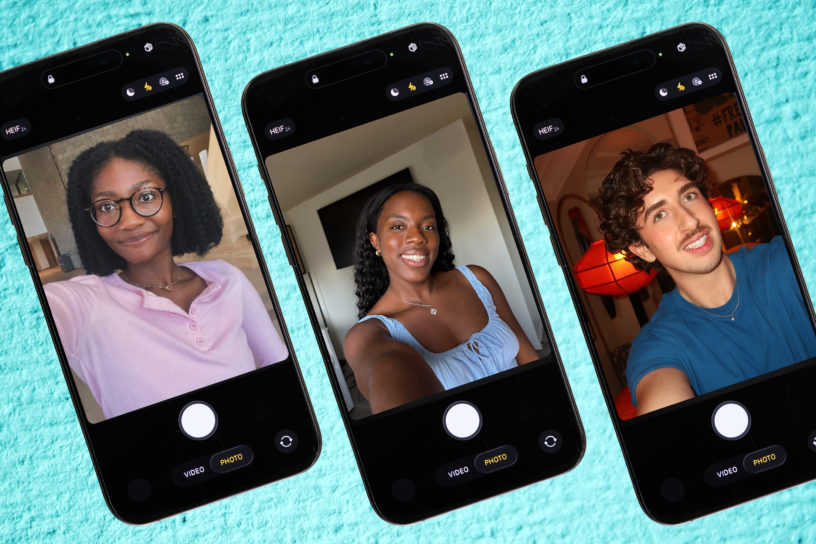
Students in the School of Medicine have amassed thousands of followers documenting their education for social media. In doing so, they’ve also joined a larger mission: proving the new school stacks up against the competition
By Daniyah Yaqoob
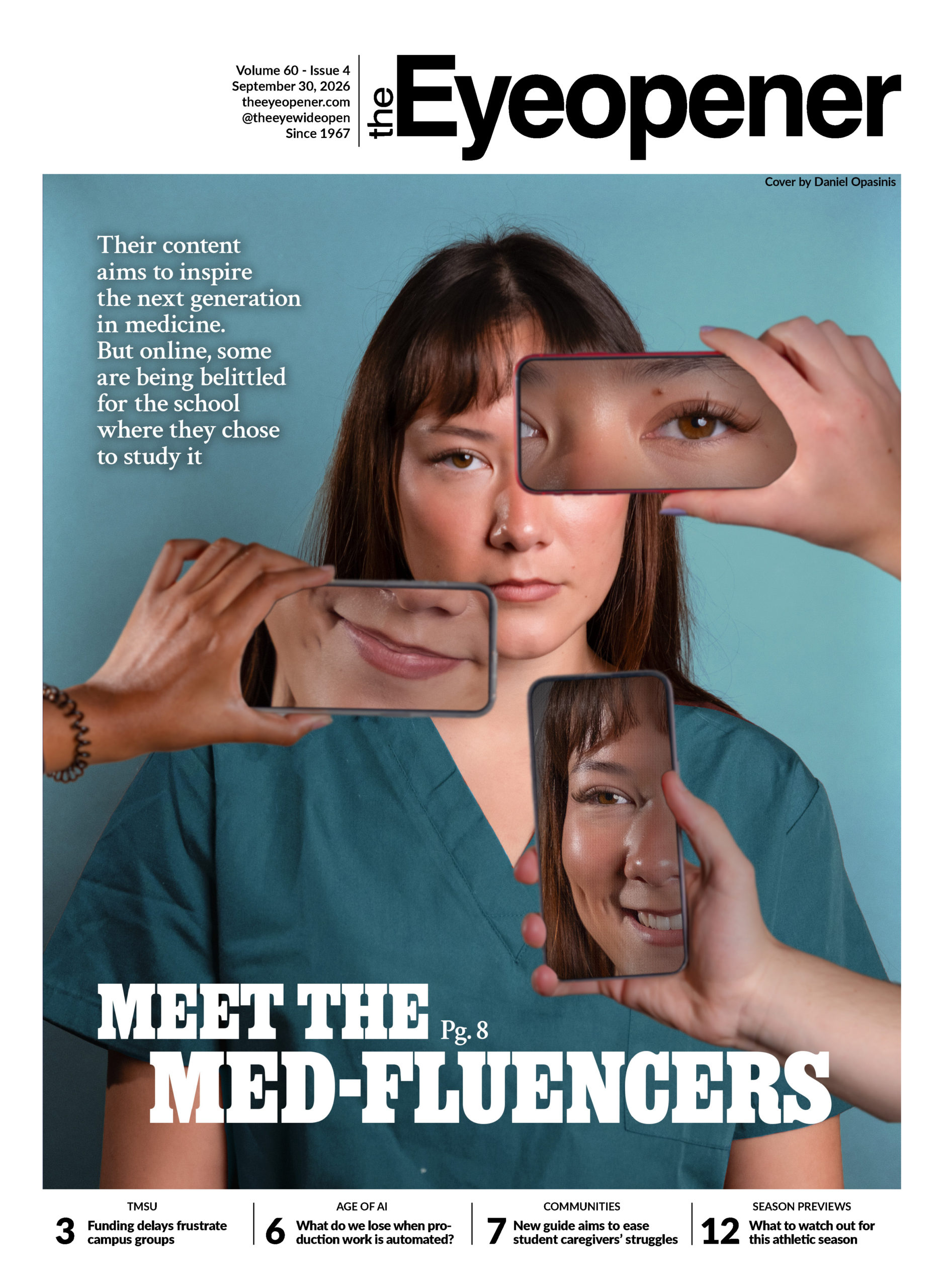
IT WAS A warm day in May 2025 when the School of Medicine sent admission offers to students who would make the inaugural MD cohort. Zaynashae Boreland was one of the applicants awaiting an offer. She refreshed her MyServiceHub portal at 9 a.m. with an anxious breath. Having become a registered nurse (RN) years prior, she set her sights on medical school. And Toronto Metropolitan University (TMU), which was close to home and had a mission she says aligned with her own, seemed like the perfect choice. When a notification pinged in her inbox, she set up her phone camera against her laptop, three lenses looking her in the eye, to capture her reaction. She clicked the notification open.
“There it is. Official. Been placed on the waitlist,” she said to the camera, a hand over her mouth to restrain the soul-crushing disappointment. Another realization sent her reeling right after: she would have to update her followers.
Since 2022, Boreland has run a side gig as a content creator. On her Instagram @medwithzayna, she’s built a following of just under a thousand, posting about her life as an RN. Since she posted online that she had applied for TMU’s medical school, her followers were waiting for an update. By the evening of May 13, decision day for many Canadian medical schools, she posted her reaction video and switched her notifications off for a week after to avoid seeing any of the responses. She wouldn’t find out until later how supportive her community had been despite the apparent defeat; they told her they found comfort in her candid reveal, and to know they were not alone in the waitlist process.
Then, two weeks later, she got a call informing her she’d been moved off the waitlist and secured a spot in the program. The very first thing she did was lift up her camera again to share the news with her followers.
“If I could take the call on a different phone, or whatever, I would have because I would have set up that camera and been ready to film,” Boreland says. Her followers were overjoyed for her. She says the relationship between them is what keeps the cogs in her brain spinning, trying to determine what to bring to her audience next.
Although TMU’s medical school is only now in its second year, Boreland is one of many content creators—or “med-fluencers”—who have popped up on the new campus.
“Med-fluencer” is an emerging term describing those in medicine who dabble in content creation, filming informative videos, vlogs or skits. On the more famous side of the spectrum are people like Dr. Mike, Dr. Glaucomflecken, “Foot Doc Dana,” of the United States, Sabrina Yang in Canada and more who have accumulated massive followings by standing in front of their cameras in a pair of scrubs.
At TMU, there are a handful of emerging content creators who do everything from motivational content, to application guides, giveaways, sponsorships and day-in the-life vlogs. While some other medical students poke fun at the number of them on the Brampton campus, these med-fluencers see their mission as more than making informal vlogs or filming trends. Their content, they hope, can validate a school that has been heavily criticized online and in the media by providing a look from the inside.
The Ontario government gave TMU the okay to open a new medical school in 2022. And from the beginning, the stated mission of the school was to serve those communities in the Greater Toronto Area who have been historically underserved. As the only medical school currently in the Peel Region, it would also work to solve the significant shortage the region faces in quality health care, according to officials. However, the school’s efforts were met with backlash for all kinds of reasons.
When the school had announced in 2024 that it would not require the Medical College Admission Test (MCAT), a common test required by medical schools across Canada and the U.S., and would admit students with the lower-than average minimum GPA of 3.3, it was received with hesitancy, including from some students The Eyeopener spoke to at the time.
Others lambasted the school for its heavy emphasis on diversity, equity and inclusion (DEI) in its admissions process—writers for the National Post even opined when the inaugural class started in September 2025, “We want more doctors. TMU’s DEI med school isn’t the way.”
“Admissions should be based on merit and aptitude, not politics; otherwise, we risk having future physicians who are less qualified to meet patients’ needs,” authors Matt Spoke and Ariella Kimmel argued, perhaps oversimplifying TMU’s requirements for its students.
The school’s DEI mandate also found its way into local headlines. TMU responded to the debate around reserving 75 per cent of seats for “equity deserving admission pathways” by removing what President Mohamed Lachemi called “aspirational” language from the website. It was reported by the National Post that Premier Doug Ford’s office had even spoken to the school about the equity admissions. But nevertheless, the school says that DEI will be “intentionally infused throughout all facets” of the program, according to the university’s website—but the fury of the original debate still affects how seriously some took the medical school on social media.
Threads upon threads on Reddit discuss the merit of the school, and some even advise that TMU should be applicants’ “last choice.” Part of the flack the school has received online has been for the supposed influencer culture it has cultivated. On Reddit, one comment even suggested the “M” in TMU stands for med fluencing.
NOW IN HER second year as a medical student, Boreland is in classes on Monday, Wednesday, Thursday and for a half-day on Friday. Every other Tuesday, she’s in clinical placements, where students are immersed in hospital and community experiences in the Peel Region. Still, every day, she finds the time to make at least one or two posts.
The majority of Boreland’s content is spontaneous. “I don’t plan it out,” she says. And yet, it resonates with her followers. Boreland is now at just over 10,000 followers on Instagram, and just under that on TikTok, a milestone she hopes to reach soon and plans to celebrate with a giveaway.
Boreland says filming is now second nature to her, four years into her content creation journey; every vlog she films begins with a shot of her pulling her bag out of her car, and in every class, her peers have become used to her phone resting against her laptop, the back camera facing Boreland to capture her studiously nodding along in a lecture. After a stacked day on campus, Boreland will come home and begin to edit the day’s footage; a self-described “talker,” the voiceovers come naturally. And having done so much editing by this point, it now only takes her half an hour to get the video up on the internet. The footage she doesn’t use ends up recycled in other posts.
One online commenter even suggested the “M” in TMU stands for med-fluencing.
For Andrew Faller-Saunders, a first-year medical student, keeping up between school and content can be intense—they’re in class four out of five days a school week. Shortly after he was accepted into the school, he started an account on Instagram called @andrew.in.med, a public journal to document his experiences.
His first post went up on Sept. 7, an introduction to himself and what he hoped the account would become. “I wanted to make this space to share a bit of my journey through medical school, but also the things that brought me here and continue to shape how I think about medicine: public health, mental health, substance use, disability justice, health equity, community, research and advocacy,” a caption under his headshot read. But then, it was three weeks of silence on his profile. The thought kept gnawing at him: I made that first post, now I need to follow up.
But medical school is intense, and on top of the two Toronto hospital jobs he works as an evaluator and caregiver, his content schedule does fall behind. The stethoscope ceremony two weeks ago and orientation week activities, still haven’t received their spot on his Instagram grid; for now, they sit in a folder with other posts he’s still hacking away at. He still plans to continue the content whenever time permits; to an extent, caregiving and cultivating a community online go hand in-hand for Faller-Saunders.
“I definitely have felt that overwhelming feeling, already,” he says with a laugh. “It’s only the beginning, [hopefully] the more you get used to it, the easier it’ll get.”
Roselaide Decker hopes that’s the case, too. As an undergraduate student, she watched other people’s content about medical school which motivated her along the application process. This summer, when she got in, the now-first-year medical student made her own account: @roses.are.med.
It was inspired by a suggestion she’d heard another person give to incoming students: to create a page dedicated to documenting the medical journey and where they could network within the industry. And so after testing the waters with a carousel post of the medical school’s open house on her personal Instagram, which received a “huge” positive response, she took the big step of making it her first public post under her new online persona.
“Love love loveeee the username,” a fellow TMU medical student, and influencer, @medwithanam, commented underneath.
In the three months she’s been posting, she’s accumulated just under 200 followers on Instagram, and over 30 people have reached out to her for support in their own medical school journeys—a full circle moment after she spent years knocking on others’ doors.
“That’s been a great part that I didn’t really expect. There’s a lot of prospective applicants and undergrads who express the same fears I had. To get messages from them has been like, ‘oh, wow, I know exactly how you’re feeling. Here’s all the resources that I have,’” she says.
It’s not just in the virtual world that her profile has helped her connect; even within the medical school, Decker said people are beginning to recognize her. They stop her in the halls and ask her when her next post is coming out. When they see her bring up her phone, they quickly organize the space they’re working in so she has the best shot.
“I have helpers,” Decker says with a smile.
She’s now even running for vice president of communications on the TMU Medical Student Council, and for her campaign videos, her classmates are pitching in, in front of and behind the camera.
Boreland also has her own fanbase at the institution. Faller-Saunders says he watched her vlogs to get an idea of the space and tips videos during his own application process; her presence and advice on a free social media platform made the process feel more accessible to him. Even the dean of the medical school, Dr. Teresa Chan, knew who Boreland was. When they met in June, Chan had advised Boreland to expand to YouTube so she can “really grow” and build a following. Chan told The Eye in an email that content creation is a way to combat health misinformation.
For Faller-Saunders, who grew up in poverty and has seen the devastating consequences of the health care system’s failures up-close, including when he lost his mother to suicide, the goal with his social media presence is to advocate: for Palestinians suffering a medical crisis, for his father, who lives with a disability and wants to share his story with the world but does not have the platform to do so and for those he believes the health care system fails in various ways.
“I’m not doing it to be famous or anything like that,” he says. “I see a lot of the work that I want to do in that space where it’s being vulnerable, trying to make spaces for things that aren’t talked about as much.”
In that way, Faller-Saunders’ goals as a content creator align with his goals as a future physician: to create a safe space in the world for the people searching every corner for support. As noble as medicine is, his content creation is for a purpose he believes is noble too—so anyone who takes that work unseriously becomes noise in the distant background.
Even the guest speakers at the medical school have touched on the power of social media in their profession. Decker says one speaker brought up the value of knowing how to communicate with people in simple terms, which some medical professionals who make content for the average audience have mastered. Others still have reminded students to be wary of what they post online as medical students and to consider the way they represent the school when they go about filming their day.
“I think there’s the tendency towards virality and things like that. But I have to remind myself that I’m a medical student. There’s a responsibility that comes with that and I want to be able to maintain that,” Decker says. It’s a responsibility the others take seriously, too.
“I’m not doing it to be famous or anything like that. I see a lot of work that I want to do.”
IT’S OBVIOUS ON social media: any good also comes with the bad. While Instagram and TikTok have been effective places for med-fluencers to create communities bent on solving the world’s health care problems, there is also a share of hate comments.
Boreland and Decker are both Black women in medicine. While their public platforms have allowed them to connect with other Black students applying for medical school, on the more rare side, they have received demeaning comments on account of their identity.
“There have been backhanded comments about TMU as a school and me being able to go there, talking about the demographics of the class,” Decker says, referencing the DEI backlash.
Under a video of her transition from being a registered nurse to medical school, one that received significant attention, Boreland also spotted comments from people who didn’t think she deserved to be in medical school.
“The whole point, for me, at least, is to share my story as a Black Jamaican whose family immigrated here however many years ago, to show that this is possible for us,” Boreland says.
For both women, it was a matter of deleting the comments as soon as they came in so they didn’t have the chance to oxygenate and grow.
“Luckily I’m the owner of the platform, so it’s very easy to control,” Decker says. She says the pushback actually pushes her to keep going, reframing the narrative around the medical school that spreads online.
For its part, the university itself has been active on social media, pushing word of the medical school, and the stories of its students, out into the world.
“I think TMU has done a really good job at being very present on social media. Because it’s a new school, it’s hard to advocate for its right to even be here,” Faller-Saunders says. There was a point in his life when he thought medicine would not be an option for him; it felt out of reach because of a number of systemic barriers. But when TMU launched its school, and its mandate had an eye on “not just individual health, but communities and system change,” it was the first time he felt like he belonged. His second-ever post was specifically to appreciate the school for featuring his story on their socials.
While he hasn’t figured out what exactly his content will look like in the future that’s something he wants to ask his followers for input on—one thing is for certain: he, Boreland and Decker all plan to reaffirm to the world, and their thousands of followers combined, that their medical training is based on merit. Where they go to school has no bearing on their talent, or their passion to fill a health care gap and accessibility problem the country is struggling with.
And so when they whip out their DJIs and their phones, whether intentionally or not, TMU’s med-fluencers are now playing a role in validating the school as an institution capable of medical training by providing an inside look—because what do the haters really know?



Leave a Reply