

By Elizabeth Armstrong
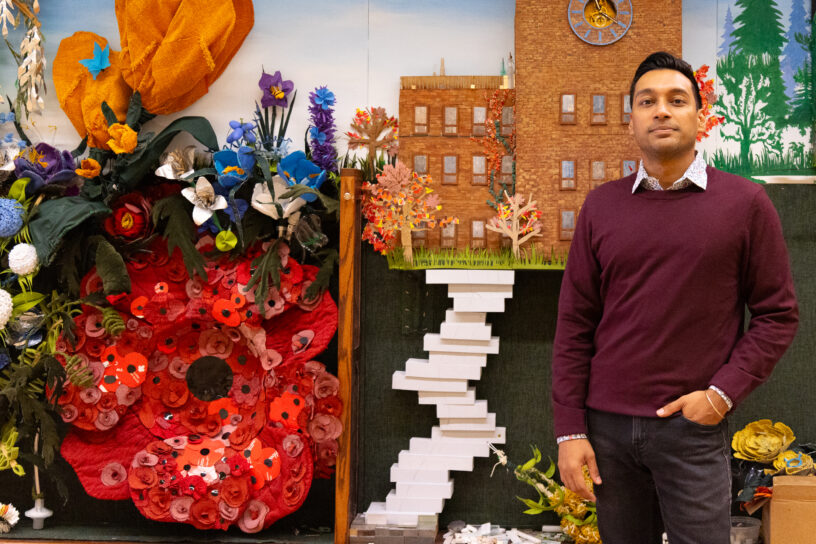
Narishdath Maraj, a graduate of Toronto Metropolitan University’s (TMU) Fashion Communications program, has been upcycling his entire life. He’s a designer and sustainability professional focused on repurposing materials and reducing textile waste. In his words, he wants people to understand the value and potential of the materials around them.
Maraj is currently creative director and sustainability lead at Mpolo Designs, a Toronto-based design consultancy. Among his current projects with the organization are a research-driven initiative examining how natural fibre textile waste can be repurposed into biodegradable, mycelium-based materials. Another is Grown From Away, which will turn hospital waste—including gowns and tubing—into permanent artwork. The piece, which is nearing completion, will be installed at Sunnybrook Health Sciences Centre and unveiled later this fall.
Maraj has also worked on notable projects here at TMU, too, including the branded materials transition project, which upcycled Ryerson-branded clothing and sportswear after the university’s 2022 name change, preventing 12,000 kg of fabric being sent to landfill.
The Eyeopener sat down with Maraj to discuss his work, his passion for upcycled designs and his advice for those looking to pursue a similar career.
Q. What made you want to pursue sustainable and upcycled fashion? Was this always your dream career?
A. I’ve always been interested in fashion and upcycling. I was doing it before I even knew what the word [upcycling] meant. I grew up in Trinidad and Tobago in the ’90s. I was always a creative child, and I had the opportunity and the freedom to do it. I also had access to a lot of textiles and fabrics, my mother’s sarees and just a lot of surplus fabrics.
I have a sister who’s eight years older than I am, and she had a Sindy doll, which is similar to a Barbie. It had this really terrible yellow dress. As a six or seven year-old kid, it was my goal to create something new for that doll, and that led me into a childhood of creating a full wardrobe [for the doll] from hand-beaded sarees to gowns.
I’ve taken a lot of those childhood passions and turned them into skills. I was really fortunate to have the opportunity and the resources as a kid to do it and then the support from family and community to pursue it.
It’s definitely something I’ve always wanted to do and I’m really grateful that I’m doing it.
Q. What are some of the challenges you have faced in your career?
A. One challenge is getting people to change their attitudes towards consumption and waste, and the things we’re accustomed to buying and using, then simply discarding.
I think another challenge is changing the industry slowly, but also getting people to realize that they themselves also have to change. There’s blame going everywhere, but taking responsibility for yourself individually is the very first step, and I think that’s probably one of the most important things we all have to overcome.
Q. What skills or connections did you gain from your time at TMU that have benefitted you throughout your career?
A. TMU played a huge role. I did a fashion design degree in Fort Lauderdale back in the day and I had a whole career. Then I decided to move to Canada.
I ended up going back to school [in 2018] and I did the Fashion Communications program at TMU. I loved going back to school with the life and work experience that I had and seeing university from a very different perspective than my peers at university at the time.
I was not in my early 20s anymore; I was really there to focus and it wasn’t just a passion anymore, it was me developing a career. It was nice because I think my professors and the fashion department, and then later on the university as a whole, took notice of that.
It was a great relationship that developed into a small career at TMU, working on several projects.
Q. What do you hope to see for the future of the sustainable and upcycled fashion industry?
A. It’s going to keep developing; I’m really happy that it’s happening.
To see the level it’s at now and the craftsmanship that’s really going into it, but also the respect that it’s gaining…I think the generation today is very much to be credited for it: people are understanding that there is a lot of value in [sustainable/upcycled fashion].
I’m really excited to see the innovation from the supply chain and what more we can do.
Q. What advice would you give to TMU students looking to pursue a similar career?
A. To stay curious. It’s easy to get stuck into a mindset that’s career driven and I think experimenting is important. Don’t feel like your career has to follow a predetermined path.
For young designers, I encourage them to explore different disciplines and work with people outside of your field. Talk to people outside your fields, because you can realize that there are people out there that have similar challenges and perhaps your skill sets could help each other.
I encourage people to try to be resourceful, understand materiality and work on small budgets to see what that’s like.
I would say definitely the most valuable thing is to have your own experience and your own perspective. Try to stay within your values but feel free to experiment.






Leave a Reply