

By Maria Beltran
While conducting fieldwork around the Great Lakes, David McFarlane finds himself subconsciously colour-coordinating the garbage he collects along the shoreline—a habit he says his wife teases him about.
Having grown up just a few miles from Lake Ontario, McFarlane has long been drawn to water. Fascinated by its magnitude and the life it sustains, he has returned to it throughout his creative practice.
McFarlane—who is currently a PhD student at Toronto Metropolitan University (TMU)—is a longtime artist and musician. His doctoral project explores ways of creating music in dialogue with the five Great Lakes.
He initially experimented with a technology called biodata sonification, which translates signals gathered from plants and water into musical data. But he began questioning whether the practice was “extractive,” growing uncomfortable with introducing even small electrical currents into the environment without knowing how they might affect it.
Instead, McFarlane drew on his background as a sculptor and guitarist to create a hybrid instrument: a guitar attached to a canoe, with mobiles made from found branches and discarded materials that he and his wife had collected along the shore. Once the canoe is on the water, the movement of the waves sets the mobiles in motion, causing them to strum the guitar strings.
Though he wouldn’t describe his art as overtly environmental, McFarlane says, “if you care about water, you care about many aspects of the planet.” Collecting garbage along the sites he visits is a “gesture of reciprocity.”
The natural world has long been a subject of artistic expression. In Spain’s Altamira cave, prehistoric artists painted bison, horses and deer across the stone walls and ceiling, carefully rendering the animals’ shapes and features. Thousands of years later, landscapes, wildlife and the changing seasons still continue to inspire artists working across different media.
But the environments that have inspired generations of artists are themselves undergoing profound changes. The Intergovernmental Panel on Climate Change (IPCC) warns that human-caused climate change has already resulted in widespread damage to ecosystems and communities, with some losses becoming irreversible.
It’s undeniable: a forest destroyed by wildfire, a shoreline littered with plastic, a once familiar place that no longer looks the way it did. Environmental loss is not always measured in disappearing species or rising temperatures. Sometimes, it is most felt in the places people have come to know and love. Researchers use the term “ecological grief” to describe the distress associated with this loss.
But it’s not always the distress that inspires humans to create art. For artists and researchers, their diverse relationships with the natural world are manifested in different forms. Some turn to creative expression in response to environmental loss, while others begin with a nostalgia for a particular place, a childhood memory or simply a desire to understand their roots.
Like their ancestors who lived centuries before them, these artists create as a way of relating to nature, but also to make sense of what it means to be part of a changing world.
McFarlane’s work involves returning to the lakes, observing their movements and experimenting with ways to respond to them. For Chizuru Nobe-Ghelani, an assistant professor of social work at TMU, a different kind of relationship with the natural world developed through her practice of keeping chickens.
In 2018, while finishing her PhD, Nobe-Ghelani began keeping three chickens in her Toronto backyard when the city’s UrbanHensTO program launched. The program, which ended in 2023 over avian flu concerns, allowed people to keep up to four hens “for enjoyment and for egg production.” For her, the chickens were her gateway to appreciation.
“Have you seen chickens, the way they live?” she asks. “They’re so slow. They peck all day.”
Nobe-Ghelani began appreciating the cycle of life unfolding around her, from the nutrients chickens returned to the soil to their eggs that she and her son collected each morning.
“I really learned from chickens how to be on the land ethically.”
The experience brought back memories of her childhood in rural Japan, where she was raised by her grandmother, who had what Nobe-Ghelani describes as an “animistic” relationship with nature. Her grandmother grew her own food, spoke to her garden—and also kept chickens.
After leaving Japan to pursue a post-secondary education, Nobe-Ghelani gradually lost touch with that connection to the environment, but keeping chickens helped her reconnect with it.
Monique Tschofen, a professor in TMU’s English department, has also reflected on the role of attention in how people understand the natural world.
Having previously focused on abstract philosophical questions, Tschofen began reconsidering the direction of her academic pursuits. She wanted to pursue work she found meaningful, both personally and beyond academia.
During a filmmaking opportunity in Loreto, Mexico, where gray whales give birth, Tschofen encountered scientists whose familiarity with the animals left a lasting impression.
Some of the scientists could recognize individual whales from only a brief glimpse above the water, recalling sightings from decades earlier.
“That’s a form of attention that’s also really amazing,” she says of their ability to recognize individual whales. “How good that would be to know anything that well.”
As part of an assignment, Tschofen’s students are currently learning how to take field notes. She asked them to observe their surroundings and follow something that interests them over time, whether an old tree in their neighbourhood or unfamiliar plants growing along a garden strip.
“You do come to love things that you pay attention to,” she says. It’s something an artist would know well. But paying attention also requires the awareness of what is terrible. Tschofen is clear-eyed about the severity of the ecological crisis.
“We are in a sixth mass extinction,” she says.
Over the past 500 million years, Earth has experienced five major mass extinctions. The most devastating, some 252 million years ago, wiped out an estimated 96 per cent of marine species. The most recent, 66 million years ago, brought an end to the age of non-avian dinosaurs. While previous extinctions were driven by natural phenomena, scientists warn that human activity is now driving an accelerating loss of biodiversity.
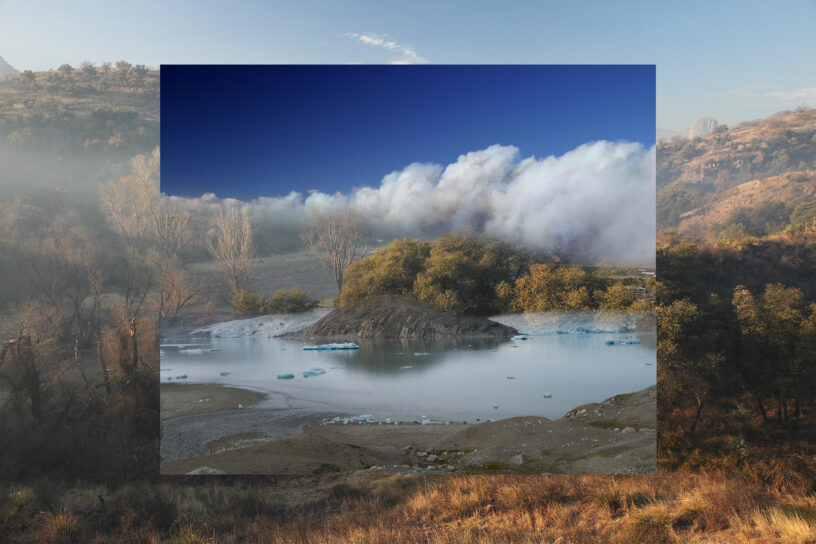
Originally from Edmonton, Tschofen describes how wildfires have become such a regular occurrence in Western Canada that emergency preparations are now part of seasonal municipal work. Her nephew, a city planner, has helped locate temporary accommodations for people forced from their homes.
“They literally talk about it as fire season instead of summer now,” she says.
Asked whether she finds a reason to be optimistic despite the climate crisis, Tschofen is unequivocal. “Oh yeah, no, I think we have no optimism at all,” she says.
What concerns Tschofen is not only the scale of environmental destruction, but how it is represented. She is critical of disaster narratives that frame catastrophe as a heroic journey of survival, often leaving the broader environmental context unmourned. She believes art should encourage audiences to sit with uncomfortable realities, including the sadness that comes with environmental loss.
“Western culture is really terrible at grief,” she says. “We’re really bad at mourning.”
Together with Jolene Armstrong, an associate professor at Athabasca University, Tschofen created Solastalgia, an interactive documentary combining filmmaking, watercolour, bookmaking and digital media to explore the climate crisis and its emotional dimensions.
Coined by Australian environmental philosopher Glenn Albrecht, solastalgia describes the distress associated with environmental changes to home.
Before entering academia, Nobe-Ghelani spent more than a decade as a community-based social worker with survivors of torture, war and migrant communities in general. Her doctoral research examined Canadian citizenship as a social good and how social work practices can both include and exclude migrant communities within a settler-colonial society.
After completing her PhD, she began exploring relationships between Indigenous peoples, migrants and the land. Alongside researcher Tim Leduc of Wilfrid Laurier and Elder Norma from Six Nations of the Grand River, she co-facilitated land-based learning circles with the Canadian Centre for Victims of Torture.
Her interest in land-based practice also led her to train in forest therapy and horticultural therapy.
During one forest-bathing activity with migrant communities, Nobe-Ghelani invited participants to find a tree they felt drawn to and spend some time with it.
One older woman was drawn to a fallen tree, broken in half. She wanted to embrace it but feared slipping on the terrain.
The woman told Nobe-Ghelani that the tree reminded her of loved ones back home. She felt deeply for both, but her age and physical limitations made it difficult to reach either of them.
The encounter stayed with Nobe-Ghelani, who began considering how the woman’s experience might relate to ecological grief, particularly among migrants separated from their homelands. The question is especially pertinent given the unequal impacts of the climate crisis.
Communities in the Global South, particularly those with limited infrastructure and resources to adapt, are often among the most vulnerable to environmental disasters. Floods, earthquakes and disasters have killed by the dozen, most recently in places like Nepal, Afghanistan and Venezuela.
Nobe-Ghelani is now developing research into ecological grief among racialized migrant communities, exploring how experiences of migration, displacement and relationships with land might shape people’s understanding of environmental loss.
Among those working with her is one of her research assistants, Maryam Khraishi, a third-year social work student whose experiences shaped her own understanding of displacement and grief.
For Khraishi, grief has had a familiar presence throughout her life. “I’m Palestinian, and so my process of mourning land has been inherent to who I am,” she says. “I was born into this world of displacement.”
She describes growing up with an awareness that something was missing from her life: a connection to a homeland she had never been able to fully experience. As a cancer survivor, Khraishi has also confronted grief through questions about her own mortality.
“At some point I lost the ability to walk, and that is a very minuscule, very minor thing…but you mourn a part of your body and [the] loss of independence,” she says.
These experiences have shaped how she thinks about mourning, and believes conventional definitions of grief leave little room for losses that extend beyond human life.
“We don’t have a lot of room in typical…Western understandings of grief to mourn things that aren’t a traditionally living creature,” she says. For communities whose relationships with land have been disrupted by colonialism, environmental loss cannot always be separated from histories of dispossession.
Nobe-Ghelani wonders whether people’s reluctance to confront ecological grief has something to do with power. To fully acknowledge environmental loss, she suggests, is to confront the decisions and systems that have contributed to it.“People in power don’t want us to feel that sad,” she says. “Because feeling sad…is basically acknowledging what has been done wrong.”
Nobe-Ghelani’s research seeks to understand feelings that are often difficult to articulate, particularly among people whose relationships with land have been shaped by migration and displacement. She questions the separation between humans and the natural world that informs many Western worldviews.
In the audio studios at the Rogers Communications Centre, where McFarlane spends much of his time completing his dissertation, he has been experimenting with ways to make music with the lakes rather than just representing them. His interest in the Great Lakes grew out of a longstanding love of water, but his project also led him to question how humans listen to and interpret the natural world.
“I realized that I wanted to not so much personify the lakes…but find a way to speak with them,” he says. “I like the idea of witnessing a lot and paying attention.”
During recording sessions, McFarlane and other musicians would improvise in response to sounds collected from the lakes, allowing those recordings to guide their playing rather than following a predetermined composition. “Those sounds set the tone, and we responded,” he says.
Sometimes the musicians remain silent. At other times, the sounds lead them in an unexpected direction. McFarlane wonders whether they are interpreting the lakes or simply responding as they would to another musician.
“So I don’t know if that’s interpretation or just a response to another player,” he says.
Tschofen’s work approaches the question of witnessing from another direction: how images of environmental disasters are presented, and what happens when they are transformed through art.
In Fire and Water, a multimedia installation exhibited at the 2025 Electronic Literature Organization Media Arts Festival in Toronto, Tschofen and Jolene Armstrong brought together sculpture, moving images, including from the Los Angeles wildfires and poetry.
For Tschofen, the work raises questions about how environmental disasters are represented and what happens when familiar images are translated into different artistic forms.
“What is disaster media? How does it help us think about things? What happens if you translate it across other media?” she asks.
Tschofen wants viewers to confront the realities of environmental change, including the discomfort and sadness they may provoke.
“Pay some attention. This is really real, and you should feel kind of sick and you should feel really sad,” she says.
But as much as art evokes grief, for people like Khraishi, acknowledging grief does not mean abandoning joy.
Growing up Palestinian, she says, meant living with an awareness of displacement and loss. Yet weddings, celebrations and moments of happiness remained important parts of her family’s life.
“I think joy can coexist with grief in a way,” she says. “It underscores the need to have joy in the moments that deserve joy.”
“But that does not take away from the fact that sometimes I sit in that nihilism and I sit in that deep feeling of sadness.”
For Nobe-Ghelani, grief itself may hold possibilities that are often overlooked.
She sees art as a way of reaching people beyond cognitive understanding, particularly when experiences of loss are difficult to put into words.
“Art is so powerful in speaking to people in a way that goes beyond cognitive way of knowing,” she says.
Through her developing research on ecological grief, Nobe-Ghelani hopes to challenge the assumption that grief is necessarily a negative emotion, particularly when expressed collectively.
“I think I also want to kind of disrupt that, where grief could be generative,” she says.
Art cannot reverse ecological loss or guarantee a better future. But it can create space to witness what is happening, express what cannot easily be articulated and recognize that grief need not be experienced alone.
In one of Khraishi’s classes, she recalls a professor asking students why products of research continue to be important, despite academic institutions historically contributing to the exploitation and marginalization of communities.
His argument, as Khrashi understood it, was that there’s always something of value when it comes to documenting experiences and perspectives.
Art, too, can serve as a form of witnessing. Documenting not only environmental change but the different ways people process, experience and feel.
Reflecting on her professor’s argument, she puts it this way: “Through this research we give proof, we give substance, we give undeniable reality that this is what people are experiencing, and therefore you cannot silence it.”




Leave a Reply