

By Jasmine Makar
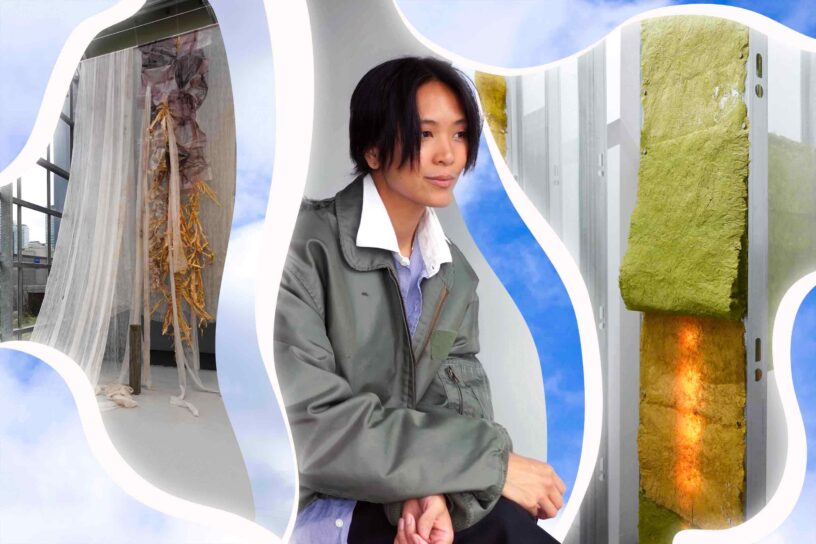
Alyssa Alikpala has always been drawn to nature. And growing up in Vancouver, the Toronto Metropolitan University (TMU) alumna and interdisciplinary artist, has had a very close relationship to it. Working with organic and discarded materials, she finds inspiration in the idea of impermanence.
“The fact of [nature’s] impermanence and the fact that it’s always changing is probably what really is the most striking to me because of how much it reflects what life is,” she explains.
Alikpala’s career has spanned many fields and disciplines. After graduating from TMU’s fashion program in 2012, she worked in the fashion industry for nearly four years, then transitioned into working in film. Eventually, she pivoted to become a spatial designer while continuing to grow her own artistic practice. Alikpala returned to TMU in 2023 for a residency under the Design Fabrication Zone.
Established in 2022, the residency is a three-month program that gives Toronto-based creatives the opportunity to “bridge fine arts, craft, and design, with digital fabrication technology,” according to their website. Residents produce and show off their artwork in a solo exhibition.
Before beginning the residency, Alikpala discovered the urban farm at TMU and knew she wanted to work with their waste material that couldn’t be composted. “It was a chance to give it sort of another life, and that is something that I generally am quite interested in too,” she said.
Some of the material she used from the urban farm included tarp and plastic tubing, playing off the eventual theme of her residency: decay. Her primarily textile installation used white fabric cascading from the ceiling, giving a waterfall-like effect, while other organic materials hung from the ceiling with soil directly below it.
Alikpala has always been interested in the idea of impermanence, but during the COVID-19 pandemic, this concept became a foundation of her practice as she spent more time exploring natural materials and resourceful ways of working. She emphasized that although she has stepped away from fashion, she’s continued to use the skills she learned at TMU to create her art now.
“I actually think a lot about the body and the body’s relationship to its environment, and even though I’m not working in the scope of fashion, there is still that main sort of subject of being like the body,” she said.
Alikpala creates art in many different mediums—metal casting, papermaking, sound, sculptures and installation—all while using a variety of materials. Her creative process can look very different from piece to piece. The majority of the process for Alikpala is experimental; like many artists, she sometimes works with materials she has on hand, which also helps her develop other creative ideas.
“Along the way of making one thing, I sort of discover all these other things that lead to sort of other ideas that I can get excited about and get curious about developing further,” she said.
Building mood boards, compiling visual references and her curiosity are often factors she considers when starting a project, but she also has to pick her medium.
“My curiosity or interest in exploring a certain medium almost comes first, and then thinking about how that form fits within the bigger scope of my practice.”
Because she often uses organic materials, they change from the moment she starts processing them into her pieces to when they’re being shown, and that all plays a role in the art she aims to exhibit.
“There’s almost this desire to keep it from staying in a certain state, but the truth of the matter is, it’s going to eventually, you know, die or deteriorate quite a bit,” she said. “There is an understanding that these things are going to change, and that’s part of the work, really and truly.”
With every stage of her art taking a different shape or colour—like grass changing from green to yellow, shifting its texture as well—she explains that there’s a beauty to seeing something in one particular stage, like a “snapshot” of the ever-changing materials.
Additionally, visiting or seeing the space where her art will be exhibited often affects how she creates the pieces, providing specific context, whether physical or geographic.
“I can’t really usually make the work independent of the space. It has to be with regard to or like thinking about the space it’ll exist in, and that might give it context.”
This shows up in various pieces she’s worked on, where she uses room corners and bricks as surfaces for her art, almost giving the illusion that the material is growing out of the wall itself.
She also uses braiding techniques in some of her art. In a 2021 piece featured on her website, she French-braided outgrown grass, this time using ‘material’ still growing from the ground. Another one of her pieces includes hand picked brick from around the site, laid out in a circle formation at Tommy Thompson Park, which can be seen from Google Maps.




Leave a Reply