

By Tristan Forde
As students settle back into school life, they begin to search for groups that they can connect with to form new friendships and bonds.
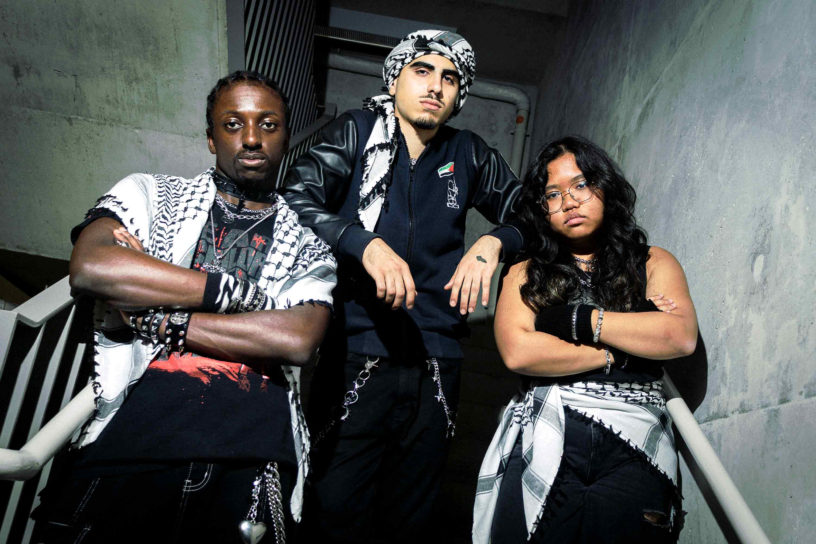
While in search of a space for alternative students at Toronto Metropolitan University (TMU), second-year criminology student Virina Youssef found a gap for her community on campus.
“I was just thinking the best thing I could do is build community and what better way then to start a club,” said Youssef.
She took it upon herself to organize the TMU Goth Students Union (TMU Goths). The group quickly picked up traction—among not only goth students but many other alternative students.
The group had planned for its first official event—a picnic on Sept. 24 in the Kerr Hall Quad—which never happened. The event would’ve fallen on the same day as a rally in the quad, protesting the arrest of a student by TMU Security the week before.
Second-year media production student Allyson Casquejo was the first member of TMU Goths’ executive team to bring up the overlap between the picnic and the rally. “As people in the goth, alternative, punk subculture…it’s important to participate in those [types of] protests if you can,” she said.
Many members of the club planned to attend the rally in support of the arrested victim, leading to their decision to postpone the picnic, Casquejo said.
On Sept. 19, a pro-Palestinian demonstration took place during a panel hosted by The Dais featuring Canadian minister of artificial intelligence and digital innovation, Evan Solomon.
Student activists questioned the minister in protest of the involvement of digital tools in the genocide in Gaza.
The demonstrators were escorted out—and shortly after—a security guard physically restrained a student, detaining her for over an hour in a campus building at 111 Bond St, as previously reported by The Eyeopener.
“I think that it is very important that if you are in any of these [alternative] subcultures, you need to rep the politics as well,” said Youssef.
“There is an ongoing genocide, it feels unfair to not highlight those things…”
Second-year psychology student Kayla Karlsson spent much of her life in online spaces enjoying media like anime and video games. She ultimately ended up on the path of alternative culture.
“A lot of alternative music is sort of about being different and as a kid who was really weird I think that really connected with me,” Karlsson said. “One of the scariest things you can do is be authentic and be yourself.”
As the alternative scene began to grow more, the mid-1970s saw the rise of a much more aggressive style of rock music. Adopting the prison slang term ‘punk,’ this style of music became characterized by rebellion.
“Punk is freedom, it means freedom of speech [and] freedom of expression”
Guitarist of The Black Halos, Jay Millette said punks disliked the establishment at the time. “They were angry and they put [their disapproval] into short blasts in songs to inspire.”
Bands like the Stooges, The Ramones, MC5, the Sex Pistols and many others formed the foundation for ‘post-colonial punk,’ never shying away from addressing issues such as abortion, anti-monarchy, anti-consumerism and more, according to the State University of New York Press.
As an icon of the industry, Poly Styrene of the band X-Ray Specx—a biracial woman in a predominantly white, male industry—became a beacon of hope for not only people of colour but alternative women broadly, an article in The New York Times reads.
Styrene’s legacy impacted many, as she wasn’t your “typical” punk. She leaned into the do-it-yourself (DIY)aspect of punk music by incorporating elements of pop and folk music into her songs, eventually being known as a post-punk visionary, the article continues.
The roots of punk and alternative subcultures continue to change, not going unnoticed by students on campus.
“Its nice to see that there has been a shift and there is more inclusion in that scene,” Karlsson said. “It definitely started off very [white, male centred].”
As the years went on, alternative music never stayed stagnant. Alongside post-punk music it started branching out into many different subcultures.
Goth music—emerging from the British post-punk scene in the early 1980s—was pioneered by groups like Siouxsie and the Banshees and Bauhaus.
Emotional hardcore music, commonly known as “emo,” was spearheaded by bands like Rites of Spring and Dag Nasty, known for their raw, confessional messaging.
“Punk is freedom, it means freedom of speech [and] freedom of expression,” said Youssef.
One emerging alternative genre is Taqwacore—a blend between muslim culture and punk anti-status-quo ideology.
Bands like The Kominas and Al-Thawra challenge societal and cultural norms through a Middle Eastern lens.
A British TV show all about Taqwacore was released in 2021 called We Are Lady Parts. The show tackled the struggles women face in rock music but also highlighted the racial challenges faced by muslim women of colour in a heavily westernized society.
Much of the Taqwacore scene in recent years has been focused on standing in solidarity with Palestine amidst the genocide in Gaza. They’ve also focused on denouncing U.S. foreign policy such as their ongoing military presence in the Middle East and across Central Asia.
“Art is political, every form of art is political, even if it doesn’t seem like it is”
As more eyes turn to focus on the genocide in Gaza, countless bands and groups in the alternative scene have been using their platforms to call out corporations for their investments.
“It seems, so quickly, we’re repeating history and people are losing their rights,” said Karlsson.
Singer and songwriter Patti Smith has been proactive in signing letters of boycott, creating songs like “People Have The Power” which have been heard playing at various different demonstrations and headlining events like “Hoping For Palestine,” in 2018.
“There is an ongoing genocide, it feels unfair to not highlight those things in music, books, art and fashion,” said Karlsson.
“If you are in any of these [alternative] subcultures you need to rep the politics as well”
Groups like Bikini Kill have hosted benefit shows with the Palestine Children’s Relief Fund and partnered with Palestinian Feminist Collective. Green Day altered their lyrics to “Jesus of Suburbia” at Coachella 2025 to address the children in Palestine. A handful of other bands have also been vocal, like Amyl and the Sniffers, Soul Glo and Against Me!
“Music has always been political and it always will be,” said Karlsson. “It’s such a great vehicle and tool to be able to express things.”
Having spent time in various alternative online spaces, Casquejo expressed frustration at those who believe subcultures and politics should remain separate.
“Art is political, every form of art is political, even if it doesn’t seem like it is,” said Casquejo.
Following recent events on TMU’s campus, the call for freedom of expression is growing.
Karlsson said TMU Security’s use of unreasonable force against a student is alarming. “It’s embarrassing,” she said.
As previously reported by The Eye, a spokesperson for the university said the school has “been made aware of the incident, and understands the concerns that have been raised. We will be reviewing this matter thoroughly and will take any necessary actions.”
Inspired by the impact music has had on politics in the past, groups like TMU Goths allow students to find like-minded individuals.
“Be an active member [of your community]. Whether you’re in a club, going to shows or at university, take advantage of that,” Youssef said. “[Don’t] be standing on the sidelines.”





Leave a Reply