
By Amira Benjamin
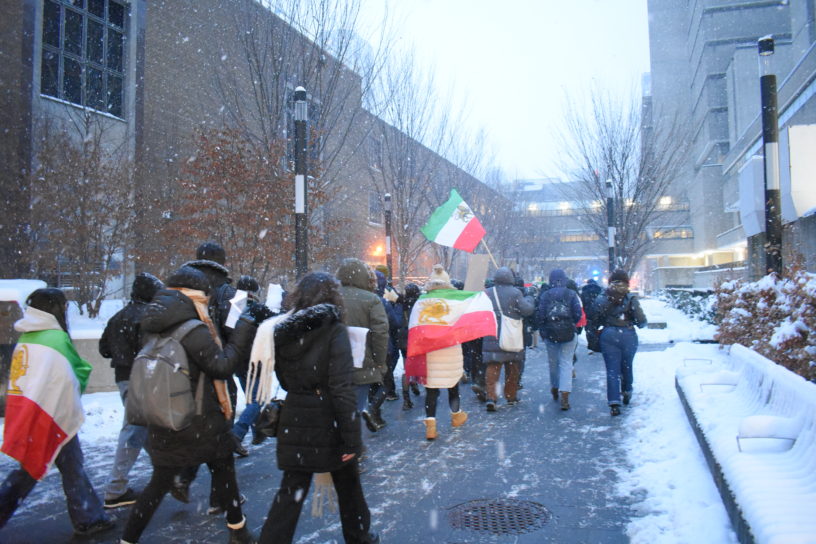
Students and community members from across Toronto came together on this past snowy Friday afternoon to rally in support of Iranians protesting against their government.
Hundreds of demonstrators marched from the University of Toronto (U of T) through Toronto Metropolitan University’s (TMU) Nelson Mandela Walk, then to the U.S. embassy to protest the week-long internet blackout, government censorship and increasing casualties by the regime in Iran.
Bita Khalghisohi, co-president of the Persian Students Association at the U of T Mississauga, said the main objective of the protest was to “amplify [the] voices” of the Iranian people and combat misinformation and propaganda.
“A lot of Western news outlets headline these protests due to economic reasons,” she said. “Yes, the economic situation in Iran is bad but you can look at that as a last straw that triggered [the protests].”
A flurry of Iranian flags and photos of victims were seen across demonstrators. Chants of “down with dictator” and “your silence is violence” were heard as well.
The protest was organized by several Iranian student groups from universities across the province, including TMU, U of T, Queen’s University and the University of Waterloo.
Arman Naderi, an executive officer for the Iranian Students’ Association at TMU (ISAMET), said many other student group leaders were in conversation with each other for weeks leading up to Friday’s rally.
“Us Iranians in other countries were [asking], ‘how can we support…our people in Iran while [being] in Canada?’,” said Naderi. “That’s when our university and other…Iranian clubs in Canada decided to join together.”
Since late December, Iranians, including shopkeepers who are economic pillars and students, have been protesting the soaring cost of living and generations of deep dissatisfaction with the Islamic Republic (IR), the ruling regime in Iran.
Beyond economic hardships, the current uprising in Iran is a culmination of decades of oppression by the IR, the consequences of the IR and Israel’s ongoing relationship and the human cost of the IR’s meddling in the Middle East and abroad.
According to Iran International, as of Jan. 18 at least 16,500 protestors have been killed and 330,000 have been injured by the IR and affiliated groups including the Islamic Revolutionary Guard Corps.
The IR has also cut Internet access since Jan. 8, while state violence against protestors has increased to the thousands. As of Saturday, partial SMS connection restrictions have been lifted, while all communications are strictly monitored. The majority of killings were done in just the first two days of the internet blackout.
Naderi said that once news outlets reported at least 12,000 deaths, students were much more motivated to take action. “Even on short notice, we needed to do something now,” he said.
This is reported to be the largest protests in Iran since the 2022 Women, Life, Freedom movement—sparked by the murder of Mahsa Amini while in police custody.
Khalghisohi expressed frustration with online discussions and misinformation she’s seen about the protests, feeling as though social media platforms and posts are not the same as news outlets in terms of effectively spreading information.
“It’s exhausting. My people are dying and I need to explain to everyone why [they] should be supporting me. It’s just sad I need to justify or give evidence why [people] should support this revolution.”
Naderi and ISAMET are working with the university to expand accommodations and support for affected students, especially international students.
“For example, because of a lack of communication and no internet, people, especially international students cannot get money from their home countries,” he said.
Naderi also highlighted how some Iranian community members were willing to hire more Iranians and offer free therapy to support those who need it right now.
“Our request [to the university] has been waiving the late [tuition and ancillary] fees, providing emergency bursaries and if possible, free food,”
he explained.
“The university agreed to some of these terms, like waiving the late fees…but I feel like more can be done.”
On Jan. 10, several Iranian student associations across Canada published a joint statement “in solidarity with our people in Iran who are risking their lives to reclaim our country from the dictatorship of the Islamic Republic.”





Leave a Reply