

By Daniyah Yaqoob
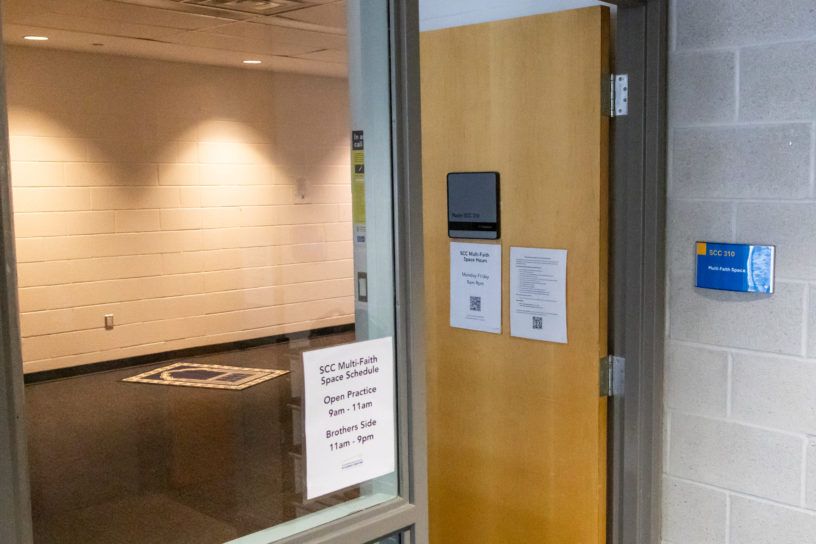
The multi-faith space at OAK 319 in the Student Campus Centre (SCC) was relocated over reading week, to two rooms down the hall: SCC 309 and SCC 310. However, Muslim students who used the previous space are unsure why the room relocated — and what the change will mean for them, especially as Ramadan is underway.
The prayer room in OAK 319 was expected to close Feb. 17, with the space at SCC 309 and 310 opening on Feb. 19—either the first or second day of Ramadan for students observing, depending on the calendar they follow.
The SCC staff said the reason for the relocation was due to student feedback, and health and safety concerns.
“Our student community has expressed issues with the existing multi-faith space in OAK 319 relating to accessibility, a lack of communal space and heating/cooling issues,” building staff said in an emailed statement.
The statement also mentioned there were concerns about a blocked fire door due to personal items left in the hallway — hinting at the shoe rack, where Muslim students remove their footwear before standing on prayer mats inside the multi-faith room.
Kashaf Alvi, a fourth-year politics and governance student at Toronto Metropolitan University (TMU), who uses the room often—and even more during Ramadan—said while she understands the health concerns, the old room had become a safe space to practice her faith, away from distractions.
OAK 319 is located in the back corner of the third-floor of the SCC, secluded from the rest of the building. Meanwhile, the new room is right in front of the third-floor stairs, adjacent to the elevator and across the hall from the TMSU office, where activity is constantly bustling.
“It [would] be kind of sad, because the infrastructure over there is really good. They have a proper window area, the bathrooms and everything,” Alvi said. A statement from the SCC said the ablution facility will remain open for student access.
Despite posters plastered around the SCC indicating the change, Alvi said she was unaware of the relocation. She felt the community was not adequately consulted in the decision.
The SCC staff said in an email their decision to shift the multi-faith space was made in collaboration with the Toronto Metropolitan Students’ Union (TMSU), the Toronto Metropolitan Graduate Students’ Union (TMGSU), Toronto Metropolitan Association of Part-time Students (TMAPS) and the Muslim Students’ Association (MSA).
However, Abdelrahman AlQazzaz, vice-president of Islamic education with the MSA, said it felt more like they were notified of the change, than consulted.
“They told us this in advance, but I feel like they didn’t really consult us with this decision. It was very matter of fact,” AlQazzaz said. In an emailed statement to The Eyeopener, the MSA said they were given two weeks’ notice.
The relocation comes just weeks after the multi-faith prayer space had been closed for “repairs” during the winter break.
AlQazzaz said the MSA had been optimistic about the much-needed improvements to the space. The MSA said in their statement that some students had raised complaints about ventilation and overall comfort in the room as it was.
But when students returned, they discovered little in the way of renovations. They saw a new supply-organization system, a black curtain that replaced a solid room divider, a new schedule and a new set of rules in place. The rules prohibited students from staying in the room for too long, or using the space as a gathering place outside of prayer — which drew the ire of students of many faiths on Reddit.
Yasmin Yussuf, a third-year professional communications student who said she uses the space nearly every day she’s on campus, said the repairs left her dissatisfied.
“If anything, it was like a downgrade,” Yussuf said. She said changing the solid divider in the room to a black curtain made her feel like those responsible hadn’t done adequate research into why Muslims require segregation in prayer spaces in the first place.
It is an Islamic practice for Muslim men and women to observe their prayers with a separation between them, as this was a practice of the Prophet of Islam and segregation generally is an important principle of their faith, inspired by the Holy Quran.
Now, she said she’s unsure of how to feel regarding the room’s relocation and how it will impact the Islamic practices of prayer — will segregation be upheld? Will congregational prayers still take place?
“I wouldn’t necessarily say I’m excited or hopeful considering how they have done renovations in the past. It just seems like they don’t really have our interests in mind,” Yussuf said.
AlQazzaz similarly said he doesn’t “know if the administration understands the idea of the Musalah (prayer space) for Muslims.”
“I think they imagine it in the secular kind of way, just going there, doing your own thing by yourself. But for us, it has much more dimensions,” he said. AlQazzaz underlined the importance of the communal prayer experience in Islam, particularly during Ramadan when more people focus on boosting their faith and connection with one another.
“It functions as a center for our community, a place where students support one another, share news, advertise events, seek guidance and build meaningful connections, contributing to their personal well being and sense of belonging on campus,” the MSA said in a statement.
The multi-faith space at the SCC is supposed to cater to anyone at TMU who practices any kind of religion. But the rooms in OAK 319 have mostly been used by Muslim students.
Yussuf said that Muslims are required to pray five times a day and because prayer timings coincide with class timings, there is a need for a space on campus to observe prayer.
However, Yussuf emphasized that nothing in the current room had labelled it a ‘mosque’ or ‘Muslim-only.’ It was open to people of all practices — in fact, one of the goals of the winter break renovation was to set a schedule so people of all beliefs could use the space during open practice hours.
While AlQazzaz agreed there should be a space for people of all religious practices to observe their traditions, he said he couldn’t help but feel an underlying desire to have a dedicated space for Muslims that accommodate their practices in addition to the multi-faith spaces.
“This is just my intuition, but it feels like they’re trying to get rid of us. Like they couldn’t handle the flow of what it’s being used for,” he said, referencing the volume of Muslim students who used the multi-faith space.
The MSA told The Eyeopener that the multi-faith space at OAK 319 had already been overcrowded. The “slightly smaller meeting rooms” the multi-faith space has been moved into now might also present a challenge.
In its statement, the MSA said it appreciates the attempts at accommodating Muslim students in the SCC. But they said it is still their goal to establish a larger, permanent prayer space on campus for their student body.
“Comparable institutions such as University of Toronto, York University, and Harvard University provide Muslim students with dedicated spaces that reflect the frequency of use and the religious significance of congregational prayer,” the statement read in part.
Most students will get to see the new multi-faith space for the first time when they return from reading week on Monday. The SCC said both rooms are available for open practice from 9 a.m. to 11 a.m. each day, while from 11 a.m. to 9 p.m., SCC 309 will serve as the women’s side and SCC 310 as the men’s.
Yussuf said that though she’s looking forward to seeing what changes were made, she’s not entirely optimistic that it’ll be for the best.
The SCC also said in its posters that additional prayer spaces would be opened during Ramadan in the ILC, for Muslim students to observe their daily prayers.
“It would be nice for the staff to work with us. Many students have many ideas and we’re willing to work with administration,” AlQazzaz said.







Leave a Reply