

By Amira Benjamin, Vihaan Bhatnagar and Shaaranki Kulenthirarasa
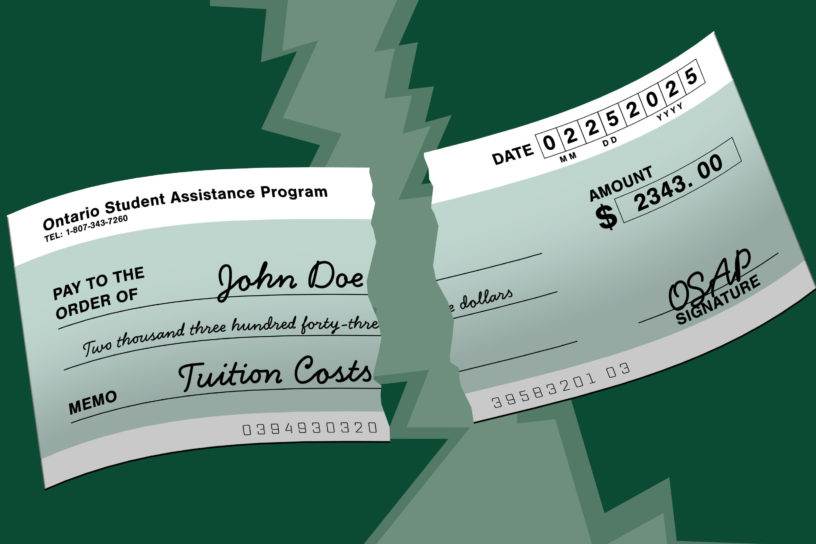
Students at Toronto Metropolitan University (TMU) are grappling with the Ontario government’s decision to end the provincial post-secondary domestic tuition freeze and making cuts to Ontario Student Assistance Program (OSAP) grants.
Doug Ford’s Progressive Conservatives (PC) government announced on Feb. 12 that OSAP grants will be cut from 85 per cent to 25 per cent.
This means if a student from Ontario owed $20,000 in student loans, they were eligible for up to $17,000 in grants that they don’t need to pay back. Starting this September, they would only be eligible for up to $5,000.
It was also announced that at least 75 per cent of students’ OSAP funding will become loans. OSAP loan repayments may begin six months after graduation.
The average debt for a student who graduates with a bachelor’s degree in Ontario was $30,800 in 2020, according to a 2024 survey conducted by Statistics Canada.
“The federal government’s decision to remove grant eligibility from students at private career colleges, coupled with increased program uptake in recent years, has put billions of dollars of pressure on [OSAP],” said Bianca Giacoboni, press secretary for Nolan Quinn, the minister of colleges and universities, in an email to The Eyeopener.
The changes to Ontario’s student financial support framework were made to align the province with other jurisdictions in Canada, Giacoboni added.
In 2024-25, the Ontario government spent $1.7 billion on OSAP grants alone—145 per cent more than **2020. In 2025-26, OSAP costs increased to $2.7 billion.
The government also announced that starting this September, post-secondary institutions will be allowed to increase tuition every year by two per cent for three years. Afterwards, they must either follow the three-year average rate of inflation or an increase of an additional two per cent every year, whichever is lower.
*The Student Access Guarantee program ensures students in financial need get aid to cover tuition books and mandatory fees — whatever is not covered by OSAP.
Jolie Malik, a first-year media production student, said the planned cuts to OSAP grants will make her finances unmanageable.
“It’s really making it hard for me to want to continue going to school. I don’t think [cuts to OSAP grants] is the best move,” she said.
The PC government also announced their intention to raise the annual operating funding for post-secondary institutions to $7 billion and add $6.4 billion in new funding. TMU published a statement to their website on Feb. 23, explaining the changes to students.
In an interview with The Eye, TMU president Mohamed Lachemi said TMU will “continue to look for ways to…find efficiencies and cost savings to limit impacts on our students.”
President Lachemi said it’s too early to know how the funding will be allocated across the province and will affect the post-secondary sector but “the majority funding is to be used as operating budget.”
Glen Jones, a professor of higher education at the University of Toronto (U of T) and former dean of the Ontario Institute for Studies in Education, says the OSAP cuts are a “relatively regressive policy.”
Jones believes the wealthiest families in Ontario will only “spend a couple hundred bucks” more on education, while lower-income individuals “will pay several thousand dollars more” because of the shift to loans from grants.
“It’s not about increasing access. It’s essentially rewarding, to some extent, the wealthiest population and taking money to fund the system from the most needy,” he said.
“If you want to fund a higher education system, tuition is a good way to do it because everyone pays and then you can provide financial support, both loans and grants, to the population that need it most.”
This will be the first tuition increase since 2019, when the PC government cut tuition by 10 per cent and froze it. Jones thought the 2019 tuition cut and freeze was a “terrible decision.”
“You had lower tuition income to the institutions and you had a government that decided not to provide any additional money, even though there’s been inflation over this time period,” he said. “They essentially drove universities and colleges towards international student fees as the primary mechanism of generating revenue.”
Ontario universities have been financially struggling in recent years. The tuition freeze and receiving the lowest provincial funding in the country have led universities to significantly hike international undergraduate student tuition, increasing by 19 per cent since 2021.
However, last fall, the federal government cut the number of study permits issued to international students by 49 percent, as previously reported by The Eye.
Trudy Kuropatwa Trent, a third-year performance design and production student and president of the Performance Student Union (PSU), says students who have reached out to her are “freaked out” over the news.
“Because of the new loan system…it makes it impossible to graduate without student [loan] debt,” she said.
“It’s impacting you, not just throughout your educational career when you’re in school [and] you’re working part-time if you can, even if you’re in full-time classes. You’re still going to have that debt follow you around as you enter the workforce.”
Elizabeth Buckner, an associate professor of higher education at U of T, finds the OSAP changes, especially as part of a package with increased post-secondary funding and lifting the tuition freeze, “really disappointing.”
“Honestly, the stabilization of the sector is being done on the backs of particularly lower-income students,” she said. “There are many students who do not rely on OSAP for higher education, so it’s not all students who are going to be affected equally.”
“I think that that’s important to keep in mind students, who need financial support to attend college or university, are now going to essentially have to take out a substantially larger proportion of loans, as opposed to grants.”
Bernalli Rosales, a third-year performance design and production student who has been receiving OSAP grants for their disability, believes that without the financial assistance, they may not be in school.
“I personally don’t know if I would be able to finish my degree with these cuts because at the moment, I am not in a mental space where I can work and study at the same time,” they said.
Ekram Yimer, a second-year economics and management science student, believes the change to 25 per cent grants and 75 per cent loans will make accessing OSAP worse.
“That’s my main concern, that I’ll have to pay more out-of-pocket,” she said. “Because OSAP didn’t cover what I needed to be covered in the first place.”
Yimer also believes that her goal of graduating debt-free is no longer viable.
Kuropatwa Trent believes believes Ford’s comment that students shouldn’t take “basket weaving course” are a “distraction by the provincial government.
“Healthcare has the same problem that education has, which is privatization [and] chronic underfunding,” she said.
“Yes, you’re going into these programs that are reported to have higher employment after graduation, but that so often is not the case, and because of the privatization of our education, you’re not going to school.”
Kuropatwa Trent has been organizing with student advocacy groups to increase awareness and protest the changes.
“In the short term, what we hope to do is get as many students out and organized as possible, because when we’re united, we can and will achieve what we want, which is bringing an accessible education,” she said.
“We can’t afford, economically, not to fight back.”
*This section of the article has been added for clarity on February 25.
**Correction: A previous version of this article included the incorrect year. The Eye regrets this error.





Leave a Reply