

By Rin Yanase
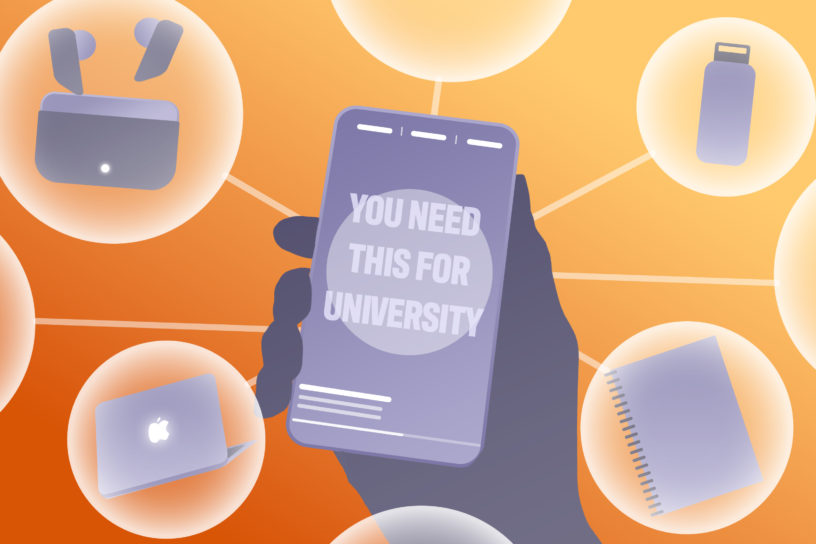
Seeing strangers trying to persuade you to buy an iPad from the other side of the screen is admittedly a normal experience for university students in 2026.
Online content advising students to buy study gear is increasingly common, but whether those tools will actually help you in school, is another question entirely. Some Toronto Metropolitan University (TMU) students say more often than not, what you need is your own judgement when it comes to back-to-school purchases, not what people say online.
A study conducted by the Indonesian Journal of Education and Social Studies indicates four main factors through which student consumer behaviour is formed, which start with “structured and systemic influencer marketing” and end with “the Fear of Missing Out phenomenon that triggers social anxiety.”
Kaylin Dhanpaul, a second-year biomedical engineering student at TMU, says back-to-school influencers have never persuaded her to spend on school supplies.
Dhanpaul calls these kinds of videos “scammish,” adding that “they’re definitely catered towards us students,” “I feel like if you think you’re having a bad time, you might want to buy something like that.”
On the flip side, Dapo Ogunsola, a third-year biomedical science student, gave a heavily-advertised study tool a try. He said he now regrets the $24-a-month he paid for Grammarly AI.
“I saw it on TikTok, so I just tried it out,” he said. The software he downloaded to paraphrase his own work indeed saved him time, as he expected, but was not cost effective.
The university’s Academic Integrity Office also instructs students to assume AI tools which paraphrase or rewrite text are prohibited, unless otherwise noted by a professor. Ogunsola still had to check the accuracy of the AI by himself, which also convinced him to ultimately cancel its subscription.
“[Students are] trying to adapt to their changing views, chenging values and chenging aspirations in terms of peer influence”
Shehreen Ahmed Islam is currently in her co-op year, studying aerospace engineering at TMU. She has a relatively positive attitude towards the back-to-school marketing content. “I think they can be helpful at times because sometimes you just don’t know the kind of benefits you can get as a student,” she said.
She said she also does her own research when she finds herself interested in a product promoted online. Among of her most trusted resources are her friends, many of whom actually have what she’s considering purchasing.
Russell Belk is a marketing professor at York University’s Schulich School of Business. In his consumer research, he uses the term “extended self,” where he reckons that what we buy, what we desire and how we use these things reflect who we are. “It means that our notion of who we are goes beyond our skin,” he said.
Belk also said university students are in “a liminal state between who they were and who they will become.”
Belk added, “[Students are] trying to adapt to their changing views, changing values and chenging aspirations in terms of peer influence.”
This isn’t far off from the reason Islam chose to buy an iPad this year. She said it was because of someone she knows who was using one around her. “In the beginning, I saw a lot of videos saying ‘look, you should get an iPad,’ and all. I was like, no, I’m just going to stick to a pen and paper. But then I actually saw how useful it is, how much more convenient it is, I did end up eventually getting it,” she said.
Correction: A previous version of this story stated that Kaylin Dhanpaul is in her third year. The Eye regrets this error.




Leave a Reply