

By Noah Curitti

In Brazilian jiu-jitsu (BJJ), there’s a concept called “physical chess”—meaning every move leads to a result, says Shervin Akhlaghi. For the fifth-year civil engineering student and creator of the Toronto Metropolitan University (TMU) BJJ Club, one move led to a major breakthrough for the Canadian university BJJ scene.
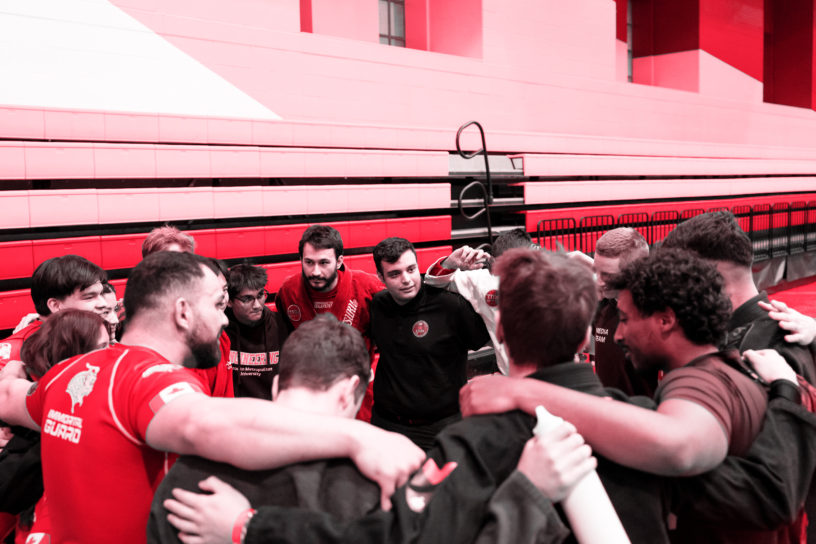
On March 14, the first-ever Canadian University Jiu-Jitsu Championship (CUJC) was hosted at the Mattamy Athletic Centre (MAC), on TMU’s campus—an achievement made possible by Akhlaghi. He says the event marked a turning point for BJJ, elevating it from a campus activity to a national competition.
Akhlaghi’s own connection to BJJ is rooted in his heritage and a drive for self-improvement. He started training and competing in jiu-jitsu tournaments across Ontario three and a half years ago. In these competitions, he met university students who shared his passion for the sport and learned about the different clubs across Canadian universities.
Akhlaghi also points to the diversity of the sport. “I’m Iranian myself,” he said, noting the country’s ancient history with wrestling, a cultural perspective he tries to bring to jiu-jitsu. “We have people from every corner of the world: Georgians, Russians, Brazilians. It’s a melting pot shaping the future of Canadian jiu-jitsu.”
As a blue belt with two stripes, Akhlaghi’s ability has grown from raw strength to strategic intelligence. The second of five belt ranks, the blue belt introduces advanced techniques and more refined defensive skills. There are multiple stripe stages within each belt level. Four stripes must be acquired to graduate from the blue belt.
Chaim Grafstein, a coach at TMU BJJ, remembers Akhlaghi’s early days. Shortly after he started training, “it became obvious he had a real capacity to understand and grow as an athlete,” said Grafstein. “He wasn’t just hardworking, he was really intelligent. He was studying engineering, participating in Model [United Nations (UN)] and always talking about politics and current events.”
That mix of skill and intelligence shaped Akhlaghi’s approach to the sport. He caught on quickly to attacking from the mount position, which was taught to him by Grafstein, so much so that training partners began to, playfully, complain. He was too strong to move—not because of physical strength but because Akhlaghi effectively used the mount position. Grafstein says, “that development in jiu-jitsu reflects Shervin’s overall growth in his training and in the sport.”
Akhlaghi’s journey into leadership began when he realized that, while lots of university students were passionate about jiu-jitsu, many could not afford to participate. In the GTA, training fees often exceed $150 per month, a high price for the average student. Akhlaghi sees this not only as a financial gap but as a community failure. He says this is why he decided to create TMU BJJ.
Akhlaghi pitched his idea and began the process of creating a recreation club. “The goal was to promote BJJ on the TMU campus and give students access to affordable martial arts.” He volunteered to teach the classes himself, lowering the cost to $65 per semester or $100 for two semesters.
The lower cost made the sport more accessible at TMU, he said. Shelby Mawson, a second-year student at TMU’s Lincoln Alexander School of Law who had previously trained in mixed martial arts, says they were immediately interested in the club after meeting Akhlaghi.
Mawson says that Akhlaghi introduced them to an aspect of their TMU experience that never would have happened. “Shervin’s passion for Brazilian jiu-jitsu shines through everything he does. As a teammate, he further invigorates my love for the sport and motivates me to be the best practitioner I can.”
Akhlaghi’s passion for the sport didn’t stop at TMU. Through various tournaments, he’s met students from the University of Toronto (U of T), Queen’s University, Wilfrid Laurier University and the University of British Columbia (UBC) who all echoed the same aspiration: an association of their own. Akhlaghi says he realized if these clubs could unite, they could create something much bigger for the sport.
The formation of CUJA was Akhlaghi’s most ambitious venture to date, he said. He sought to create a united voice for six initial schools: TMU, U of T, Queen’s, Laurier, McMaster and UBC. Akhlaghi notes that the endeavor of creating the national association, which is separate from TMU BJJ, was taxing.
“We reached out to the [Ontario University Athletics] and the response we got was that we cannot make this a varsity sport because the financial model doesn’t make sense,” Akhlaghi recalls. “Our dream was kind of shot dead.”
But rather than conceding, Akhlaghi put his Model UN background to use. “I learned how to navigate through administrative bureaucracy.”
The obstacles, he says, were immense. Funding was non-existent because the organization was too young to satisfy the paperwork requirements of major banks like RBC.
Finding a location was another hurdle, a planned event at TMU’s Kerr Hall Upper West Gym fell through due to institutional obstacles, he says. Yet Akhlaghi persevered, and was able to secure the backing of the Ontario Jiu-Jitsu Association and the Canadian Jiu-Jitsu Association, ensuring the CUJA would be a fully sanctioned nonprofit.
Grafstein said, “When Shervin pitched the idea of CUJA it seemed like a big challenge, but if there’s anyone who can do this, it’s Shervin. He laid out every barrier that he anticipated and set up a plan to deal with them.”
Akhlaghi’s dedication helped secure a historic venue, Maple Leaf Gardens, now the MAC and home to TMU’s hockey, volleyball and basketball teams. He also nabbed a partnership with Hayabusa Fightwear for podium prizes.
He managed it all while keeping membership free for participating universities. Akhlaghi says this is about, “bringing everyone together, not making money off university students.”
As the inaugural CUJA competition approached, the atmosphere in the training rooms was electric. “Shervin’s creation of CUJA motivated us to train harder,” says Mawson. “It shifted our focus from recreational practice to competition. We’ve realized we are part of something bigger.”
The event marked the first of its kind in North America. For Akhlaghi, the milestone was bittersweet as he had to sacrifice his own spot on the mats to ensure the event ran perfectly.
“I really wanted to be a participant,” he admits. “But I needed to be fully present to make sure the CUJC ran smoothly.”
For Mawson, being part of the moment was a testament to the sport’s growth in Canada over the last decade. “For too long, BJJ has been relegated as a hobby martial art,” he says. “CUJA and the CUJC had the opportunity to show what BJJ has to offer to the broader academic community. It was a pivotal moment for the sport in this country, and it is only the beginning,” says Mawson.
The CUJC on March 14 made history. Akhlaghi’s legacy, stemming from passion and determination, was measured on the mats where Canadian university BJJ finally had a chance to compete on a national scale.



Leave a Reply