
By Amira Benjamin
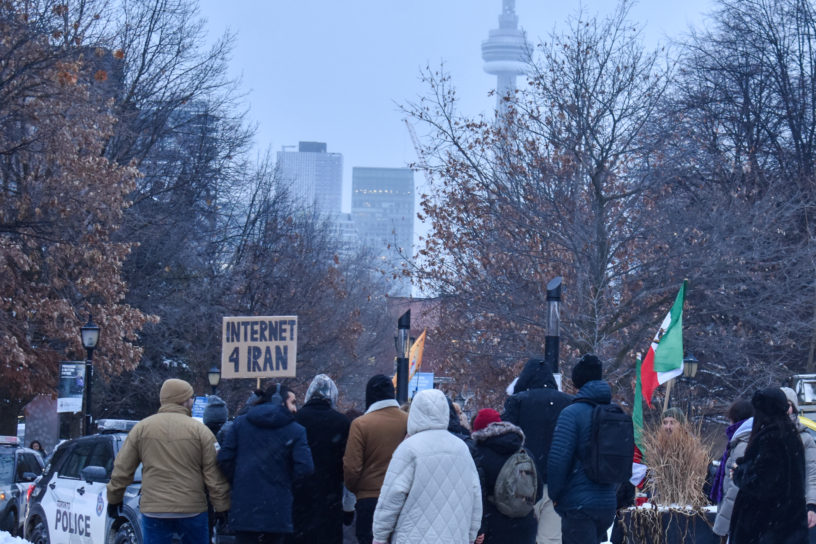
Iranian student groups across Ontario are calling upon the Ministery of Colleges and Universities to temporarily convert tuition fees for international students amid the U.S. and Israel’s strikes on Iran.
Internet access in Iran has been shut off by the Islamic Republic (IR) since the U.S. and Israel first bombed the country on Feb. 28. Iran’s internet blackout is now the longest nation-scale internet shutdown on record in any country, according to cybersecurity watchdog organization NetBlocks.
Before the war, the IR had also shut down the internet and communication lines from Jan. 8 to late-January during the anti-regime protests in Iran, as previously reported by The Eyeopener.
For Iranian international students, the blackouts can make it difficult to send or receive funds to pay tuition and other school costs.
On April 2, five Iranian student associations from Toronto Metropolitan University (TMU), York University, University of Toronto, Queen’s University and Western University posted a statement on Instagram demanding “immediate action from the Ontario government as Iranian international students confront a worsening humanitarian crisis.”
The students demand a response from the Ministry of Colleges and Universities within seven days of the release, the statement reads.
In fall 2025, TMU rescinded a policy that allowed international students with open work permits to pay domestic student tuition, as previously reported by The Eye.
The policy was put into place after the Canadian government allowed Iranian students’ visitor visas to be changed into study permits following the 2022 death of Mahsa (Jina) Amini.
The Canadian Press has reported that several other Canadian universities, such as Queen’s University and Carleton University, are offering exam deferrals, tuition relief and counselling services for affected students on a case-by-case basis.
Al Jazeera reported as of April 3, at least 2,076 civilians have been killed in the strikes in Iran, with 26,500 people injured since the war began. This is on top of the estimated over 30,000 civilians who were killed on Jan. 8 and 9 alone by the IR during widespread protests.
Shervin Akhlaghi, a student representative for TMU’s board of governors and a fifth-year civil engineering student, coordinated with student groups to write the statement.
“We have a lot of Iranian international students here, [who] could not predict this [war] happening, in a sense that the internet would be cut for 35 days straight,” he said.
“One of the biggest issues is…if [students] can’t pay their tuition, and they can’t complete their degree in a certain time, that’s going to impact their study permit or their immigration status in Canada.”
Akhlaghi said Iranian international students in Canada who have been protesting the IR but cannot pay their tuition may risk deportation. “At the end of the day, it’s a humanitarian issue rather than a political one,” he said.
Karan Kaviani, the president-elect of the Iranian Students Association at TMU (ISAMET) and third-year biomedical student, said some Iranian students who were unable to pay their previous term’s tuition due to [the January and the current] blackouts cannot enroll in summer courses due to a hold on their student accounts by the university.
“We tried to communicate with [the university] saying, ‘it’s a blackout in Iran, most of the banks are shut down and that’s really hard for many people to even afford their living expenses, much [less] their tuition fees,” said Kaviani.
He said he met with the Registrar’s office to explain the situation faced by Iranian international students and suggest the university provide some financial relief to affected students, but hasn’t heard back.
“We didn’t hear back from [TMU] at all. So we came together and said, ‘maybe we have to publish a joint statement with other big universities in Ontario’,” he said.
Akhlaghi said there should be a shift in university policy to better accommodate international students who may be navigating times of conflict or “humanitarian crisis.”
“It’s a really complicated situation that I don’t think universities have had to deal with before. But that doesn’t justify their lack of vision or creativity in terms of how to deal with this situation,” he said.
Many students struggle to call their friends and family due to the internet blackout and the time difference and need to wait for incoming calls from Iran—which are expensive and often surveilled.
“If you ever miss a call, it’s your only chance. Your phone should always be turned on, unmuted so you don’t miss anything,” said Kaviani.
Arman Naderi, a fifth-year computer science student at TMU and an executive officer of ISAMET, said the war has been “significant and destabilizing.”
“I have a Canadian passport but my brother is back home. After three months, he called me and I was at work and I just did not see his call,” said Naderi.
Amirreza Foroughifar, a fourth-year biology student at TMU who is the advocacy vice president elect of ISAMET echoes this sentiment. “I’m [in] debt and I was gonna apply for graduate programs because I’m in my last year of my undergrad,” he said. “I applied and I also recently got accepted, but I have no idea how I’m gonna pay the funds, because the [Iranian] economy is in shambles right now.”
Correction: A previous version of this story attributed the final quote to Arman Naderi. The correct attribution is to Amirreza Foroughifar. The Eye regrets this error.




Leave a Reply