

By Ava Whelpley
It was a summer afternoon in Yellowknife. A thick smoky smell blanketed the air from the wildfires blazing in Alberta and British Columbia, when a roadkill porcupine was brought into the North Slave Research Centre.
Christine Dunbar, an Inuvialuit beadwork artist born and raised in Yellowknife, did a necropsy on the porcupine, which was a rare sight for her and her team. It is among the various day-to-day tasks she completes as a wildlife laboratory and field technician. Her other tasks include inventory for various samples, helping with caribou collar retrievals and filling in wherever else is needed.
She works on a small team, in a small lab with typical black countertops. It engaged every sense: the room was filled with all sorts of abnormal smells from dead animals and a loud humming noise emanating from the freezer.
Before disposing of the porcupine carcass, her coworkers asked if she wanted to harvest the quills so that not as much would go to waste. They asked her, knowing she was a beadwork artist and would value the quills.
As Dunbar worked to pull the quills out with little force, she felt grateful. Grateful she could have such a rare opportunity and honoured her coworkers would understand the importance these materials have to her as an artist. Dunbar said she hasn’t had a chance to use the quills yet, but she hopes to when she finds the time.
“I just think there’s so much you can take from the outdoors that can give you so many ideas and it’s just kind of endless inspiration,” she said.
Growing up in Yellowknife, Dunbar had accumulated a large collection of beaded earrings and felt it was time to give beading a try for herself.
After a trip to Michael’s where she says she purchased all the wrong supplies, Dunbar started beading in 2020 during the COVID-19 lockdown in the third-year of her undergrad at Lethbridge Polytechnic. She told The Eyeopener she taught herself through YouTube tutorials.
“How I define myself now is through beading and through my full-time job…being a wildlife biologist…I just feel like I’m authentically myself when I’m beading, and I really like that,” Dunbar said.
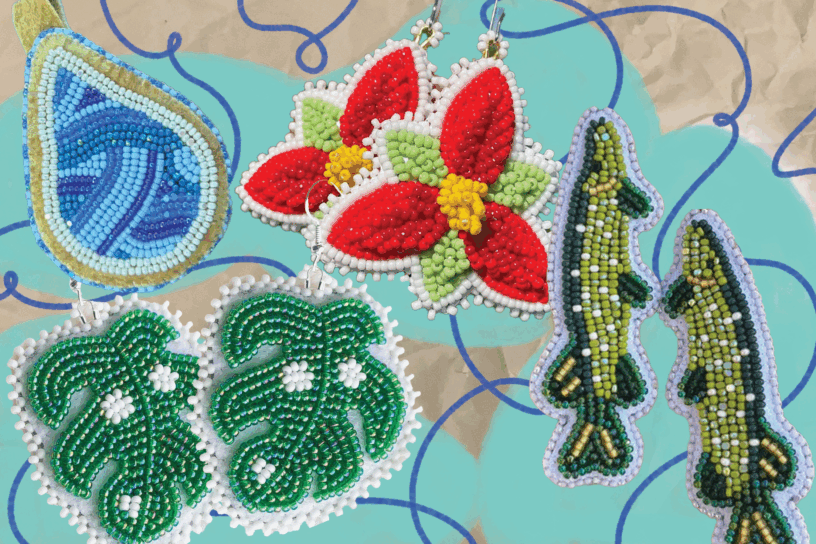
Indigenous beadwork artists like Dunbar have been inspired by the land for generations. They use materials from the land in their works and create art that often resembles the environment, such as beading berries and floral patterns. Beading has also become a bridge for artists to reconnect with their culture and has promoted healing and community building.
Danielle Lussier is the chair in the Indigenous knowledges and perspectives program at Queen’s University and Red River Métis from Treaty 1 territory. They have been working on a project called Beading Astroparticle Physics with the McDonald Institute at Queen’s. It “brings Indigenous Knowledges and Perspectives and astroparticle physics into conversation with each other,” according to the project website.
The project works to stimulate conversations around the relationships between natural science and the land, and act as a starting point for people to “understand land as their relative,” Lussier explained to The Eye.
For the project, Lussier embellished a lab suit with beading to remind people the relationship science has with the land. “Often this [scientific] research happens in labs that are in a place that are largely divorced from the territory they’re on, right? They exist there and whatever, but people aren’t necessarily thinking, you know, ‘where’s the water coming from’,” they said.
Lussier also engaged in beadwork as a form of knowledge translation when they were a doctoral candidate. “I insisted on creating a piece of beadwork as the penultimate chapter of my dissertation,” they said.
Lussier hoped they could be a role model for other scholars, who were engaging in culturally significant knowledge translation, to ensure their beads would be respected as their own sufficient form of knowledge translators.
Beading in certain communities has always been a way of holding and transferring knowledge. Wampum belts, a core aspect of Haudenosaunee culture, hold legal knowledge such as treaties and agreements between different peoples.
“Some of these belts have like 10,000 beads. You’re talking years of labour put into creating the objects that then hold law,” explained Lussier.
The process of creating the wampum belts involves meticulous craftsmanship and can take hours to even make a single bead, they said.
Beading can also be a healing and community practice for many artists.
Xander Stonefish is a Lenape and Anishinaabe beadwork artist from Delaware Nation of the Thames and third-year material art and design student at OCAD University. He explained how beading is a way for him to learn his language, Lunaapeew.
“I’ve also been using the language to talk about these different floral designs and patterns,” he said.
Stonefish explained there is only one speaker left in the community and that he hopes to learn Lunaapeew and continue to decipher unfamiliar words.
For Breanna Deis, a Dene artist reconnecting to her community of Ulkatcho First Nation, beading is a healing practice that also connects her to her ancestors.
Her mother was adopted during the Sixties Scoop—when the Canadian child welfare system forcibly removed thousands of Indigenous children from their homes during the 1960s and were adopted by non-Indigenous families across North America—resulting in the separation from her community.
At the beginning of her beading journey, Deis recalls spending an evening beading in low lighting. When she looked down at her work she saw she had worked in about 20 beads that were the wrong shade of purple. Now a skilled artist, she laughed it off thinking, “That’s not spirit beads. That’s just a whole other level, we’ve gone haywire here.”
“There’s things like spirit beads and creator beads that are kind of practices where your ancestors speak to you through your artwork, through a misplaced bead, and I think that is so magical,” Deis said.
When a spirit bead appears in her work, Deis finds herself reflecting on the importance of imperfection and humility as an artist, allowing her to embrace the healing qualities that beadwork provides.
She started by finding a Facebook group where users shared monthly beading patterns. Members of the group would post photos of their work and share feedback on each others’ designs.
Additionally, Deis connected with a mentor in an extracurricular class at university that focused on decolonization and resurgence. There, she addressed her feelings towards reconnecting.
“I always felt disconnected because my mom was adopted…I kind of started there in that class, talking with that mentor and saying, ‘am I native enough?’ Like, what does that even mean,” Deis explained. “What is it to be native? Is it culture? Is it blood? Is it a mix of the two?”
Deis said she had always been an artist, specifically a painter, but when reconnecting she began to explore beading as a way to learn more about her culture.
Lussier says specific community-based gatherings, like beading circles, promote healing and connection.
“So there’s just the act of being together and being able to visit…And it brings you into closer connection and engagement with folks, but also you sit around the table and you share information that keeps people healthy and alive,” they said.
In terms of healing, Lussier described the ways in which the act of beading itself can be meditative and relaxing.
“You can’t rush it. If you try, your thread gets tangled, beads end up all over the floor. You know, you’re cursing, which is not so good. So, it has to be slow and it has to be intentional, and you have to be focused, which of course calms you down and it brings a rhythm and a breath to what you’re doing,” Lussier said.
Stonefish explained how beading helps him to ground himself and connect with other artists throughout Turtle Island.
“It’s [about] connection because I get connected to beadwork or beadwork artists all over Turtle Island and get to talk with them on how they do their techniques,” he continued. “It’s healing because it helps me straighten my mind when I get into those bad places…and then all of a sudden it brings me back to the ground to figure stuff out.”
After a few years of beading, Stonefish’s mother taught him a new stitching technique—the two needle method—which is the method he now uses the most. On top of that, his mother taught him that he could use the plants that grow in his community as inspiration for his beadwork.
“My beadwork is a representation of my home,” he said.
Stonefish is heavily influenced by the land and uses its natural designs to create his floral patterns, specifically his strawberry and blueberry designs.
Lussier explained that in their culture, Métis people are known as the “flower beadwork people.” The name comes from their distinctive floral designs and Métis beadworkers are frequently inspired by the natural world.
“Many people were frequently beading flowers and were inspired by the land around them. But it was also often associated with wayfinding and health,” Lussier said. “So, if you’re beading a specific plant, it flags for the wearer and for people around them that that plant can be a helper. Or that plant is associated with a certain territory.”
Beadwork artists in many Indigenous communities have been creating art borrowed from nature for generations. In doing so, they’ve been working to incorporate traditional approaches with modern ones too.
Deis, who described being inspired by the harmonious colours of nature, also likes to ensure she is taking a modern spin with her work. She believes that the artwork being displayed in museums, which is often acquired through contested and unethical means, can situate Indigenous people in the past and that it is important to showcase current work too.
“I think that’s really what I like to focus on in my work because there’s just so little awareness… people who don’t really know Indigenous people, Indigenous issues or the things that we care about,” she said.
For Deis, community is at the heart of her process.
Now that her skills have developed, she creates free YouTube tutorials for others to learn how to bead. She explained that when she was learning during the COVID-19 pandemic, she was unable to go to a class or learn from an elder. Now, she hopes these tutorials will help others learn despite not having someone in their community teach them.
“We should all be sharing [beading] with each other so that we can embrace this and get to enjoy this part of our culture, as well as share it with people,” she said.



Leave a Reply