

By Chels Awad
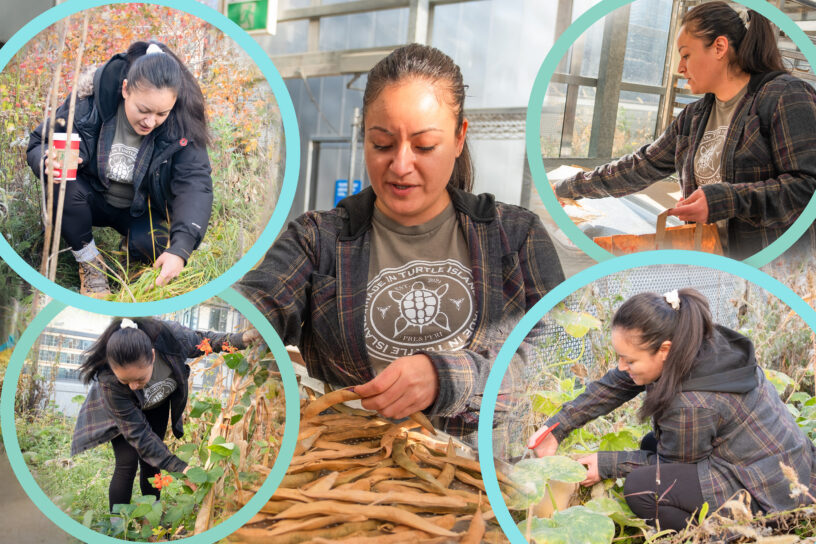
Atop the Daphne Cockwell Complex (DCC) on Church Street sits the unassuming home of a blossoming harvest this fall. The Indigenous Foodways program, which operates on the urban farm, is an initiative that honours the traditional agricultural techniques of the Haudenosaunee People using the Three Sisters crops. These are tended to by the caring hands and heart of the program, Samantha Williams.
Williams is the Indigenous-led program coordinator for Indigenous Foodways. Williams took The Eyeopener through the space, highlighting the variety of crops she’s cultivated with the help of student volunteers and landscapers. On the far side of the rooftop, the garden offered the last of this season’s wild strawberries, which were tart and flavourful.
A majority of the DCC’s eighth-floor rooftop is home to two groups that cultivate various crops throughout the growing season: Williams’ Indigenous Foodways program and the Black Food Sovereignty Initiatives, which is managed by Nicole Austin, the Black-led programs coordinator.
Williams began volunteering at the urban farm in 2019. She said she pitched the idea for a dedicated growing space and the program began as a pilot in 2021. Since then, she’s received requests for tours of the farm.
“I’ve had requests where they treat these things, and these medicines, as inventory,” she said, “It’s not a[n] inventory item.”
Williams said many requests have been presumptuous and come from non-Indigenous faculty who do not understand the spirit of reciprocity through which she is able to operate the farm; she defines reciprocity as the practice of giving with intention and servicing the community.
“All of the reciprocity that I have received, like receiving plants, receiving cloth, that only happens with Indigenous community. Only,” said Williams.
Williams has many Indigenous students who volunteer with her and take part in the medicine she cultivates and bundles by hand. This year, she said the Indigenous Students’ Association held its first event of the year on the rooftop. She stepped back and “let them take over the space, so that they could enjoy it, so that they have a say about how it’s being used,” she said.
Williams said she is sometimes shocked by requests that seem to assume her program is a fully-staffed department.
She emphasized that her role at the program is to act as a steward, creating a space where Indigenous students feel safe and a sense of belonging.
“My favourite collaborations are with students. I know probably a lot of staff across campus will make requests and almost assume that they’re entitled to Indigenous Foodways; that’s how they feel. It’s really hard to constantly explain to them that I don’t work for them and that’s not my priority,” she said.
Williams said her priority instead is the Indigenous students and the communities they build to honour their cultures and traditions.
When describing her agricultural practice, Williams told stories of her father, who was a farmer. She said spent a few summers when she was a teenager helping out on his farmland in Costa Rica and learned by watching his work, making mistakes she now laughs about.
Williams said farming on a roof, in an urban environment, is different from traditional methods—specifically because the microclimates eight stories up require specialized care. Planters for the Three Sisters crops were designed in circular mounds, instead of traditional rows, which took a lot of trial and error before she sowed a successful yield.
She uses a method called ‘companion planting’ which allows for the three main ‘Sister’ crops—corn, beans and squash—to symbiotically flourish. The first Sister crop is corn, its tall stalks providing a climbing mechanism for bean, the second Sister. As the two crops crawl upward, dually providing stabilisation and enriching nitrogen for the soil, the third Sister squash, is planted in tandem. It provides them shade from the sun and prevents the soil from drying out or growing weeds.
“Sometimes it is offensive to get all these requests that are like, there’s no reciprocity; they don’t understand what it takes, what actually goes into it,” she said. “People will be like: ‘Hey, do you have 20 braids of sweetgrass?’ Do you know how long it takes to produce one braid? So people take it for granted,” she said.
“If I gift someone a braid of sweetgrass, they might not realise what it took; it took my intentions, my time. So people might treat it like Amazon: ‘Hey, can I have like four braids of sweetgrass?’ Well, you know it takes me an hour to produce that, and that’s if I do it really fast,” said Williams.
The entire philosophy behind the Indigenous Foodways program is one of stewardship, reciprocity, creativity and community building.
“There’s not a lot of safety for Indigenous students and staff. That’s something that I try to provide, is the psychological safety and protection of other Indigenous students who are about to enter the workforce,” she said.
She believes intrinsically in her students. “If you trust in creative expression, the people will give their best. And often that is the case,” Williams said.



Leave a Reply